The Australian Association of Group Psychotherapists is presenting a morning seminar on 8 November 2014 at 18 Erin Street, Richmond from 9.00 until 1.00pm. The Seminar is for people interested in the History of Psychoanalysis and in the Politics of Discourse.
************************************************
In their recent biography of Trigant Burrow the editors Edi and Giorgio Pertagato refer to him as an “AN ILLUSTRIOUS UNKNOWN MAN”. Their work, a reclamation of Burrow and his work as a psychoanalytic theorist, shows his thinking about group analysis predicted the work of Foulkes. Conceptually Burrows pioneered a clear theoretical shift from drives to relationship and relatedness which made him unpopular with Freud. He began working psychoanalytically with groups in the early 1900’s, and coined the group analytic terms “matrix”, “group analysis” and “social unconscious”.Burrows’ name and creativity has almost completely disappeared from the history of Psychoanalysis and Group Analysis. S.H.Foulkes, acknowledged as the father of Group Analysis, mentioned him but, the Pertagatos argue, did not acknowledge Burrows’ contribution sufficiently.
Burrow was an analyst who trained with Freud, was analysed by Jung. In 1911 he founded the American Psychoanalytic Association with Ernest Jones and others, and was the first co-president of the American Psychoanalytic Society.
Dr Paul Coombe and Dr Peter Hengstberger will both present papers based upon their reading of Burrows’ work.
Paul Coombe’s Paper: ”FREEDOM, CREATIVE THINKING, PSYCHOANALYTIC DISCOURSE AND POWER’, will explore some of these ideas and look at how creative and paradigmatic breakthroughs are not enough. They they need a receptive place to grow. Entrenched, privileged and organised power cliques can dominate and squeeze out divergent streams of thought.
Dr Peter Hengstberger, in his paper: ”SOME THOUGHTS ON THE WORK OF TRIGANT BURROW AND HOMOPHOBIA’, will focus more directly on particular aspects of Burrow’s work which are also related to the dominant and entrenched views of the time and culture.
ABOUT THE SPEAKERS
Dr Paul Coombe is a psychiatrist and individual and group psychoanalytic psychotherapist in private practice in Melbourne. He was formerly Consultant Child Psychiatrist at the Royal Childrens Hospital in Melbourne and Overseas Senior Registrar in Psychotherapy at the Cassel Hospital,London from 1990 to I993. He is the immediate past president of the AAGP and a member of the Victorian Association of Psychoanalytic Psychotherapists. He has published widely in local and international journals including in areas of family therapy, psychoanalytic aspects of eating disorders, small and large analytic groups, Munchausen’s Syndrome by proxy and the works of William Shakespeare.
Dr Peter Hengstberger is a psychiatrist and individual and group psychoanalytic psychotherapist in private practice in Brisbane. He is the current President of the Australian Association of Group Psychotherapists and a member of the Queensland Psychoanalytic Psychotherapy Association.
DETAIL
Cost for non-members of AAGP $60.00
For catering purposes please register by email to Dr Frances Minson
frances.minson[at]gmail dot com
You are very welcome to stay to lunch.
AAGP website : http://www.groupanalysis.net.au
I am delighted to introduce my first guest posting. Dr John McIntyre, a Canberra based education research and policy consultant and Adjunct Associate Professor in the Faculty of Education at the University of Canberra has kindly accepted my invitation to write a post for this blog. His subject is Rosemary Benjamin and influence of Susan Isaacs in Sydney’s Theatre for Children during the 1930s.
A brief exploration through Google shows that John McIntyre has worked for over 25 years in the professional preparation of adult and vocational educators at the University of Technology Sydney where he was a senior researcher and Director in the UTS Research Centre for Vocational Education and Training. His research has focused on outcomes and participation in ACE in Australia, much of it commissioned by government. He has also published work on early school leavers and equity strategies of VET providers, research methodology and policy and research relationships in adult education.His recent work includes ‘Client engagement in a learner-centred system’ and a feasibility study on a national internet portal for adult learners. In 2007 he evaluated the Victorian ACE Research Circles for the Adult, Community and Further Education Board, Engagement, Knowledge and Capability:Connecting Research and Policy to Practice. These and other publications can be found on his website.
John McIntyre is also deeply interested in theatre and the arts. After reading my posts about Susan Isaacs’ Australian tour in 1937 here and here, John contacted me with information about Rosemary Benjamin and the influence of Susan Isaacs’ thinking in the the Children’s Theatre Benjamin created in Sydney during the 1930s. You can find some more about Benjamin at this lovely site: http://www.artpages.com.au
Here is John McIntyre’s post….
Recently I have been exploring the history of the Theatre for Children, Sydney, that was founded and directed for one twenty years by an Englishwoman of Jewish background, Rosemary Benjamin (1901-1957).
Arriving in Sydney in late 1936, Benjamin soon made friends with Jewish emigrés from Europe including the Finkes, the psychoanalysts whose daughter Ruth acted in the theatre, Gertrud Bodenwieser, the leading exponent of expressionist dance and composer and musician Sydney John Kaye (Kurt Kaiser). Rosemarie Benjamin is another link in the story of ‘Freud in Oceania’.
By the time she began her Sydney work, Rosemarie Benjamin had developed her ideas about appropriate theatrical performance for children, ideas formed by early twentieth century progressive education and profoundly influenced by Freudian thinking in London of the 1930s. For Benjamin’s generation, Freud’s discovery of the unconscious enriched new ideas of play, creativity and development and contributed to the ferment of the ’new education’ in a way that is now hard to appreciate.
Benjamin believed that children’s theatre should be authentic, performed as serious theatre by adult actors in plays and draw deeply upon myth and fairy-tale. Through such theatre, children could encounter their inner conflicts in symbolic terms, identifying with characters expressing ‘difficult’ emotions of guilt, fear, anxiety and horror. Allegorical figures drawn from myth could act as intermediaries in this cathartic process. Authentic theatre understood in this way could serve the expressive needs of children and ‘child development’. These ideas are outlined fully in Benjamin’s ‘Story of the Theatre for Children’ (available on-line at the State Library of Victoria).
In the years 1925-1936 Benjamin as a young woman was working as a play organiser for the London County Council, a new kind of educational work, while seriously pursuing a career in drama, twin strands that eventually merged in children’s theatre. Benjamin’s narrative always highlights her 1930s visit to Soviet Russia to study children’s theatre as a life-changing experience, though her explanations of children’s theatre are wholly Freudian.
Who influenced this Freudian strand in Benjamin’s thinking? In 1930s London, Benjamin must have come in contact with the leading edge of Freudian thought as it was being absorbed in progressive education, when Susan Isaacs was coming to prominence. Though direct evidence in Benjamin’s papers is lacking, I think there are three clear indications of Isaacs’ influence:
Benjamin emphasises emotions, especially difficult emotions (fear, guilt, anxiety, aggression) and the way these can be called forth in expressive play. Theatre employing plays based on myths and fairy tales permits children to encounter and deal symbolically with such forces. A broad understanding of phantasy (as it was later outlined by Isaacs in her famous 1948 article) appears to be assumed.
Isaacs discovered that ‘new education’ rather than being wholly permissive,children need to have a structured context to help them manage the expression of difficult emotions. Benjamin is insistent that theatre performances need to be structured with devices that help the child to respond to reactions aroused by the play. Such devices include allegorical figures like ‘Jester’ that ‘come in front of the curtain’ act as intermediaries between the real world and the fantastic world of the play.
There is a commitment to systematic observational of children’s experiences as a way of testing and informing theoretical understandings. Benjamin encouraged audience participation and practised the serious study of children’s responses to characters to inform the crafting of performance. Underlying this is a strong conviction about the developmental value of children’s theatre.
It may also be that Susan Isaacs (as a columnist and educator) gave Benjamin the inspiration to promote new ideas to the wider audience, for Benjamin was a tireless advocate of her cause, and quite possibly a better publicist than producer.
At the end of 1936, Benjamin left London for a Sydney holiday. By then, Isaacs was leading the new department of child development at University of London and had published two defining works in the field. She was a leading figure in the New Education Fellowship which the next year held its World Congress in Australian cities, with Isaacs as a key member.
In Sydney, Benjamin no doubt participated in the Congress, and she was on the NSW committee of the NEF until the war years. This World Congress contributed much to enthusiasm for new educational thinking in Australia, and this took place alongside other streams of cultural modernism permeating the Antipodes. Benjamin must found among her Jewish emigré friends a congenial milieu in which her own novel enterprise might prosper. She returned briefly to Europe after the war for a study tour, but after resuming her work in Sydney suffered a long illness before she died in London in 1957.
It will be interesting to see how Chinese culture will come to shape and influence the development of psychoanalysis and psychotherapy worldwide as the conversation between the oriental and occidental worlds unfolds. Here is a pertinent article from The Guardian.
One of the reasons for starting this blog was an interest in exploring the influence of psychoanalytic ideas in this part of the world: Australia and the Oceania region. The advent of the National Library of Australia’s data base, TROVE, and the link to Australia’s digitized newspaper collection has enabled an ease of research by laptop rather than making the physical journey to spend hours trawling through ancient newspapers. How this might shape the way history is developed and written will be interesting to see.
In the 1910s and 1920s – the interwar years – in the sprawling country that was settler Australia, with so many people living a long way from anywhere that resembled a city, interest in culture, whether politics, literature, science and philosophy could be hardly restricted to metropolitan newspapers and readers. Regional and local newspapers, depending upon the interests of their editors and readers, reported widely on literary and scientific events and thinking. Local papers generally confined reportage to political, economic and local news with a serial thrown in. With contributions from people with particular expertise, newspapers across the country reflect the diverse interests amongst Australian people. Freud’s name was well enough known by 1938 that the process of his escape from Europe was reported on a daily basis in numerous local papers across the country as well as in the metropolitan and regional press. So too was his death a year later. So what is the result when ‘Psychoanalysis’ is typed into the search engine.
A little research was needed. Using the word ‘psychoanalysis’ as my tool, I undertook a little survey of the TROVE digitized newspaper site. I used the year dates: from 1920 to 1929. In this period 1126 ‘articles’ were found from a total of 769 digitized newspapers. The total number of articles concerning psychoanalysis for the entire archive, dating from 1803 to 2007, is 2941. Other words could be used, such as ‘Freud’, ‘Psychotherapy’, ‘Psychology’ and ‘Psychoanalytic Psychotherapy’ and may yield different articles which will add to the store of items available. The point here, though, is that during the early part of the twentieth century news of Freud and his work, transmitted through the print media, reached a far into remote Australia as well as finding a more likely audiences living in the metropolitan areas.
Now, to content. Inevitably some writers will be critical of psychoanalysis and its method; others, admiring of Freud and his work wish to recommend it . There was also reportage of lectures and educational events: Workers Educational Association lectures were a major forum for lectures about psychoanalysis. From 1923 a new venture, the formation of the Australian Society for Psychology and Philosophy by University of Sydney’s Professor Sir Francis Anderson began attracting interested and critical readers – also from places hundreds of miles from Sydney. Between August 1923 and March 1924 the Capricornian a weekly newspaper in Rockhampton, a town in Northern Queensland, published four items of over 1000 words centred upon the introduction of the Association’s new journal, The Australasian Journal of Psychology and Philosophy. and within this, exploring responses to the new science of psychoanalysis. Not so the the Newcastle Morning Herald and Miner’s Advocate, a regional paper serving Newcastle, north of Sydney. Nevertheless who, from the perspective of early twenty-first century urban Australia, would guess that at this time in the early 1920s, that in a place as remote and as rugged as the ‘frontier’ mining town of Kalgoorlie in Western Australia, that the topic of psychoanalysis would have even rated a mention?
Kalgoorlie, some 370 miles from Perth, was begun as a miner’s camp in 1893 when gold was discovered. It was declared as a town in 1895. It was and remains small enough population-wise. Wikipedia, that ever reliable source, suggests that Kalgoorlie’s population was about 2000 by 1899, increasing to 6000 by 1903, or so. Census data from the 2011 collection show Kalgoorlie’s population to be 13,949. This little film compiled from photographs at Western Australia’s State Library with commentary by Don Pugh, is a glimpse into the conditions in which the early settlers were living.
Perhaps it is reflective of the randomness and the sporadic way in which psychoanalytic ideas were spread globally. Or perhaps it shows how dispersed the population was as well as the reliance of many people upon the written word for information about the world about them. In the 1920s newspapers were the main form of mass communication, if not for many people, the only form. Fortune seekers on the Kalgoorlie goldfields may also have been medical practitioners or lawyers or indeed, Oxford Dons before going off to try their luck.
Between 1920 and 1929 Kalgoorlie’s daily, the Kalgoorlie Miner, published twenty articles where psychoanalysis was a key work, if not subject. In contrast with the metropolitan papers, The Sydney Morning Herald and Melbourne’s Argus which published 65 and 46 items, this is a surprisingly high number. South Australian daily, Adelaide’s Advertiser published 92 items during the same period while Perth’s two papers, the West Australian and the Western Mail published 90 items between them during the same period. One would expect more articles on the subject to have been published in the larger metropolitan areas of Sydney and Melbourne, both, at one time, Australian government centres.
The material is not lightweight. On 1 February 1921 readers of the Kalgoorlie Miner found this little item headed, “What Psychoanalysis is Doing”. Here is the full text.
Since Freud began his searching and patient investigation of the unconscious mind, over twenty five years ago, a constantly increasing number of psychologists, mentalphysicians, and educational reformers have found it necessary to reconsider a number of problems associated with the conscious activity of the mind in health and disease.
It is not too much to say that psycho-analysis has revealed the springs of human behaviour in an entirely new light, and that its discoveries are of an epoch-making character. The practical results are indisputable in the cure of hysterical affections and those mental and physical symptoms that have been classed loosely under the description ‘neurasthenia.’
Psycho-analysis, as practised by ardent and highly-qualified physicians in military and civil hospitals during the war, relieved a very large number of sufferers from states of morbid dread, acute mental depression, loss of memory, and obsessional ideas. The treatment provides a means for which physicians have sought for generations, and the proof of its efficacy is shown to-day by the host of people who have been released from some of the keenest emotional torture experienced by humanity.
At a period in civilisation when the difficulty of adjustment to conditions that conflict with deep primal instincts induces an enormous amount of nervous and mental disturbance, psycho-analysis brings a healing boon to mankind. The menace to mental sanity, and frequently the physical health, is not invariably present in the consciousness. It was through an analysis of a patient’s unconscious mind, as revealed in dreams, that Freud, became deeply impressed by the part that the unconscious plays in the causation of hysteria, abnormal fears, and impulsions of a morbid character.
Psycho-analysis, as Dr. H. Coriot says, ‘bears the same relation in all its principles to the human mind, and to social consciousness, as bio logy does to the organic world.’ Many difficult social and moral questions become plainer through a knowledge of the unconscious mind. Psycho-analysis supplies an explanation for forgetfulness, slips of the, tongue and the pen, and many of our puzzling weaknesses and strange deep-rooted prejudices. It is not possible to describe the technique of the system in a few words. The cure of mental illness comes through ‘transference, a feeling of acknowledged sympathy towards the physician such as is noted in all medical practice when the patient relies on the wisdom orthe doctor. This is not ‘falling in love with the doctor.’ as suggested by some critics. Any demonstration of that kind would put an end to the treatment. I recommend interested persons to read ‘What is Psycho-analysis?’ by Dr. Coriot; ‘The Freudian Wish’ by Holt; and ‘Man’s Unconscious Conflict,’ by Dr. Lay.
Perhaps it should not be so surprising that such interest and vigorous thinking about intellectual and cultural issues is so easily demonstrable at this time in Australian history. Or probably anywhere for that matter. But Australia at this time had just dried the ink on its own constitution signed in 1901. It was leading the world in some political and social spheres. White women had gained the right to vote, beginning in 1895 in South Australia with New South Wales Women achieving this in 1908, well ahead of the United Kingdom where women’s suffrage was not achieved until the late 1920s. It’s welfare reforms, particularly in the field of state children, were well regarded. From the late nineteenth century, in several states the ‘boarding out’ of state children was internationally recognized as the ‘Australian System’. In 1916 workers in Victoria had won a long and hard battle, commenced in 1856, for the 8 hour working day: 8 hours work, 8 hours sleep and 8 hours leisure and would be achieved nationally during the 1920s. Some interesting research is yet to be done.
Wilfrid Lay (1917), Man’s unconscious conflict: a popular exposition of psychoanalyis, New York, Dodd, Mead and Company; https://archive.org/stream/mansunconsciousc00laywiala#page/n5/mode/2up (accessed 18 August 2014)
Several accounts of Dr Clara Geroe, Australia’s first Training Analyst, have appeared in the public domain during the last thirty years. Two of these are oral history interviews with Dr Harry Southwood, the first and, for some time the only, psychoanalyst in Adelaide South Australia published in 1994 and, in 1995, a similar interview with Melbourne based Dr Frank Graham. Both were undertaken by Dr Wendy Brumley and published in the Australian Journal of Psychotherapy as was Deidre Moore’s Memoir of her analysis with Geroe, in 1998. This was also published in the British Journal of Psychotherapy in 1999. These impressions of course add to an emerging portrait of Geroe in addition to that provided by her son, George Geroe and in the memories of those who were either her patients or supervisees.
While trawling through archival material in the State Library of South Australia I came across another oral history interview, this time undertaken by Dr william Andrew Dibden as part of a larger project on the history of psychiatry in South Australia. I have blogged about this previously here. That post mined Dibden’s interview with Dr Harry Southwood to introduce ‘Dr Charlie Winter’, a German doctor whose training had included analysis with German Psychoanalyst Hans Sachs. In this post I am picking up the threads of this same interview to provide another glimpse of Clara Geroe. First, though, I will follow Dibden’s process as he begins tracing Southwood’s career.
The interview reads as a meeting between two old friends and colleagues who together have lived the evolution of psychiatry; from the days, said Southwood, when ‘the word “psychiatry wasn’t known. I never heard the word”Psychiatry” in 1939. I might have read it, but there was no Psychiatry in Australia”. Southwood became interested in ‘psychiatry’ when he attended lectures in psychological medicine given by a Dr Rogers, commonly known as “Daddy Rogers”, who lectured in forensic medicine. ‘Not’, said Southwood, ‘Psychological medicine’. He continued. ‘He was one of those traditional gentlemen aristocracy doctors of the city of Adelaide and he had a private practice which was, I gather, largely what we’d call today ‘psychiatric’.
Southwood may have been referring to Richard Sanders Rogers, listed in the Australian Dictionary of Biography as an ‘orchidologist and physician’, born in Adelaide in 1861 and who died in 1942. Upon reading the entry in the Dictionary of Biography one learns that after completing an undergraduate degree at the University of Adelaide Rogers qualified in medicine in Edinburgh and returned to practice medicine in Adelaide. He was a consulting physician at the Royal Adelaide Hospital from 1897. A member of the South Australian Medical Board in 1910-40, he was president in 1932-38. Rogers was the first superintendent (visiting) of Enfield Receiving House (1922-36), superintendent (visiting) of Northfield Mental Hospital (1929-36), and honorary consulting psychiatrist to all State mental institutions (1939-42).
Southwood graduated in medicine, became a General Practitioner in a small practice and subsequently gained a Bachelor of Science – a way of increasing his psychological knowledge. The course he completed combined physiology and psychology. He was appointed as a Medical Officer at Enfield Hospital in 1939, just before the commencement of the war and was able to combine this with private practice. He became interested in ECT and built his own machine – ‘originally made out of a gramophone’.
Southwood’s interest in Freud began when he read some of Freud’s work as a schoolboy. As a general practitioner he tried to apply what he had learned, taking detailed histories in the course of his work,
trying to understand just how it was [the patient] got into the mess they were in…It was simply the idea that of we could understand all about it, we could find a better way of coping with whatever the problem was. And they were all fairly simple things, looking back on them. People would never come to a Psychiatrist those days, I suppose. They weren’t going to a psychiatrist then. They were only going to a GP because they had headaches, or they couldn’t sleep, or they had indigestion or something. And it was only talking to them and finding out that perhaps they were more worried about their mother or worried about their husband, or worried about because they were frightened of getting pregnant, or whatever it might be. That’s where I was at at that time.
After reading an article by Roy Coupland Winn, published in the Medical Journal of Australia, again around 1939, Southwood related, he wrote to Clara Geroe. Perhaps it was several years later than this as Clara Geroe did not arrive in Australia until March 1940. He did not receive a reply. A year later he wrote again saying something along the lines of
‘Dear Dr Geroe
I understand that analysis begins from the moment of one’s first contact with one’s analyst…I wrote to you a year ago and haven’t heard from you since. I presume that has caused [some analytic crisis]. I would be interested to know if there is any prospect of a reply’.
‘She rang me up’, Southwood continued. It was, he learned,
characteristic of Clara – she wouldn’t write for a year, then suddenly she’d ring you up and make you think it was an immediate crisis. Anyway she rang up and said she was sorry she hadn’t answered my letter. I think her system was not to answer anyone’s letters but if you wrote two or three times she’d think you meant business. Anyway we eventually got into communication and I…went off to Melbourne and started my analysis with her.
At this time training was not well organized Southwood explained. The Melbourne Psychoanalytic Society was a ‘sort of unofficial branch of the British Society. But it was after the war and everything was chaotic and so on’. Subsequently Southwood had supervision with Clara Geroe. ‘I used to analyse someone in Adelaide as best I could and I’d take my notes across to her every month or so. And we’d have long talks’, discussing all that had transpired between himself and the patient and what he did and should have done. His dated his training years from 1946 to 1953 and was eventually made an Associate Member – of what is not specified in the interview, perhaps the Melbourne Institute of Psychoanalysis. He was, he recalled, the first to achieve this. Frank Graham, another doctor, who was Melbourne based, followed.
References:
Transcript of Interview with Dr Harry Southwood by Dr Andrew Dibden for Psychiatry in South Australia Oral History Project, dated 3 November 1979. PRG 842/1/2, State Library of South Australia
Harry Southwood with Wendy Brumley (1994), Interview, Australian Journal of Psychotherapy, Vol.13, Nos 1 and 2, pp. 1-19.
Frank Graham with Wendy Brumley(1995), Interview, Australian Journal of Psychotherapy, vol. 14, Nos 1 and 2, pp.1-14.
Deidre Moore (1998), A memoir of my psychoanalysis with Dr Clara Geroe, Australian Journal of Psychotherapy, Vol.17, Nos 1 and 2, pp. 178-191.
(1999) British Journal of Psychotherapy, Vol. 16, No.1, pp.74-80.
COPYRIGHT… Christine Brett Vickers This piece is entirely based on my research. You are welcome to use it with the appropriate acknowledgement.
An insight into Australian life during the Great War. Membership of Empire, being part of Britain and the promise of adventure motivated many. Those that returned were deeply changed and troubled, if not damaged by their experiences….
Next Tuesday 19th August the ABC will be showing the first of the four-part documentary ‘The War that Changed Us’. It combines the stories of six real-life Australians involved in different ways with WWI, with analysis and commentary provided by many of the historians I have reviewed on this site.
It promises to be a more nuanced approach than the ra-ra ‘War that Made Us Australian’ type approach that I find so uncomfortable. Its six main characters are two soldiers Archie Barwick, Harold ‘Pompey’ Eliot, army nurse Kit McNaughton, anti-war activists Vida Goldstein and Tom Barker, and pro-war pastoralist’s wife Eva Hughes.
The documentary was created and co-written by Clare Wright (whose book The Forgotten Rebels of Eureka I reviewed here) and features interviews with Janet Butler (who wrote Kitty’s War the much acclaimed study of Kit McNaughton, who features as one of the six characters in this…
Planning for Melbourne’s Freud Conference in May 2015 is well underway. An annual event, the conference has a long tradition of inviting international guest speakers to present their work and meet colleagues from the fields of clinical and applied psychoanalysis. The conference is organized by representatives of the Australian Psychoanalytic Society, the Victorian Association of Psychoanalytic Psychotherapists, the Australian Association of Group Psychotherapists. Douglas Kirsner from Deakin University and one of the founders of the conference has provided a detailed history here
During the last twelve months the Freud Conference committee have developed a Blog, another WordPress Blog : The Freud Conference which provides details of speakers and interests but also publishes material associated with the speakers and their interests. It’s worth going over and having a look.
The theme for next year’s conference is not clear but two speakers, Dr Marianne Leuzinger-Bohleber and Dr Werner Bohleber from the German Psychoanalytical Association will be coming. Both are regarded as two of the world’s foremost clinicians, thinkers, researchers and authors on the theory and treatment of people who have suffered catastrophic trauma. Their work perspectives from the fields of psychoanalysis, history, philosophy and the neurosciences.
Dr Marianne Leuzinger- Bohleber is a training analyst, former chair of the Research Subcommittees for Conceptual Research and also a member of the Swiss Psychoanalytical Society. She is vice chair of the Research Board of the International Psychoanalytical Association, Full Professor of Psychoanalysis at the University of Kassel and head Director of the Sigmund Freud Institute Frankfurt/Maine. Her main research fields include epistemology and methods of clinical and empirical research in psychoanalysis, interdisciplinary discourse with embodied cognitive science, educational sciences and modern German literature.
Dr Werner Bohleber is a training analyst in private practice in Frankfurt and Main, Germany and a former President of the German Psychoanalytical Association (DPV). His main area of interest is about trauma in both the individual and wider social sense, terrorism, right wing extremism ans anti-Semitism and the consequences of a particular history with the Nazi era of German National Socialism. Interested in the welfare of children, he studied adolescence, identity and the transgenerational consequences of World War II on children’s development. In 2007 Werner won the Sigourney Award which recognizes distinguished contributions to the field of psychoanalysis.
As usual there will be plenty of time for discussion and conversation. It is one of those rare events, these days, which eschew the ubiquitous parallel sessions and twenty minute papers. Anyone who is interested in is welcome to attend.The conference will be held on Saturday 16 May 2015 at The Melbourne Brain Centre in Melbourne’s Royal Parade, Parkville, within walking distance of the cafes and boutiques of Lygon Street and a short tram ride from the city centre.
For further enquiries contact Christine Hill, christine.hill@monash.edu; mobile: 0411 556 205.
In her 2005 book, Freud in the Antipodes,, Joy Damousi writes of the visit of the American Psychiatrist, Dr Anita Muhl, to Australia from Feruary 1939 to the end of 1941, to provide education and consultation about human behaviour and relationships to professionals and lay people. Damousi’s analysis concerns Muhl’s role as a ‘listener’ as people either poured out their hearts to her sometimes in long letters, or curious, sought Muhl’s opinion on about an aspect of their lives – whether about a dream or a difficulty they were having. Damousi’s thesis, that this reflected the development of a ‘listening culture’ co inciding with the emergence of Freud’s ideas in the early decades of the twentieth century, is developed here.
Upon looking at the very rich archive of her visit, it becomes clear that Muhl’s three years living in Melbourne attracted considerable interest from groups and people who were interested in the developing mind and were seeking ways in which to further that understanding. Muhl was not the first international expert in child development and psychology field to spend time in the country. Susan Isaac’s six week visit to Australia in 1937, as a speaker at the New Education Fellowship Conference, had put a face to the author and magazine columnist expert on child development. And since the early 1920s psychology courses at the universities of Sydney, Melbourne, Queensland Adelaide and Western Australia, all included a strong component of psychoanalysis in their psychology or education programs.
Looking through the archive the question about where to find help for psychological distress and from whom to seek it, was a common question in the letters from the public – that have been included on the file. Some writers stated explicitly that they had found no one able to help them. Part of the the agreement made for Muhl’s visit was that she was not able to practice. Her focus was to be teach, lecturing and consultation. Muhl’s visit also intersected with the arrival of Australia’s first training analyst, Clara Lazar Geroe, in March 1940 and the formation of the Melbourne Institute of Psychoanalysis in October that year. Geroe, too, was to find a sophisticated and receptive audience.
Muhl’s visit was at the invitation of Una Cato, the daughter of philanthropist Frederick Cato, who had made his fortune as a grocer. The idea of a visit was developed between Una Cato and Anita Muhl during the latter’s stay at the Cato residence during the latter part of 1937. At this time she was wending her way back to the United States after a prolonged world tour. Muhl subsequently related that when Cato suggested she return for a tour of lecturing and teaching, she had replied that she would come for three years, all expenses paid. Cato had the means to enable this.
First Cato did her research, ascertaining the degree of interest in a possible visit from Muhl from amongst the medical. legal, education, medical and psychological professionals. Amongst the people she met with during March 1938 were psychiatrist, Dr John Williams, the educators, Christine Heinig and Kenneth Cunningham, the philanthropist, Sir Herbert Brooks, British Medical Association President and paediatrician, Dr Kingsley Norris and Mrs Rapke, whom Cato listed as ‘Magistrate at the Juvenile Court’. At this time Julia Rapke, well known in feminist circles, was forming the Women Justices Association of Victoria. Some were enthusiastic, without knowing much about the subject. Others were more circumspect. Christine Heinig wondered about Muhl’s training: was she familiar with the work of Melanie Clyne (sic) she wondered? Others checked her qualifications while remarking on her good sense, sanity and tact – observations made during her short visit in 1937. Cato was able to gain support from these senior people, providing assurance Muhl would not be practising psychiatry with patients during her visit. In turn they wondered what venue would be best for her. And she met with people at the university. An honorary post meant she would work for free, one consultant noted. A university appointment would be due recognition of her qualities and skills, another noted. In the end Muhl retained her independence. She took up residence in a building called Kia-Ora, along St Kilda Road. Outside the trams rattling by her doorstep provided access to the city. Under the heading, ‘Director of the Association for the Understanding of Human Adjustments’.
Muhl made herself available for lectures to women’s auxiliaries, schools, medical people, nurses and legal practitioners.Nursing groups who invited her to speak to them more often than not chose to hear Muhl’s thoughts on the serious matter of Mental Hygiene rather than the option she provided, an account of her visits to India or Iceland. Women’s auxiliary groups fundraising for hospitals, mental institutions and welfare organizations sought her out for lectures; she lectured to social workers, psychologists, teachers and educationalists, probation officers, and held reading and discussion groups for women doctors. Members of the (male) medical fraternity also sought her opinion and invited her to lecture to them. She provided pieces for the Women’s section on the Australian Broadcasting Commission and negotiated her way through Melbourne Society. She was able to say ‘no’ to those who wished to use her to prop up their social status; and to invitations she considered irrelevant to her purpose. At the same time she seems to have gone out of her way to oblige – for example, accepting an invitation from a newly formed mother’s group at one of Melbourne’s maternal and child health centres.
As news of her presence and knowledge spread people wrote to her about their problems. We do not know how many people wrote to her. The letters that remain are remarkable for their thoughtfulness as writers puzzled over their problems and invited Muhl to puzzle with them. One, written by Rose Currie in late 1939 provides a glimpse of the hardships and anxiety experienced by women living in isolated places. It also suggests the mental effort needed as people sought to understand their minds.
Rose Currie wrote: I am no longer young and I am a daughter of pioneer parents, on land, in Gippsland. I wonder if your ‘Mental Hygiene’ would conquer a disability such as emotional tears?
For many years I was associated with public life. I still am associated with local affairs, and a struggle with tears is a perfect nuisance in some circumstances. It is not that I have not, and do not try to overcome this disability. It cramps one’s style greatly. I have thought it is because of the great stress of pioneer days on the land, among the tall timbers, which my mother experienced. Fear of Bushfires in summer, Storms in winter and all the anxieties associated with her young family and dangers with stock, etc.
I would appreciate greatly your opinion if fears in a mother can be transmitted to a child, and, if, even in middle age, it can be overcome by Mental Hygiene and Prayer?
Rose Currie had heard Muhl read the Prayer of St Francis of Assisi during one of her radio broadcasts. Could she have a copy? Muhl was happy to oblige. In her letter to Currie she assured her that infants did, indeed, pick up upon and reflect mother’s moods and state of mind.
In January 1940, the author and poet Celia Albrey wrote to her:
Will you let me know if your Association deals with individual problems in psychological neurosis and maladjustment? Mine is a problem of some five years standing – a psychological ‘hold-up’ in creative work following a period of tragedy and manifesting itself in severe physical illness whenever I try to overcome it and I feel that modern knowledge and common sense should overcome it but it is beyond me unaided.
My chief difficulty in this state is that I do not know whom to consult and I know it is no job for a layman practitioner. If such individual cases are outside the scope of your distinguished work will you let me know of a specialist here (in Melbourne) whom I could consult?
Muhl replied she was unable to practice and recommended Dr Alice Barber or Dr Selby Link as possibilities.
In a sense Muhl’s visit, to educated and consult was timely. If the two letter writers are any reflection of the public at that time, both were groping towards the understanding of something within themselves, perceived, but hard to grab, was moving them. Perhaps they were aware of Freud’s theories of repression from reading and listening to radio broadcasts they felt free to admit that understanding was beyond their conscious awareness. Muhl was the expert where no other could be found.
References:
Joy Damousi, Freud in the Antipodes: A Cultural History of Psychoanalysis in Australia, Sydney UNSW Press, 2005.
Dr Anita Muhl Correspondence 1939-41, MS 11459. State Library of Victoria.
Letter from Rose Currie, 10 October 1939, Anita Muhl Correspondence, MS 11459, Box 1765/6, State Library of Victoria.
Letter from Celia Albrey, 5 January 1940, Anita Muhl Correspondence, MS 11459, Box 1765/1, State Library of Victoria.
It is the practice of the Psychoanalytic Psychotherapy Association of Australia to have its annual conference during the Queen’s Birthday Weekend in June. Because the PPAA is a federated structure, with each state having its own psychoanalytic psychotherapy association, each state takes its turn to hold the annual conference. In recent years the preference has been for city venues. People are time poor these days. But for some years the conferences, which began in 1982, were often held in country venues around Australia. One can imagine how lovely it would have been to troop off to a winery, or to an island off Queensland, in the tropics where it is warm and sunny in contrast with the cold of the southern midwinter, for a weekend of fine dining, wining, talk and frivolity. But in 1998 the organisers decided that St Josephs Home, a disused Catholic orphanage in Ballarat, a goldfields city in Victoria, some two hours drive from Melbourne, would be an apt venue. Why this was chosen is lost in the veils of history. The effect on conference delegates housed together for three days in a place where there were so many relics and reminders of the harsh lives of former residents, the little children who lived there, lies behind the composition of an anthem. Ostensibly it is a song for psychoanalysis. I think it is for those little children.
Ballarat, a regional city of some 86,000 people, was once the site of the first Victorian gold rush which began in 1851. Fortune seekers flocked to the diggings from Britain, America China and Europe – one of them my great grandfather in 1856. He tried his hand at digging but eventually became a policeman. He was too late for the Eureka Rebellion of 1854, a protest by the ‘diggers’ against licensing fees, whether one was successful or not, and enforced by the police. After the gold was spent Ballarat did not decline as several other towns in the region did but turned itself into a commercial government centre servicing the western districts of the state. In this corner of the British Empire grand buildings and large houses were built, schools. parks and gardens were established and the churches each staked out their hill. This small city, echoing the British life at home in the old country, also had its share of hospitals, asylums gaols and orphanages. The Ballarat Asylum built in 1877 was renamed the Ballarat Hospital for the Insane before becoming the Lakeside Mental Hospital. It was called the Lakeside Psychiatric Hospital when it closed in the 1990s.
St Josephs Home in Sebastopol Ballarat, was founded c.1911, and closed in 1980. During the last decade or more the Forgotten Australians, children who grew up in such homes, have begun to describe and document their experiences. This has culminated in two national apologies from the government. The first to the ‘Stolen Generations’, children of Aboriginal origin removed from their parents, in February 2008. The second apology, which occurred some eighteen months later in 2009, was to the ‘Forgotten Australians’, to all children who had been placed in out of home care. This came after many years of lobbying by these groups and investigation by the relevant bodies which included the Catholic Church. The children, now adults, tell of their abandonment, and the search for a good maternal figure. Some tell of the lies they were told, that their mother was dead, to discover, years later, that their mother was alive and that her letters to them were with-held. Children remember harsh conditions in which they were forced to live. They recall the exacting and arbitrary discipline that often disguised physical and verbal aggression. Many were sexually abused and as I write, a Royal Commission investigating child sexual abuse in institutions is traversing the country gathering evidence. In 2009 the University of Melbourne also apologised for its use of ‘orphan children’ for medical experimentation. In all these accounts the alone-ness of each child pierces one’s heart as we listen to their struggle to survive. This is not to say there were not good experiences to be had and, indeed institutional care may have provided relief from very difficult home circumstances. However the question about why the state of Victoria chose institutional care over boarding out of its state children remains. Recognition of the value of the maternal bond for the well-being of children, argued carefully by prominent author and activist, Catherine Helen Spence, in her 1907 book, State Children in Australia, was incorporated into state children relief legislation in New South Wales and South Australia from 1871.
Members of 1998 psychotherapy conference at the Ballarat orphanage, a live-in event in one of the coldest regions of Victoria in the depth of winter, thought a great deal about the history of these buildings and former residents. They were haunted. Too. Were there ghosts in the room? Or did they hear their endless cry of little children or caught glimpses of others locked in silence of despair? It was the oppressive quality of the atmosphere they remembered. There was no beauty in that place.
One of those who attended that conference was Antoinette Ryan. During her long career, beginning as a psychiatric social worker in Melbourne and Sydney, Antoinette has held various official positions in the Victorian Association of Psychoanalytic Psychotherapists, including Chair of the Membership Committee and of the House Committee, and has been a member of the VAPP Council and the Training Committee.
She retired two years ago, and now devotes her time to socializing with family and friends, painting classes, and learning the art of bonsai. Occasionally she surfs, either in Cornwall or Tasmania. She has written short stories, and was a potter for some twenty years.
‘It was a terrible place’, she said of the Boys’ Home. “We were haunted by ghosts of the place; we all felt spooked. It was terribly oppressive.’ She wanted to find a way to respond, to counter the deadly sense of emotional deprivation about her. And so an anthem was created.
Here are the words of the anthem, published here with Antoinette’s permission. It is to be sung to the tune of ‘Jerusalem’ with apologies to William Blake and acknowledging the composer Hubert Parry, who composed it in 1916 as an anthem to a nation in the depth of the Great War. It was subsequently appropriated by the suffragettes, with Parry’s permission, and first sung by a massed women choir at the Royal Albert Hall at a suffrage rally in 1918 as an anthem for freedom from oppression
‘Jerusalem’ is an apt choice of melody and sentiment. It urges reclamation of mind and soul. It is a protest against oppression as it urges us to fight for our lives as the little children had to do. The date of composition for Antoinette’s piece was 7 June 1998. It was revised on 10 June 2007. Here it is. You can sing it if you like!
PPAA Anthem
So here we are, as Winter comes, Gathered to meet and share concerns.’ So we are here, we meet again, From distant corners of our lands.
And do we dare to hope for more? For therapy to grow in depth? Till be defeat despair, beat despair, And foil destruction’s grasping hands.
Bring us our chair, our couch of pain, Save us from mem’ry and desire, Bring us our Freud, our Jung, our Klein, For highest standards we aspire…
We will not hold with mental flight, Nor let our inner hearts be blind Till we have traced the threads, faced the dreads, And fortified our thinking minds.
If you would like to be reminded of the original ‘Jerusalem here it is.
How interesting it is to see the place of women in England and the colonies during the 1930s. As a world renowned expert on child development, London psychoanalyst Susan Isaacs, a follower of Melanie Klein, was invited to speak at the 1937 New Education Fellowship Conference, an international movement founded by Beatrice Ensor in 1914. A reaction against the boring rote-learning styles of the nineteenth centuries it sought to encourage children find their own path in education. On the antipodean leg of its tour from Europe via America the conference travelled first to New Zealand before embarking on a national tour of Australia in August and September 1937. There was considerable interest in Isaacs from among the women’s movement, a group whose work also supported developments in child guidance and psychology. Unlike the Australian press coverage in which there are few, if any images, New Zealand editors included photographs in their reportage. She was one of two women delegates in a band of 21 who toured Australia and New Zealand: the other was Beatrice Ensor the Fellowship’s founder. Was it possible that she was photographed with the delegates’ wives, because it fitted, somehow, with the way things were done, then. Despite these reservations it means we can images of Isaacs very different from the studio shots featured on the 2009 biography by Philip Graham: Susan Isaacs: A Life Freeing the Minds of Children.
.
Isaacs incorporated Klein’s theories of children’s phantasy life into her work on education and child development. She believed that one could not be a psychoanalyst without such an understanding. Like Melanie Klein and later, D W Winnicott, Isaacs was influenced by the observational work undertaken in the 1920s by Merrell Middlemore, an obstetrician, trained psychoanalyst and member of the British Psychoanalytical Society. Middlemore’s work. ‘The Nursing Couple’ recording closely observed interactions between newborns and their mother in hospital was published in 1941, three years after her sudden death from cardiac failure in 1938. In an interview for the Melanie Klein Trust the late Hannah Segal acknowledges Isaacs’s interpretations of Klein’s work, particularly her seminal paper, ‘The nature and function of phantasy’ published in the International Journal of Psychoanalysis, 29, 1948, 73-97.
The New Education Fellowship Conference landed first in New Zealand on 10 July 1937. These were renowned experts, with a few professorships and knighthoods amongst them. The photograph, taken from the New Zealand Herald, 12 July 1937, p.12 is not fully annotated although the image of Susan Isaacs is clearly shown in the top left hand corner photograph. The first photograph on the top left-hand corner shows, L-R: Dr Harold Rugg, Professor of Education, Columbia University, New York; Sir Percy Meadon, Director of Education, Lancashire, UK; Dr Cyril Norwood,President, Sir Johns College, Oxford; Dr Susan Isaacs, Psychoanalyst and Head of Department of Child Development, University of London; Professor De S. Brunner, Professor of Education, Columbia University, Mr G.T. Hankin representing the Board of Education at the University of London; and Mr Laurin Zilliacus from Finland, Chairman of the NEF. The others show delegates doing spot of sight seeing, having lunch and generally socializing. They are rugged up in coats and hats because it was mid winter in the antipodes.
It was the way of things that women were treated separately to men. Delegates’ wives were a separate group. Both Susan Isaacs and Beatrice Ensor who founded the NEF in 1914 were included amongst them. The photographs below, from top down show ‘Mrs E Salter Davies’ and ‘Mrs C.M Wilson’. Susan Isaacs is pictured on the lower photograph with ‘Mrs E. de.S. Brunner and ‘Mrs P.L Dengler’. In the lead up to the war the Dengler’s presence created some controversy and tension amongst the delegates: they had come from Vienna in Germany.
Isaacs’s lectures drew large audience. The Herald reported that of over 1600 attendees at the entire conference of twenty one delegates, 500 had enrolled for Isaacs’s talks on infancy and the pre-school child.( NZ Herald 6 July 1937). Likewise in Australia, Isaacs drew large audiences and, in Canberra, spoke at the Albert Hall, introduced by the Governor General’s wife, Lady Whiskard. She was awarded an honorary doctorate by the University of Adelaide. She returned to England where she became more deeply involved in the psychoanalytic movement. She died in 1948 from the cancer she had first developed in 1936.
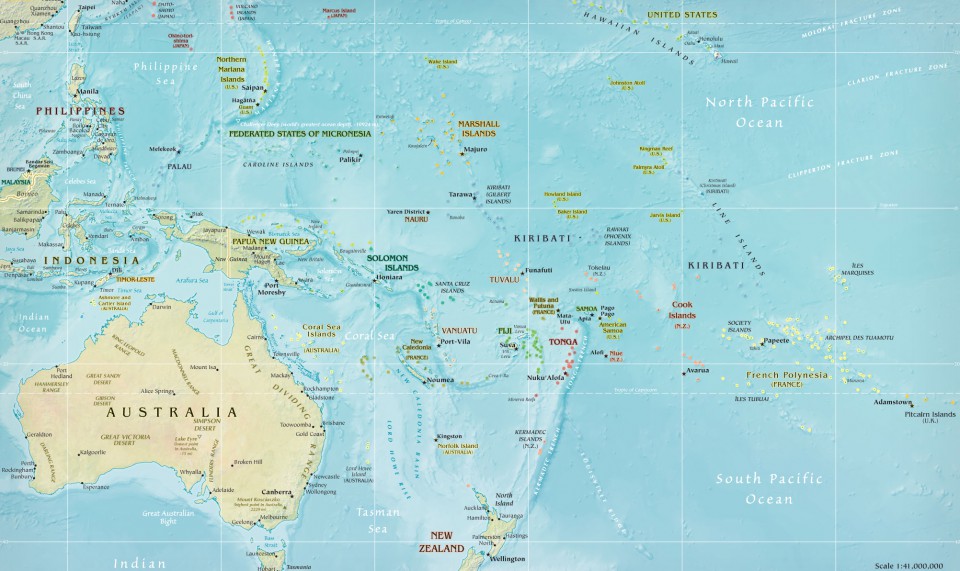

 Freud in Oceania