What Do Patients Want? Psychoanalytic Perspectives From the Couch

Tags

, ,

Christine Hill, What Do Patients Want? Psychoanalytic Perspectives From the Couch, London, Karnac, 2010.

I have been engaged on another project now near completion enough to free myself for the Australian Women Writers Book Review Project. My second review, Christine Hill’s What Do Patients Want? also fits the theme of this blog, about psychoanalytic theory and practice within Australian and Western Pacific culture. I have been familiar with this work since its inception over a decade ago. Christine has presented excerpts and research in progress at various workshops and meetings so to see the completed project and to take the opportunity to introduce it through this review. is fitting.

The ‘blank screen’ of the analytic stance, the position taken by the analyst such that the patient projects imagos from their inner world for understanding and analysis, has been a central area of debate and discussion amongst psychoanalytic practitioners during the twentieth century. The patient’s transference, good, bad and indifferent, was the central consideration in the analytic dyad. The analyst’s authority was assumed, the power structure, a given. The inner world of the patient was the object of analysis. And so it developed, more or less, throughout the first half of the twentieth century, as Freud worked to establish the principles of the psychoanalytic discipline and to stamp his authority upon it. Those who challenged him, Jung and Adler in particular, were excommunicated. Stekel and Rank highlighted the need for boundaries so that treatment could proceed.  After all, Freud argued psychoanalysis aimed to reach the heart of psychosexuality and to understand disturbances in its  development – without the analyst acting upon it. It is a medical paradigm, modelled on the traditional doctor- patient relationship. The assumption was  that the doctor’s neutrality can be sustained despite the vicissitudes of the treatment relationship. This medical model is under scrutiny – and question – in Christine Hill’s book, What Do Patients Want? Psychoanalytic Perspectives From the Couch.

During the 1950s the ‘blank screen’ principle began to buckle as the notion of countertransference began to emerge as a tool for practitioners. Paula Heimann’s 1950 paper, ‘On Countertransference’ initiated a long and continuing discussion about the affective relationship between patient and analyst, urging that the analyst’s response, her countertransference be utilised towards understanding the patient’s mind. After all, it seemed, the patient was attempting to recreate her world,and  to sustain her life patterns. Perhaps the analyst’s response, her recognition of these projections and ability to discuss these with the patient, was helpful. Nevertheless the essential power structure remained. And as Hill notes, the potential for misuse was real. At worst the doctor/analyst assumed  authority over the patient’s mind; maintaining their knowledge of it greater than the patient’s own. To quote Freud in 1912, ‘When there is a dispute with the patient whether or how he has said some particular thing, the doctor is usually in the right’. (Hill, p.4) This is not to say that the knowledge base and its applications in psychoanalysis have not been useful for patients struggling with difficult childhood memories and patterns. The understandings wrought by a sensitive analyst  who can meet the patient on their own terms, can be incredibly useful. Indeed, insights from work on early infant development, attachment, loss, as well as developing sexuality, can assist meaning making, the building of a self narrative that is reflexive, empathic and sustaining.

Nevertheless it was arguable until recently that even asking the question, What do patients want? or to suggest that people who become analytic patients have an understanding of what it is they may seek, was taboo. How could they know?  It challenged the notion that the analyst knows, or should know, best.

Perhaps the question was threatening?  Certainly in Hill’s home country, Australia, it was. To quote Hill

When I was thinking about this theme and playing around with ideas, I had some discussion with clinicians in the field. On one occasion a senior analyst said to me that what I was doing would not be considered as research – rather it was a ‘social study’. Then, to my surprise I received some vigorous denial that patients could actually know what they wanted, or know better than the analyst if their experience had been successful or not. It seemed he was telling me that patients were not in the position to know whether they had benefitted from their own analysis. ( p.152)

Despite this  Hill was accepted for an International Psychoanalytic Association Research Training Program in 1999, an experience ‘which gave me the confidence to continue’ and to find others who could ‘think about the actuality of [an analysand’s experiences] and did not perceive me as attacking analysis’.( p. 153).

Hill’s project, in part, echoes that of intersubjectivity theorist and psychoanalyst Jessica Benjamin who has written of the difficulty in all of us in being able to sustain the tension between subject and subject without capitulating to subject and object. Indeed, mentalisation theory and practice – developed by Peter Fonagy and his group at the Anna Freud Centre in London, also suggests a deepening theoretical shift towards intersubjectivity within the psychoanalytic field. Perhaps there are those in Australia who need to read more widely, or who have become far too married to the classical model of psychoanalysis to see that anything else might be beneficial. Case studies written by people who have had an analysis, whose experiences varied from gratitude to anger to disappointment, suggest that patients do have experiences of the other/analyst’s subjectivity. After all, they are people, too.

There was care in the selection of interviewees for this project. Hill recruited 18 people who had completed analytic treatment –  comprising a range of  15 years. Confirmation was sought that the analyst in question was a member of one of three schools practising in Australia: The International Psychoanalytical Association, The Australian New Zealand Society of Jungian Analysts and the Lacanian school, the Australian Centre for Psychoanalysis. Age range of the eleven women and seven men was from thirty-one to sixty. Thirteen were themselves working as psychotherapists, three in allied health and the other two in the public service. One had commenced a second analysis – and so was excluded from the project. others had received some form of treatment prior to analysis. Perhaps Hill was still responding to her critics when she writes ‘Most of the patients interviewed showed considerable sophistication in their thinking about their analysis and, thus, their stories cannot be lightly dismissed’. (p.13).

Interviews covered matters such as how the analyst was chosen: man or woman, appearance, style of working as well as the total experience. One of the interviewees, ‘Min’ was intent on choosing an analyst whose style was not rigidly classical:

“I had made decisions about how it was going to be for me and was clear that what I was going to negotiate with the analyst… Right from the word go I wanted it to be as much in my territory as it was in the analyst’s. And I wanted to be a patient-partner; I didn’t want to be a patient victim’. 

Others similarly eschewed the rigidly classical style – it did not feel safe; the analyst seemed to be too intellectual or not able to empathize fully with the patient. Other factors included experience, finances ( In Australia the medical fraternity are fully subsidised by the public health system), geographical proximity, the ability to understand and maintain boundaries – and serendipity – choosing at random from the phone book. For several analyst’s physical space was an important factor ..the dirty waiting room; the ‘mansion’ in which one analyst had a consulting room was a subject for comment.  Perhaps some patients, sensitive to the authority of a ‘doctor who knows best’, found interpretations delivered in the pejorative mode to be off putting. Others may have found a particular analyst ‘too soft’. Choice of analyst is a personal, if not idiosyncratic matter, Hill is discovering. Many of those who become analytic patients clearly put much thought into their choice of practitioner. Perhaps it is a reflection of the late twentieth century world that the ‘doctor’ is no longer to be reified, nor the patient subject to ‘whatever is available’.

Hill covers in detail the analytic process encountered by her subjects – engagement, working in the transference, the paternal transference and ending the analysis. For some the experience was good: the capacity of the analyst to hold the patient through times of incredible psychic terror was noticed and important. Others experienced interpretation as an abuse of power: ‘He would make these interpretations to me how I was resisting, I was withholding, I was not willing to give in’, one interviewee noted. ‘I wanted to give. And I felt that every time I opened my mouth that there wasn’t a reflective space for me to develop those ideas’.( p. 63). Hill explores the nuances of the analytic relationship with care and sensitivity – understanding and respectful of the interactions the interviewees are trying to relate. Listen to this, from page 90 of the book.

Kerry explained to her analyst, with feelings of sadness and regret, that she used to have a few broken belongings of her father’s, which were rosary beads and a pipe. In an earlier therapeutic relationship, Kerry had given this little package to her therapist with the words, “I shouldn’t be holding onto my father, I should be getting rid of him. You can take care of these things”. In this current experience, her analyst interpreted that she had given away the father’s belongings, not to be disposed of but for safe keeping. He told her they represented the brokenness of her relationship with her Dad, which she really wanted preserved. In spite of protestation by Kerry that he had it wrong, the analyst reinforced his comment with the words, ” No he’s yours; you’re keeping him alive inside you”. Kerry found his words so liberating, as though he were saying to her, ‘Have yourself, have your Dad, have your own thoughts, have all the madness. Have it, it’s yours. Keep it. Don’t feel like you have to fix it, get rid of it, whatever”. (p.90)

Psychoanalysis is a complex project. It involves, for some, a years, if not decades, long committment and within it experiences of varied complexity and emotional intensity. It holds the possibility for a reworking of old conflicts, a re-learning about living. For others it is a disappointment. Always it is a considerable investment of time and money. It is a serious and long term committment for patients – and for analyst. Work concerns how to understand who is doing what to whom? At bottom, for patients and analysts alike, is the intersubjective encounter that inevitably occurs. The patient’s experience of the analyst as human being should recognised Hill is arguing. Some analysts are rigid in their approach, others not. They are not, by definition, always right.But those who practice psychoanalysis want to provide help as much as people who become patients seek their help.

Through giving ‘patients’ space to tell their stories of their analytic experience, Hill has uncovered the complexities and questions that may well haunt anyone who has been through such an experience – even those who are now practising as psychoanalysts. There are more questions than answers here – about analysts, about patients, and the meaning of the experience in one’s life. The humanity within this book testifies to that.


Vale: Ivy Bennett – 2 December 2011

When I commenced this blog last August I posted about the Australian psychoanalyst Ivy Bennett. She was born in Wagin, Western Australia in 1919. Through sheer determination and  a British Council scholarship she travelled to England in 1946. Through a series of connections  she was one of the first people, if not the first, to train in Child Psychoanalysis with Anna Freud. In 1953 Ivy returned to Australia and set up a practice as a psychoanalyst near Kings Park in Perth, Western Australia. She  had frequent communication with psychoanalytic professionals in the Eastern States and remembered the warm reception she received from Clara Lazar-Geroe at the Melbourne Institute of Psychoanalysis.She returned to England for further training in 1958, married and eventually moved to Kansas in the United States. During 2011 I had a brief correspondence with her. Although she was ill, she wrote me a long letter outlining as many memories as she could about her life and the psychoanalytic scene she during the 1950s.

I have recently learned that Ivy Bennett ( Ivy Gwynne-Thomas) died on 2 December 2011. I have copied her obituary here.

Australian History and Freud

Tags

The basis of this blog, Freud in Oceania, is the influence of Freud’s ideas within Australian culture and history. There has been some comment in the Australian Press that La Trobe University, my alma mater, had pulled Australian History this year due to low enrolments. It seems that, to the contrary, the subject is alive and well, building on the work of creative historians such as John Hirst, Richard Broome and Marilyn Lake among others. How Australia has found its way into the modern world is an extremely complex story. I am reblogging this post from the La Trobe University Bulletin for your interest.

‘Civilisation’ and ‘The Inner Self’

Tags

, , , , ,

On 21 September 1921 Elton Mayo, Professor of Psychology and Philosophy at the University of Queensland, fulfilled an invitation to give the second Douglas Price Memorial Lecture. Mayo, known for his interest in Freud’s work had his own practice as a psychotherapist in Brisbane. With physician Dr T H Mathewson he studied the causes of nervous breakdown particularly its use in treatment of war veterans and shell shocked soldiers. As did his contemporaries, Tasman Lovell at the University of  Sydney and Philip Le Couteur at the University of Western Australia, Mayo established the first psychology course at the University of Queenland and in 1919 and 1920 worked  to establish a training program in medical psychology. He was particularly keen to develop a strong research base to underpin  trainings in experimental psychology and psychoanalysis. Shortly after giving this lecture Mayo departed for Melbourne where he gave a series of lectures on psychoanalysis to medical students. At the beginning of 1923 he departed for the United States for further training. He never returned to live in Australia.

Why Mayo was invited to give this, the second of what would be four Douglas Price Memorial lectures, struck my interest. Clearly the audience would include people interested in the new disciplines – psychology and psychoanalysis. Freud’s work was increasingly reported in the local press. Mayo was known for the psychology course he had developed at the University of Queensland – and made it into Joy Damousi’s list of pioneer Australian psychoanalytical thinkers. But the identity of Douglas Price has disappeared. He is not listed in the Australian Dictionary of Biography.  The National Library’s site, Trove,  provides little information about Price beyond a couple of book titles and pointers to the newspaper collection. Google provides a few clues. A short history of All Saints Church in Brisbane, published by D.L. Kissick in 1937, reveals that Price held the post of Rector at All Saints Anglican Church in Brisbane from 1903 to 1911. He was Principal of Brisbane’s Anglican Theological College. Price edited a small paper, The Cygnet, until 1911. From 1912 to his death in December 1916, he edited The Modernist publishing in both items on literature, poetry and philosophy. Kissick explained how Price’s preaching increasingly conflicted with High Anglican Church doctrines of the Divine Nature of Christ. Describing these years as ‘the saddest and most disheartening
in the history of the  ( Brisbane All Saints) parish’, Kissick outlinedPrice’s doctrinal differences with the Anglican Church. These eventually led to the Bishop forcing Price’s resignation in January 1911 and departure in April 1911. For Kissick Price

led his followers by devious ways from the reality in a search for a vain chimera of a religion of reason, from the true Faith to the man-made tenets of Modernism... ‘He finally denied Christ to be the son of God, holding there to be many sons of God and of himself he said ” I aspire to pass all barriers, even the bounds of personality, to yield myself to illimitable love, for I know I am one with God’.

Kissick’s short biography continued – not without its tenor of satisfaction as the movement Price founded eventually died away.

The Rev. D. Price then founded the Brisbane movement known as “Progressive Christianity” or “Modernism,” and was its guiding spirit until his untimely death in 1916. It is interesting to note that his last public address given on the Sunday before his death was entitled “Intolerance.” In 1921 it is said that the movement which he had led had become “moribund if not entirely dead.”

As Buckridge* notes Price’s ideas developed to the point of rejecting the doctrines of the Trinity, the Atonement, the Virgin Birth, the Resurrection and the Divinity of Jesus. Drawing from a  Ralston’s portrait of Price delivered in 1920, Buckridge describes how ‘against ssuperstition and sectarian bigotry’, Price argued ‘that the true object of religion was to foster our moral passion through an appreciation of the wisdom, goodness and beauty of the human heart as manifested in the moral, intellectual and artistic achievements of human beings of all ages and creeds’. He was ‘favourably disposed to the “science” of eugenics, and to a belief in reincarnation’. Quoting historian Jill Roe, Buckridge notes that Price  ‘made common cause with liberal Unitarians in Sydney and Adelaide,and with the Theosophists, whose world leader, Annie Besant, he publicly defended from attacks by Fundamentalists on the occasion of her visit to Brisbane in 1908’. ( Roe in Buckridge, 2006).

Price, a poet and novelist was a single man. He was devoted to his God, his work and enormously popular with his congregation. One of his  sermons, summarised in the Brisbane Courier  of 12 March 1910 reads as a commentary on the relationship between inner selves and the outer world – matters occupying psychoanalytic theorists for the next decades. Read alongside the scriptural based sermons of his colleagues, Price’s command of language – and knowledge of ‘the human beings as living and struggling in their daily lives’ is outstanding. Let’s listen and watch as he quietly mounts the pulpit and begins:

We are born as from a quiet sleep, and we die into a calm awakening, but between that sleep and awakening the possibilities of our being seem to be well nigh endless, but it is possible that we may learn to control the health of our bodies by the power of our minds; that telepathy may be so developed us to become of real use; that some sure means may be found of communicating with “the dead; that clairvoyant vision may supersede the use of telescopes and microscopes. He is a fool who lays down the law as to what is impossible. A nearer and more important possibility than any of ‘these is to learn to live at peace with one’s temperament. It is not our circumstances which mould our life, but the disposition we carry into those circumstances. Sorrow, for instance, is tempera- mental; it comes more from without than, from within; some natures attract it as the moon attracts the sea. Charles Dickens had many troubles, but he rose buoyantly  above them. Amiel would have been sad, though his every wish had been obeyed. The innermost part of us is the mysterious, wonderful and possibly divine. The outermost part of us has a somewhat clumsy envelope, full of obsolete growths, and seldom so beautiful as we could wish. Between soul and body is another wrapping, or series of wrappings, we call ”temperament,” almost as limit ing .as our physical overcoat. This it ia which determines our way of looking at things. Possibly it is not part of our eternal being, but for the time being it is ours “for better or for worse.” We were not asked what kind of a temperament we would like any more than we were asked to choose our bodies.

Quite a different story emerges from the newspaper archive.Brisbane’s Courier followed his story from the time of Price’s dismissal as Rector of All Saints in December 1910 through to his death – and beyond. Rather than Price leading a bunch of followers from the church, as Kissick stated, Price’s congregation protested to the church hierarchy about its  treatment of him.  On learning of the Bishop’s demand for Price’s resignation, members of the Congregation met in January 1911 to protest it. Upon Price’s departure in April 1911 a group defected to form the Progressive Christians or Modernists Group.The Courier newspaper was the message bank. In December 1912  notices appeared stating  Price had accepted the Modernist’s invitation to return to Australia as their leader. Price’s sudden and untimely death in December 1916 is not explained  although Kissick infers that he suffered from a painful illness. After this the Modernists continued meeting and, in 1920,  inaugurated the first of the Annual Douglas Price Memorial Lectures with Meredith Atkinson, Professor of Sociology at the University of Sydney as speaker.

More published information about Mayo is available. Not only has he a place in the Australian Dictionary Biography but he is the subject of a biographical work The Enduring Legacy of Elton Mayo, published by Richard Trahair and  Abraham Zaleznik in 1984. Mayo completed a year of medical training in 1901 but after becoming disenchanted with it, worked as a journalist before studying philosophy and psychology and developing his interest in Freud’s work. His initial career as an industrial psychologist, and  psychotherapist in Australia was followed by a long period in the United States from 1923 where he became known for his work in business and organisational psychology. Mayo was from a high achieving family: his Adelaide based sibling, Dr Helen Mayo, was well-regarded for her work on infant mortality and parent education during the early decades of the twentieth century.

Mayo’s oration, ‘Psychology and Religion’ was published and found its way to reviewers as far afield as  Perth’s Western Mail newspaper which produced a summary of his main points.  Mayo seems to have set out to prove the veracity of Price’s views. Popular resentment of church authority ‘had almost died away’, he noted. People were more willing to assess for themselves the value  the religious practices for themselves. Education and reading enabled them to disentangle these from philosophical and theological questions. ‘This last distinction has indeed become explicit in the churches themselves’, he noted:

It is evidenced in the insistence of the High Church Anglicans upon the value of religious practices as compared with religious discussions; also in their teaching that the ‘proof’ of Christianity is to be found not in the deductive or inductive logical processes, but in the personal experience of religious ecstasy.

Mayo’s focus, the focus, the psychology of religion, led to some interesting statistical facts. Citing a 1900 publication, Starbuck’s Psychology of Religion, in which the writer  had gathered material from ‘1265 cases – 1011 males and 254 females’ drawn from a variety of locales, vocations, and churches, Mayo noted that conversion is a distinctly adolescent phenomenon beginning at the age of 7 or 8 years, ‘increasing gradually up to the age of 10 and then rapidly to 16; rapidly declining to 20 and gradually falling away after that’. 

It was not to be considered as a manifestation of developing sexuality – perhaps a reference to Freud’s work – but recognised as part of the adolescent period of growth ‘in which the intellectual and emotional powers of the individual undergo a general and marked development; puberty is one aspect of such development’.

Mayo’s argument appears to have taken up Price’s idea of the self being at one with God.  ,Civilisation brought together ‘the racial impulses’ a person had inherited and ability to ‘control such development by personal ideals of intellectual and practical achievement’, he argued. One’s strived  towards a unity of self and then seek a corresponding unity in the universe about. Every separate thing is not as a thing in itself but part of a whole. One finds separateness, away from the ‘racial’ material from which one is constructed but then, Mayo argues, one is ‘compelled to merge the new-found self’ in the universe again. He concludes ‘It is in thought and feeling of this order that the religious experience, properly so-called takes its rise’.

Price’s thinking spoke to many in his congregation – a matter that the Bishops and Church hierarchy may have appreciated even as they rejected his heresy. As Mayo’s lecture also suggests,perhaps these people identified with the very human struggle he was able to articulate in his lectures –  for the ability to find and live with one’s self and one’s temperament – the struggle,  later articulated by psychoanalytic theorists since – and by those people who attempt this journey in the psychoanalytic consulting room.


Joy Damousi, Freud in the Antipodes,A Cultural History of Psychoanalysis in Australia, Sydney, UNSW Press, 2005.

Ralston, A. “Douglas Price: A Biographical Sketch.” The Place of Ethics and Religion
in Education. Ed. Meredith Atkinson. Brisbane: Government Printer, 1920.
5-17.

Roe, Jill. Beyond Belief: Theosophy in Australia, 1879-1939. Sydney: New South Wales
UP, 1986, pp. 319-320.

How to get motivated – not.

Parallel with developments in psychoanalysis during the twentieth century, psychology professionals continued with empirical research, developed their evidence base and, of course, introduced motivation and positive thinking into the workplace.

Effective teamwork is said to be the key to business success. Here is an outcome for your consideration.

Manhattan Dreaming – Book Review #1

Anita Heiss, Manhattan Dreaming, Bantam Books, 2010.

In pursuit of books by women writers to read and review for the Australian Women Writers Book Review series for 2012 I picked this at random from the shelves of a second-hand bookshop: ‘Soldier and Scholar’ in Castlemaine, Victoria. The cover is inscribed: ‘From Manuka to Manhattan Lauren’s going all the way’.  Manuka is a familiar place to me. Now a trendy shopping  and café centre, Manuka  is close to the parliamentary triangle and hub of the nation’s capital, Canberra. I remember it as the place where the family did the weekly supermarket shopping when it was one of the two main centres on the south side of Lake Burley Griffin in the 1960s. The book’s cover also tells me that the main character, Lauren, is a Koori woman, a professional art curator who lands her dream job: a fellowship at the  Smithsonian Institute in New York. Manhattan Dreaming, I later learn, won a Deadly Award for the author, Anita Heiss, a woman of the Wiradjuri nation in Central New South Wales . The Deadlys, by the way, are awards given annually to Koori people who have achieved in the arts.

The storyline is straightforward enough. Lauren, in her late twenties, with a Masters Degree under her belt, and a job as Senior Curator at the National Aboriginal Gallery in Canberra, is offered the chance of a lifetime to live and work in New York in her field. Supported by her friends keen that she leave behind her no-good, self obsessed boyfriend, a football player for the ‘Canberra Cockatoos’, no less,  and centre of a sex scandal that has featured in these circles over the last few years, Lauren leaves her place, and her country, to venture into the new world  – New York. Not only does she find that things are different over there, but she also has the opportunity, despite herself, to reconsider her relationship with the football player, and to understand what is valuable in a relationship. In New York, she learns, she can be herself and not, as she states, ‘someone’s exotic’. Gradually the sheaths fall from her eyes and she finds true love.

This is ‘chick lit’ stuff – but with another, serious, agenda. Woven throughout the text are matters of  place, family and identity – an education for some readers about the place contemporary Koori culture within the broader Australian setting. Lauren is ‘a Lucas from Goulburn’, (a regional city near Canberra) she tells her new Koori acquaintances in New York. It places her. Her family has been there for generations. Lauren’s family are her stability, her parents’ home, the centre of her world. It is not idyllic;  the Lucas family clearly has its struggles. Lauren’s older brother is in gaol for some unspecified crime – a common event for many Koori families.  Her younger brother does not seem to be doing very much. Leaving Goulburn and her work in Canberra for adventures overseas means leaving her country. But she will always return home.  It is never forever.

In a poignant scene early in the book Heiss  highlights the intimacy of Lauren’s relationship with ‘place’ as her father struggles with the idea of her moving so far away.

English: Taken by me ona recent trip to Canber...

Image via Wikipedia

THE BIG MERINO _ GOULBURN, NSW.

Image via Wikipedia

‘There’s the Big Mushroom in Canberra, and there’s a Big Cow somewhere and a Giant Kangaroo, but ah, no, you women want to go to some Big Fancy Apple in America’. Dad stood up and took his cup to the sink, running water into it as he spoke. ‘I’m sorry love, but the Big Merino has been good enough for our mob for the longest time – no big piece of fruit is going to make me let a daughter of mind go to New York’.  And there is the lovely joke between Lauren and her brother about ‘shagging’ in the eye cavity of the Big Merino! Heiss knows her places.

‘Place’ in Canberra is not so well handled by Heiss. Here her perception of the city and its workings  seems rather two dimensional. 2010 Manuka might be a centre where young professionals gather, along with scattered eateries and nightclubs. I am not sure how the characters ended up in a suburb in Belconnen so far away from the centre where Lauren spends most of her time.  Canberra has a thriving cultural and social life  hidden beneath the façade of institutions and large public buildings. This is a small quibble in the overall texture of the novel. Moving to New York one may find similar issues regarding place. But there is another intercultural event going on as Lauren works out  a new vernacular and variations in dating and relationship rituals from those she is accustomed to at home.  Of course, she is finding new opportunities and common concerns between indigenous people in Australia and the United States.

Overall though this is a tale well told. With deftness of touch Heiss reveals another side to the bad news about Koori culture frequently featured in the Australian press. So often focus is upon the tragedies in the Northern Territory Communities that have become the centre of what the Government refers to as ‘The Intervention’ means that one misses the vibrant and creative work being undertaken by the Laurens of this world.  Historically, even as missionaries and government officials have talked about the dire straights for Koori people living on the fringes of settler communities, there have also been Koori families who have found their way into that community and have been recognised for their contribution. Heiss’s task, to build bridges between settler and indigenous cultures, is well placed. She more than succeeds here.

More on the Australian Women Writers Review Challenge 2012

Australian Women Writers 2012 Reading and Reviewing Challenge

A couple of posts ago I said that I was going to participate in this event: the idea being to spread the word about quality work by Australian women, and, for me to undertake some disciplined reading and thinking about reading.

To begin this project I decided to look first at my own bookshelf full of books that I bought with the intention of reading but have not got around to doing so, have inherited from my family’s bookcases, have been given as a gift, or borrowed.  A couple of books I found in my local second hand bookshop. In the spirit of Wallaby I thought I would list my rather eclectic choice and my reasons for deciding to pursue these. Some of those ‘Wallaby’ chose – Henry Handel Richardson’s The Fortunes of Richard Mahony are on my shelf, too but are in the ‘already read’ category. My father handed the Richard Mahony book to me with the words, ‘Mahony is rather like your grandfather’ – meaning he was a dreamer…Too! But I learned that the apparently male writer was a woman – and a good one too.

Anyway the books I have chosen, not necessarily in any order of reading are:

Anita Heiss: Manhattan Dreaming; Bantam, 2010. Genre: Women’s Fiction/ Chick Lit. I picked this at random from the local second hand bookshop yesterday because it has a red cover ( visible) and the author is a woman. I have since discovered that Anita Heiss is a woman of the Wiradjuri Nation in New South Wales. This will be interesting.

Christine A S Hill, What Do Patients Want? Karnac, 2010 Genre: Non Fiction. I have chosen this partly because I work professionally in the in field of psychoanalytic psychotherapy. Hill set out to interview people who had an experience of psychoanalysis as patients in order to understand what it was like for them. I bought the book shortly after it was published.

Anne Curthoys and Ann McGrath: How to write history that people want to read. UNSW Press. 2009. Genre: Non Fiction. Why? Because it was on my bookshelf. Curthoys and McGrath are historians, specialising in Indigenous Settler relations, at the Australian National University.

Inga Clendinnen, Aztecs: An Interpretation. Cambridge University Press, 1995. Genre: Non Fiction. Clendinnen is one of the finest historians in Australia today.

Amy Witting: Beauty is the Straw, Angus and Robertson,1991. Genre: Poetry….

Lily Brett: Too Many Men, Picador 1999, Genre: Literary and Classics This book was another on the bookcase that needed reading.

Eleanor Dark: No Barrier, Genre: Literary and Classic. Dark’s work has haunted the family book case for years. I have not yet read this one.

Justine Ettler: The River Ophelia, Picador, 1995 Genre: Literary and Fiction/ Women’s Fiction/ Gen X Fiction… Another picked at random from the second hand bookshop.

Diane Bell, Ngarrindjeri Wurruwarrin: A World That Is, Was, And Will Be, 1999. I discovered this book  during my thesis writing years when I was exploring the history of the Ngarrindjeri people around Mannum and Murray Bridge in South Australia. Now to return and read it properly.

It’s going to be an interesting year!

National Year of Reading 2012

I have decided to sign up for the Australian Women Writers 2012 Reading and Reviewing Challenge after reading about it on the blog : The Resident Judge of Port Phillip.  I am a little worried though… I have a tendency to take on rather too much and can end up procrastinating. But I would like to return to habits of reading deeply and carefully, part of my undergraduate years. Time, career, writing a thesis, family responsibilities have meant that increasingly reading for pleasure was set aside, along with discovering new writers – and those of decades past. I can still recall reading Eve Langley’s 1942 book,  ‘The Pea Pickers‘  and being fascinated by the journey of two sisters who went to work as labourers in Gippsland, when I was in my early twenties.

The Challenge Convenors have set an objective, viz:

This challenge hopes to help counteract the gender bias in reviewing and social media newsfeeds that has continued throughout 2011. It actively promotes the reading and reviewing of a wide range of contemporary Australian women’s writing throughout 2012, the National Year of Reading.

I will  aim to read ten books of either fiction or non-fiction and review four of them. There are a few books published in the last couple of years that interest me – including Anna Funder’s All That I Am.  In the non-fiction field is the thesis turned into book by  Psychologist Christine Hill. What Do Patients Want?, the result of her interviews with people who have sought psychoanalytic treatment.  That makes two.

So… a project for rainy days…!!

Slips of the Mind

Freud's diagrams from 'The Ego and the Id' (1923)

Image via Wikipedia

On 6 January 1923 the  editor of the Adelaide Register published an explanation for Absent-Mindedness,  a reflection perhaps from Freud’s The Psychopathology of Everyday Life.

‘At once the most amusing and the least convincing of the doctrines which Freud has reduced from psychoanalysis is that which insists that accidents never happen’, the editor wrote. ‘He believes that slips of the pen and tongue and crockery, printers’ errors, failures to remember names and to perform acts, and many other things which are put down to “absence of mind” are due to the overlooked presence of the “unconscious” mind, which often accounts for things lost, mislaid or broken’.

Skeptical indeed!! The editor continues, despite his doubts, with a good account of Freud’s theory…

‘According to the theory there is a back stairs or nursery region of the mind which never grows up. It retains the interests and the ideas of infancy, added to by later repressed memories, and perhaps by all so-called “forgotten” experiences. This unconscious mind is illogical and non-moral, and alert for opportunities left to it by the carelessness of the conscious to gain expression for itself by taking control of the brain. The unconscious mind is aware of the objects of unconscious thought, somewhat as the secondary person in cases of dual personality is aware of the primary, though in both cases the reverse is seldom the case. And being so aware, the unconscious assimilates the new objects in its own irrational, emotional way, working by association and not by reason. Retaining its infantile zest for mud-pies, for instance, the sculptors unconscious is thinking of these while his sublimated conscious interest is busy with his clay model’.

Cover of

Cover of The Psychopathology of Everyday Life

The editor continues, providing further information about Freud’s theory of mind, the breakdown of ego, and the consequent emergence of the id…

‘The real self is the responsible self. However over comparatively unimportant matters the responsible self may relax guard – just as, in insanity, it loses the battle altogether. This relaxed guard explains the slips of the tongue and pen, and all that Freud and Ernest Jones call “the psychopathology of everyday life”.

Freud sees that, when plausible theory is explained by examples , absurdity appears; but he meets it unmoved. With that astonishing frankness about himself which repels the reserve, he tells how the loss of a knife nearly upset his belief in the theory. the knife was beautiful and useful as well as valuable, and he had it in constant use for many years. Even unconsciously he thought he could not have wished to lose it. Then he remembered the circumstances of its acquisition. His wife had given it to him, and the superstition of which he makes no secret made him fear lest it should ‘cut the love’. He lost the knife during a period of estrangement from his wife. Doubtless his unconscious (everyone’s conscious is superstitious, he maintains) had arranged the loss in hope of restoring the love’.

It is interesting indeed, that such a coherent explanation of Freud’s theory is provided for readers’ perusal, despite apparent doubts about its veracity. It may be that the editor was wise, arguing against Freud’s ideas as the common reader might, in order to explain a new idea. Freud’s theories had been circulating in the Australian press and bookshops for a little over a decade.

Inner Worlds: Portraits and Psychology – 2012

Between 18 April and 22 July this year the National Portrait Gallery‘s travelling exhibition Inner Worlds: Portraits and Psychology will be held at the Ian Potter Museum of Art in Melbourne. It is accompanied by a marvellous website, developed for its first exhibition last year.  Recordings of talks by several of the curators and a panel discussion which includes Sydney based psychoanalysts, Reg Hook and John McLean as well as Deborah McIntyre, formerly from Melbourne but now living and working in Canberra provides rounded commentary on the multiple lenses through which these portraits can be viewed.  A portrait – and discussion with David Chalmers, renowned world-wide for his work on the philosophy of consciousness is also included, much to my delight. His edited text Philosophy of Mind formed the basis of a profoundly interesting, to me at least, online course on the philosophy of mind through Oxford University. Chalmers also has his own website which I urge you to explore, here.

Inner Worlds links portraiture with psychoanalysis in Australia during the twentieth century. It brings together portraits of the early psychologists and psychoanalysts to emerge in this country as well as work by artists who, responding to the ‘New Psychology’ became interested in the relationship between art, psychology, the unconscious and ‘intense mental states’. Much of this was undertaken between the two world wars of the twentieth centuryas experiences of war, trauma and the use of psychology in the treatment of those people who were severely traumatised by these experiences were becoming clearer. For this reason some of the ‘pioneers’ selected for this exhibition were from the medical field. John William Springthorpe and Paul Dane were Melbourne medical practitioners who enlisted during WW1. Their work and interest in psychoanalysis  followed that of British – and German – colleagues who learned in the field that the ‘talking cure’ helped soldiers who were deeply traumatized by a battlefield like no other in human history. Indeed trauma, war neurosis, and hysterical paralysis were the significant subjects for inclusion in the British Medical Journal during these years.  Another war veteran, Roy Coupland Winn, originally from Newcastle in New South Wales, and the son of the owner of Winn’s Emporium in that town, became the first Australian psychoanalyst to begin private practice – in Sydney.

Credit does need to be given to Melbourne based historian Joy Damousi for her excavation of this arena. Her research, published in her 2005 book, Freud in the Antipodes,  informs this exhibition – although those who are designated pioneers are as interesting as those who are omitted. Psychologist and Educator, Tasman Lovell, appointed Professor of Psychology at the University of Sydney in 1929 is  generally credited with developing the first separate department of psychology in Australia in 1939. Not included is his  counterpart, Philip Le Couteur, appointed Professor of Moral Philosophy at the newly opened University of Western Australia in 1913. Both were appointed in the war years during which they developed  courses in experimental psychology and which included  psychoanalysis by 1918. Australia was a small place then. Psychology was presented as a branch of philosophy.  Le Couteur did not stay in Western Australia, however. Family concerns in the eastern states resulted in his decision to resign his post and move to Melbourne where he took up the headmastership of Methodist Ladies College by the end of 1918.

Representing the clergy is  Ernest Burgmann, appointed the Anglican Bishop of Canberra and Goulburn in 1934. Generally credited for his social activism, as Damousi notes, Burgmann sought to marry this with his religious committment. His interest in psychoanalysis appears to have begun in the 1920s when he attended Tasman Lovell’s lectures at the University of Sydney. By 1929 he was writing of its applicability to disciplines – anthropology, criminology, education, theology, economics and literature. It is hard to guage on the amount of evidence provided whether Burgmann’s interest was a consequence of his own particular questing mind. He appears to have been a person of many interests. Nevertheless Burgmann, the theologian and clergyman was not alone in his appreciation of the usefulness of psychoanalytic thinking in this line of work. He was not necessarily a pioneer, though. In 1923 Congregational minister Nicholas Cocks  had written at length about  the congruence between the psychoanalytic process and the theologians work in an article published the second edition of the Australasian Journal of Psychology and Philosophy. Unfortunately Cocks died suddenly in 1925 – too early, really. Perhaps there are other contenders for the pioneering label. There is till much more to explore in the Australian field.

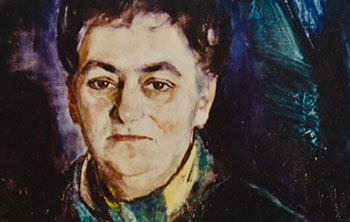
Of course the early psychoanalysts are central to this exhibition which includes portraits of Clara Geroe, the first training analyst in Australia by Judy Cassab.

Clara Lazar Geroe together with her husband and child and her colleague, Andrew Peto with his wife, arrived from Europe and Nazi persecution during 1940 – after protracted lobbying from British psychoanalyst Ernest Jones. He had also had ensured Freud was released from Germany – despite the reluctance of the British Government to act on the refugee issue.  Instrumental for her acceptance as an emigrant was the advocacy of the Australian psychiatrists Paul Dane, Reg Ellery, Coupland Winn, along with the clergy through Bishop Burgmann, and  head of the Australian Broadcasting Commission, Sir Charles Moses. This group had taken  their case to the Australian Department of Interior. Geroe, a trained analyst and member of the The Budapest Psychoanalytical Society, subsequently became Australia’s first Training Analyst  and a founding member of the Australian Psychoanalytical Society in Melbourne.

Dr Clara Geroe – by Judy Cassab

In 1982, Geroe’s interview with by researcher, Douglas Kirsner was published in the Melbourne  journal, Meanjin, then under the editorship of Judith Brett in September 1982. Here Geroe related that her first contact with psychoanalysis occurred when she was taken by her older sisters to a talk given by psychoanalyst Salvador Ferenczi a doctor in the hussar regiment garrisoned in her home-town in Hungary during WW1. His book on psychoanalysis, available in the local bookshop, was purchased by her parents. She told Kirsner,

I secretly pinched it, read it and said, ‘Oh. This is what I want to do’. I was then in the middle of my high school years and I somehow knew I must not study it yet or I would never go through with my planned medical studies.

Geroe successfully completed her studies and became a member of the Hungarian Psychoanalytical Society.  But by the mid 1930s it was clear that the Jews were under considerable pressure to evacuate Europe.It was becoming clear to Jewish people that Hitler’s regime was no longer willing to tolerate their presence. At the International Psychoanalytic Conference in Paris during 1938 Geroe began exploring the possibility of herself, and five other analysts migrating to New Zealand.  However few countries, including New Zealand and Australia, were willing to consider, if at all, taking refugees beyond quotas established in the 1920s. The Evian Conference called by US President Roosevelt had done little to change this. The New Zealand government refused the applications of all six. In Australia Geroe was accepted because, she reckoned, she had a child. It is not clear whether Andrew Peto was one of the six. Refugees were not welcome anywhere, it seems.

From her arrival in late 1940 Geroe was was a central figure in the development of the field and the training of psychoanalysts in Australia. She was instrumental in the beginning of Melbourne’s Children’s Court Clinic and the Koorong School run by Janet and Clive Neild in Melbourne. Western Australian born psychoanalyst  Ivy Bennett who practised in Perth during the 1950s remembered the warmth of Geroe’s welcome and her encouragement – ‘before the Graham controversies’ began in the late 1950s – perhaps an allusion to the nascent Kleinian influence which in the 1960s. Andrew Peto did not fare as well. After some years battling the authorities over his qualifications he left Australia for New York where he established his practice and gained recognition. Indeed a little internet search finds him as having delivered the 1978 Brill Memorial Lecture on the subject: Rondanini Pieta: Michelangelo’s Infantile Neurosis’.

In his 2002 book, The Hitler Emigres, a study of the contribution of Jewish refugees from Nazi Germany on British culture, historian Daniel Snowman notes that Jewish people were denied entry to a number of the professions. Instead many gained their education in the  arts – literature, music, art – deeply educated in these fields.  Geroe told Kirsner in 1982:

It is hardly necessary to say that members of the Society were all extremely cultured. Analysis was a cultural and vocational interest and not very lucrative. You had to be a bit of a revolutionary to become interested, to think for yourself and not be with the establishment. Amongst ourselves there was no distinction between medical and non medical people, and nowhere were women treated  more equally than in analytic circles. I became very interested in child analysis and worked with Alice Balint in a children’s clinic. Unfortunately it was closed down when the Nazis came. Child analysis was beginning; Melanie Klein had begun working and Anna Freud had written her first book. We had very intimate contact withj Anna Freud and her group; child analysts met weekly in Budapest and Vienna and we would sometimes go on an exchange seminar to Vienna for the weekend.

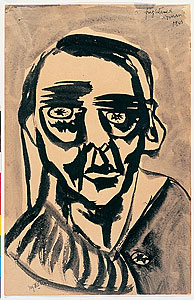
During the 1940s,  the work of these analysts, developments in training and clinical experience,  reached the consciousness of artists such as Joy Hester and  Albert Tucker.

(Joy Hester – 1945: Frightened Woman).

Both artists responded to the traumas of war – representing the internal agony experienced by many returned soldier, prisoners of war and holocaust survivors – men and women in their art work. Some of Tucker’s series, Images of Modern Evil is captured here.

This exhibition  is about ‘sight and insight’ –  It is about looking and beginning to see and to think about what might be happening in the minds of oneself and another beneath the surface appearances. it is about learning that intense emotional experiences and mental states can be thought about, talked about in a number of ways: though words, painting music and other forms. Perhaps it is also a plea for the value of the humanities and culture – so often decried these days in the academy – but which in themselves are about the attempt to understand human experience.

The advent of the the National Library’s online digitised newspapers collection enables this historical record to be easily mined – and the discovery that there was widespread interest in this field beyond  cities, intellectual elite and artists – in places as far afield, and remote, as  were Rockhampton and Cairns in far North Queensland, Broken Hill in far west New South Wales and Kalgoorlie a gold mining town in Western Australia. That said, a search through the newspapers of all the major capital cities may well have yielded results for the historian  Joy Damousi, whose book Freud in the Antipodes has also structured this exhibition.  I would have liked to see a more representative group of pioneers – from across the country –  whose advocacy for understanding the inner world did not find its time. That Bill McCrae sought the support of the British Medical Association in an attempt to establish a psychoanalytic institute at the University of Western Australia in 1943 is missed; that  several very talented  women – including Ivy Bennett and Ruth Thomas, both from that state, found their way to London and psychoanalytic training with Anna Freud’s group has also been missed. Thomas ane Bennett had in common their experience with the educationalist Professor Robert Cameron at the University of Western Australia during the 1930s and 1940s.

Of course one cannot have everything. It is enough to know that with this exhibition which is touring Australia during the next couple of years, has opened the door to an essential moment in Australian cultural history.

Like this:

Be the first to like this post.

Post navigation

Leave a Reply Cancel reply

Enter your comment here…

Please log in using one of these methods to post your comment:

Gravatar
Email (required) (Not published)

Name (required)

Website

Gravatar

Christine: You are commenting using your WordPress.com account. ( Log Out / Change )

Twitter picture
You are commenting using your Twitter account. ( Log Out / Change )
Facebook photo
You are commenting using your Facebook account. ( Log Out / Change )

Connecting to %s

Notify me of follow-up comments via email.

Notify me of new posts via email.