A Peep Into the Subconscious – Adelaide 1951

This item is taken from Adelaide’s ‘Advertiser’ dated 27 October 1951. One can never be sure about the reliability of sources when writing history. So much data is borne of subjectivity; what is included or excluded is a matter for a writer long ago. One can catch a glimpse, partially, into the milieux past and try to work out what happened on the basis of that evidence. History occurs in a space between now and then.

In October 1951 a newspaperman, by the name of Frank Dunhill, embedded himself in a meeting with a group of people interested in psychoanalysis. The resulting sketch of ordinary folk, albeit tongue in cheek, reveals a little bit about Australia in the 1950s. It is about the cautious exploration of new ideas and people, the emerging influence of European refugees in this post war period, about women finding time despite childcare responsibilities and wannabe pretenders with agendas of their own. Perhaps this was actually a group of Melbournians meeting with Hungarian born Clara Geroe with the resulting piece sold for publication  in Adelaide?  Perhaps the meeting was, actually, held in Adelaide.  Was it that Dunhill, like his counterpart in Sydney, Sidney J Baker, was knowledgeable about psychoanalysis – much more than he let on?  If anyone knows more about Frank Dunhill,  or indeed the people who attended these meetings, I will be pleased to hear from them.

Let us listen to Frank:

“There is more in psychoanalysis that meets the subconscious eye.

I know, because this week I attended the first meeting of a group of amateur Adelaide psychoanalysts who want to meet every week and talk about it.

Psychoanalysis deals with the analysis of the unconscious mind. Eight people were in the group. They included a new Australian from Hungary, a former commercial traveller who had read nearly all the text-books on the subject by Freud, Jung, and Adenauer, ( interestingly, a German pacifist and peacemaker within Germany during WW2…) a widow with one child, and a married woman — mother of three children – who came to Australia from Holland about 16 years ago. The convener of the meeting, a new Australian, also from Hungary, said he had studied psycho analysis in Paris, but had left for Australia before getting his diploma. Sitting next to him was an avowed pacifist from Melbourne, who once read half a pocket-book edition of a text book by Freud.

Next  to him was another pacifist who was once psychoanalysed, but was never told the result. Our host was a Scot.

I found my psyche was my soul. It had nothing to do with ‘Psyche at the well’.

The discussion eventually centred on child education.  Our host said he had often applied psychology as distinct from psycho analysis, to correct his child when she mis behaved. If that failed he used force. He found a combination of the two ‘very effective.’ The discussion went on. A lot of technical jargon passed over my head, and I didn’t catch up with the thread of things until somebody discussed mak ing a date for the next meeting.

That took a bit of working out because several worked shifts in their jobs. But by submerging their superegos for the common good they finally decided on Sunday night. The two women then went home and took their restraining influences with them.

After that things went a bit haywire. The two pacifists tried to show how wars could be stopped by psycho-analysis, but the rest of the meeting disagreed. Somebody accused a pacifist of woolly thinking when he tried to draw an analogy between oranges on a tree and people in a country. d Finally, psycho-analysis was discarded altogether and the discussion became a straight-out debate on pacifism,. The two pacifists became almost aggressive in defence of their own cult. When the meeting broke up about 11 p.m. the convener said he thought a plan of action should be drawn up at the next meeting. That made our host laugh uproariously. He thought that was the idea of the meeting at his home.

But as everybody had become acquainted and had in a way bared their souls to each other, the evening had not been wasted. I said good-bye, and left with a new-found Freudian complex and a now subdued pacifist as my companion.

This may be a litte to the side of the main theme here – or maybe not.Mayhew’s work and his respectful interviews with the poor in London during the mid nineteenth century impressed me deeply…It formed part of my introduction to History and my love of it.

Mike Paterson's avatarLondon Historians' Blog

Today is the bicentenary of Henry Mayhew (25 November 1812 – 25 July 1887).

“I think you will agree to be one of the most beautiful records of the nobility of the poor; of those whom our jaunty legislators know nothing. I am very proud to say that these papers of Labour and the Poor were projected by Henry Mayhew, who married my girl. For comprehensiveness of purpose and minuteness of detail they have never been approached. He will cut his name deep.”

This was written in 1850 by Douglas Jerrold, Mayhew’s friend, collaborator and father-in-law at a time when Henry Mayhew would have been collating the first edition of London Labour and the London Poor (1851). Jerrold was mainly wrong, because today Mayhew is all but forgotten. This is a great pity, because the writer was hugely influential in his own time, not least among his near-exact contemporaries, Charles…

View original post 726 more words

A Letter Home – Ruth Thomas

Tags

, , , , , , , , , , , ,

Ruth Thomas was born in Sydney in 1902. She a graduate of Sydney’s Fort Street School and continued onwards to Sydney University to study psychology and, in 1923, the founding year of the Australian Society of Psychology and Philosophy, runner up in an essay competition adjudicated by Professor Francis Anderson. The winning essay, ‘The Relation of Repression to Mental Development’ by a Mr Cunningham from the University of Melbourne was published in the Association’s journal. Sadly, Ruth Thomas’s essay, nor the title were published.  On 3 February 1924 the Social and Gossip Column in Perth’s Sunday Mail announced her impending arrival as a lecturer at Claremont Teacher’s College – also under the directorship of Robert Cameron.By 1933 Perth had claimed her as its own. She was moving further afield, the newspapers announced,  she moved to London to take up the post of Principle Lecturer in Education at St Gabriel’s College in Camberwell. ‘Rarely are Australian’s so well treated’ wrote the editor of the Daily News in October 1933. Ruth Thomas had written to her friends who passed her letter to the paper. It was published in full. it is a digression, but reveals some of the liveliness of this woman who seems to be soaking the old world and its beauty into her being..

‘I have just spent a week-end at Cambridge, which is lovely. We went over Trinity and King’s on a wet Sunday afternoon. One or two punts were out on the river in spite of the weather, and the light falling through the woods along the parklands where most of the colleges ‘back’ in (so, Cambridge ‘Backs’ they are called) was almost green as it fell through the bright colors of the new trees. I’ve seen nothing like it before. You’d laugh at it on canvas as unreal. It was fun to see the solemn young undergraduates in grey flannels and brown Norfolk jackets pacing about with the inevitable pipe. I guess they’re luckier than they know.

All was of consuming interest, even where she lived..

‘I have ‘digs’ of my own over-looking a lovely square just off the river and ten minutes from everywhere. I climb solemnly up four flights of very dirty stairs, with the odor of last century’s cooked eggs, and purple wallpaper. At the top I’ve managed to set up some thing like a decent ‘diggings.’ My room is 16ft. by 13 ft., newly done out in cream, and with a built-in wardrobe. Hence it was easy to make it look like it a study. I have a nice Davis carpet, very oriental, in orange and fawn, and ‘ a low divan you’d never recognise as a bed, bookcase and a desk, and other I whatnots, scoured from the Jewish shops in Fulham Road. The scouring required when I got them was another matter.

Perhaps London life at last sated Ruth’s hunger for the arts and culture, and a bit of ‘star spotting’.

‘The other night I went to all night place where artists congregate, for beer and food, and had a table near [the writer] Beverley Nichols. He is what you’d imagine — long and fair and thin — in immaculate evening dress, and with the air of the very modern young man. ‘Alfred Noyes [the poet] is quite different. I went recently to hear him on religion and poetry in a lunch-hour lecture af St Martin’s-in-the-Fields. He has a lovely voice and recites poetry like an angel, but he has also an illogical mind. His matter was horrible. It interested me to hear him say Shakespeare’s greatest line was ‘Ab- sent thee from felicity awhile.’ I shouldn’t have thought it. He is fat and very forty-ish, with a few hairs pulled across a quite bald head, wears large glasses and double-breasted suits. It seems a pity, for the’ author of [the play] ‘Sherwood.’

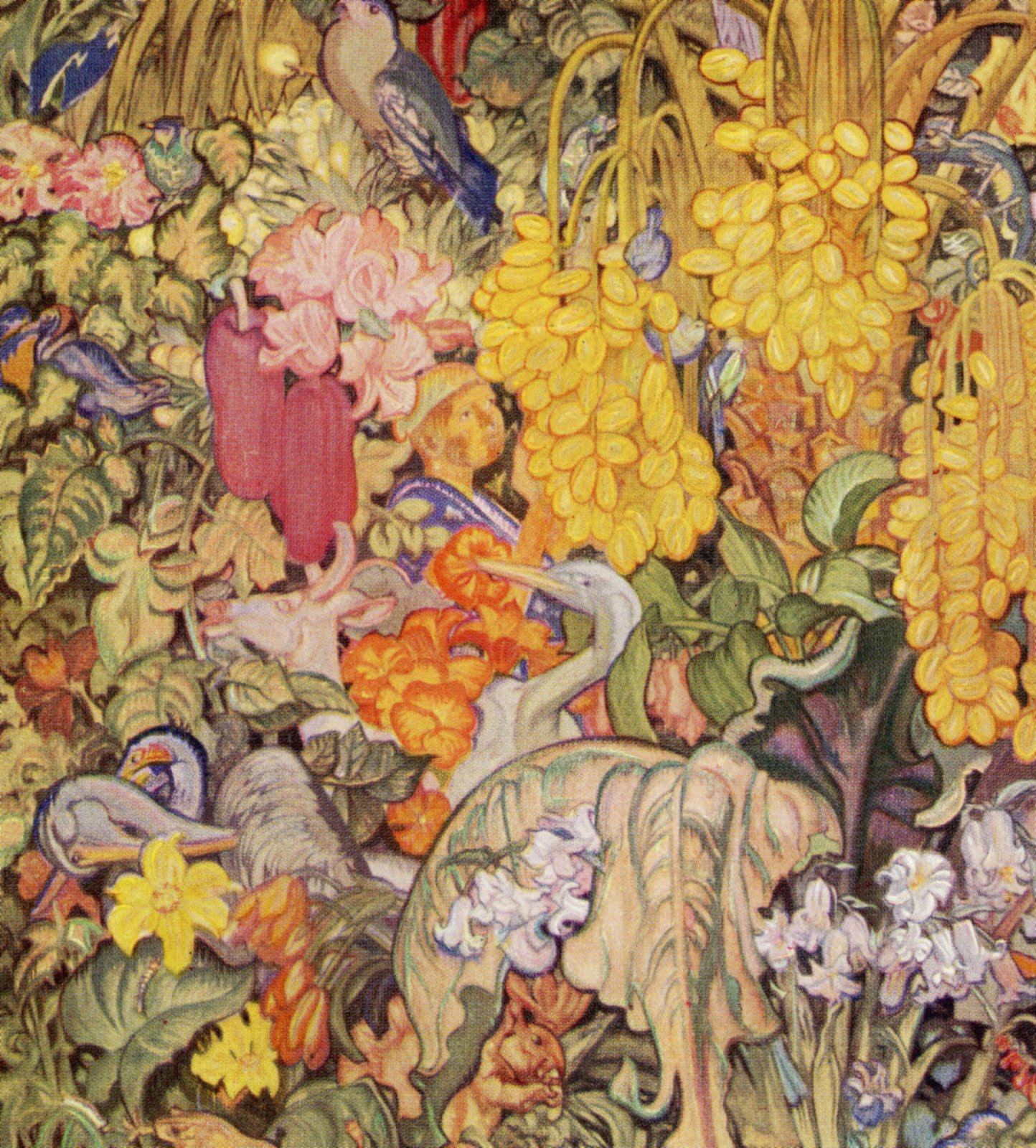
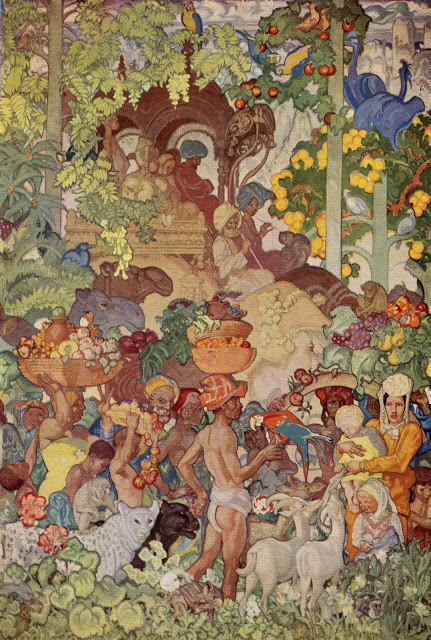
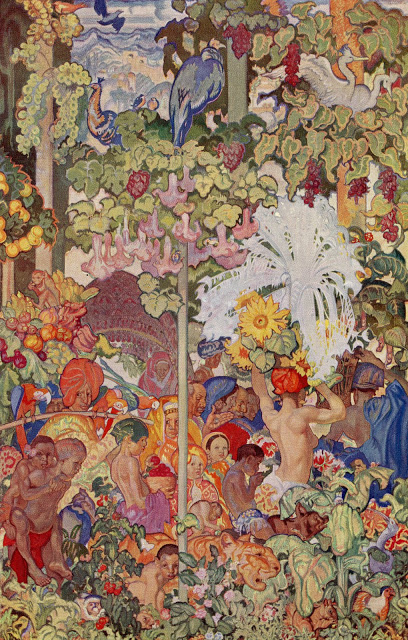
For ‘native-born’ Ruth, London was a place of firsts, of seeing sights and artwork hitherto read about in books; the subject of daydreams. There was an exhibition of artwork, murals by Frank Brangwyn commissioned by The House of Lords as a memorial to the Great War ‘Quite the acme of my artistic life here have been the Brangwyn Panels’, Ruth continued.   They were, originally painted for the walls of one of the galleries in the House of Lords as a war memorial, and range from ten to twenty feet in height. The Lords could not see that they were a war memorial, and turned them down after the artist, Brangwyn put nearly ten years’ work in them’. Only five of the eighteen proposed were completed.  The Brangwyn Murals have been uncovered by devotees of lost art….I have found three – also published via the web.

Here are three of the murals Ruth saw at the exhibition.

Ruth Thomas continued: “He strikes the note of actual warfare only, in relation to all living. The riot of life, struggle for power, parasitism and greed, sex, mother love, and pleasure are all portrayed in a most exotic symbolism and the brightest and most exhilarating of greens, blues and oranges. He contemplated, too, a modern panel, with industrialism and luxury in contrast, but there is only a rough sketch of it. It is now thought they will be bought by America and the Lords wont wake up until 2050”.

In September 1937 Ruth Thomas returned to Australia to attend the New Education Fellowship Conference then being held across Australia – after an initial stint in New Zealand. Susan Isaacs, a follower of Melanie Klein, was a keynote speaker. By this time Ruth was on the staff of the London Child Guidance Clinic.

When war broke out in 1939 Ruth Thomas was amongst those recruited by Dame Evelyn Fox to advise on the needs of evacuated children. Others included the psychoanalyst Donald Winnicott and John Bowlby. As had Winnicott, Ruth Thomas addressed ‘ordinary mothers’ on the needs of children via the BBC. By 1943 she was in charge of a children’s home in Pusey in Wiltshire. She wrote a memo which was included in the  1946 ‘Curtis Report’ – “Children Without Homes”. Its recommendations instrumental in the development of substitute care in the United Kingdom – and a decade later in Australia, in the Victorian State Government’s 1954 Children’s Welfare Act.  after the war. These all brought her into contact with Anna Freud who was also working with displaced children, including a group from European Concentration camps.  There were practical considerations alongside the psychological. Money and goods were scarce. Ruth sought contributions from the folk at home. One such was published in 1947.

Miss Thomas desires clothing that may no longer be needed -knitted woollies, jumpers and cardigans, little boys’ trousers, socks, underwear and old cloth ing that could be cut down. Parcels may be sent to “Miss Ruth Thomas, I Cornwall Gar dens, London S.W. 7.” They must not exceed 11pounds ( weight) or £5 in value, must not contain over 21b. of knitting wool, must be clearly marked “Gift” and a statement must be attached giving details and value. The sending of piece goods in parcels to England is prohibited.

When Anna Freud began a training program at her clinic in 1947, Ruth Thomas was appointed as a training analyst and as a lecturer. In an appreciation published in the Journal of Child Psychotherapy  after her death in 1983 it was noted that ‘her seminars on ego and ego development were models of clarity’. She was much sought as a supervisor; was tough, kindly with high expectations of her students….

There is always going to be migration to and fro, knowledge transmission leaving and coming to Australian shores. Perhaps it is a manifestation of transnationalism, and, as Australian historians begin to explore the possibilities within this concept, it implies a movement away from a defensively assertive independence as the influence of the mother-country is to be shaken away to recognition that we are part of something rather more global….

References:

Kenneth Brill and Ruth Thomas, Children In Homes, London, Victor Gollancz, 1970.

E. E. Model, Ruth Thomas 1902–1983: An appreciation,Journal of Child Psychotherapy, Volume 9, Issue 1, 1983.

The Daily News, 30 June 1933, p.8.

The West Australian, 29 October 1933.

The West Australian, 24  September 1937.

The West Australian, 20 February 1948, p.15.

A thoughtful essay, and a blog for following.

abelsvoice's avatarAbelsVoice

This is a much abbreviated version of a paper I developed.  Here, I represent one of three important psychoanalytic versions of transference to show how it can help us better relax into loving each other.

When in conversation I mention the word psychoanalysis, I am usually responded to with comments referencing sex, perversion, or the unconscious. Even then, the conversation usually takes on an insouciant tone. Whatever other responses I have received, I am unable to recall any that included references to love. And yet, in a letter to Carl Jung dating from 1906, Freud indicated that psychoanalysis offers transformative experiences because psychoanalysis is a, “cure through love” (McWilliams, 11). And again, near the end of his life when reviewing the sum of psychoanalytic findings in Analysis Terminable and Interminable, Freud gently reminds that, “finally, we must not forget that the relationship between the analyst and patient is based…

View original post 2,770 more words

The Freud Conference

A crucial, must do event on the social and professional calendar of all good psychoanalytically oriented therapists, analysts, academics and anyone else who is interested here in Australia, is the annual Freud Conference in Melbourne. Convened, in recent years, by a panel of practitioners drawn from the various psychoanalytic associations, the current Freud Conference is heir to the Freud Conferences of the 1980s, held by the beach at a guest house – Erskine House – in the Victorian coastal town of Lorne. Nowadays it is held in May, usually the third Saturday,and, during the last few years at the Treacy Centre in Parkville, Melbourne… opposite a sports ground and not too far from the Zoo… if one wants a quick visit during lunch-time. For the 2013 conference the venue has changed. It will be around the corner from the Treacy Centre, or at least not too far away, at The Melbourne Brain Centre, Kenneth Myer Building, 30 Royal Parade, Parkville… across the road from the University of Melbourne.

Douglas Kirsner, a philosopher and academic together with Ed Harari a psychiatrist, hatched the idea together one day over coffee… and the rest, as they say, is history.

Here is the link to Doug’s account  – it needs no more from me….

Next year’s conference, to be held on 18 May next year will be about psychoanalysis and politics, about the emergence of terrorism and refugees. Nancy Hollander will be a keynote speaker as will be Julian Burnside whose legal work on behalf of refugees is well known here in Australia.

Further details on the Freud Conference website..

On ‘A Reluctant Immigrant’ – Clara Geroe, The Meanjin Interview

Tags

There is relatively little material available in the public domain about Australia’s first training analyst, Clara Geroe. Several online biographies outlining her contribution and influence on psychoanalysis in Australia after her arrival in 1940  tress her professional work while moving swiftly across her ‘refugee story’. These accounts are based on the interviews she gave to Douglas Kirsner in 1977 and 1979 and published in Meanjin in 1983.  The impact of Geroe’s arrival, a watershed in the development of the psychoanalytic discipline in Australia, and her longer term influence is still being absorbed. She was a medical practitioner, relating first and foremost to those in that profession. But she also recognised lay professionals and drew these practitioners into her circle. Less conscious perhaps, is the influence not just of her European background in a country which stressed Englishness and upheld the White Australia policy, but also of her refugee/migrant experience. Clara described herself as a ‘reluctant immigrant’: she did not wish to leave Europe and only came to Australia’ because Hitler came to Europe’. Her link with Britain legitimized her status and presence: she was Australia’s first qualified and approved training analyst under the aegis of the British Institute for Psychoanalysis.

During the last two decades historians have been able to provide a good account of the encroachment of Nazism on daily life in Europe; they have been able to investigate the response of governments outside Europe, providing context for the types of decisions, and circumstances people such as Clara Geroe were facing. Let us begin with Kristallnacht.

On 6 November 1939, Herschel Grynszpan, aged 17, a young man of  Jewish German origin, bought a gun, loaded it with 5 bullets, and walked into the German Embassy in Paris. He shot one of the diplomats Ernst vom Rath  three times in the abdomen -an act of revenge for his family’s expulsion from Germany. It was the excuse the German authorities needed, the historian, Martin Gilbert explains. On 9- 10 November, Kristallnacht, Nazi stormtroopers conducted systematic raids in cities and towns across the country. Synagogues were smashed, homes and businesses broken into and looted. Jewish families were rounded up made to stand and wait outside in the cold night for hours. Women and children were separated from their menfolk who were deported to the concentration camps for several weeks. They returned  with orders to leave the country, to go to any country that would take them.

The trouble was, as Louise London pointed out in her 2004 book, Whitehall and the Jews, few countries would do so. Great Britain, acting on policies developed in conjunction with the USA in 1933-4, and London shows, fearing that the influx of foreigners would undermine its social fabric, limited its intake essentially to women and children – to be employed in service. Few men were admitted. Many who did make it avoided internment by joining the British Armed Forces.  Those who were not of German origin fared better – for a time. Despite this reluctance to accept refugees, members of the psychoanalytic profession, led by Britain’s Ernest Jones, became  one of the few professional groups to lobby for  European colleagues at risk of Nazi persecution. The Freud family was an exception. Even so when the family arrived in London Anna Freud fearing repercussions for those left behind, asked reporters to stress they had been well treated.

Australia was slow on the up-take and New Zealand, too, was closing its doors. While there had been some co operation between Britain and the Dominions concerning intake during the interwar years, this had dwindled from about 1933 – due to concerns about an influx of  undesirables – possibly communists and revolutionaries in the guise of refugees.  (London 2000:43).

To leave one’s country of birth with no possibility of return: to relinquish its sights, sounds and smells; to be without the mirroring of one’s self within one’s community is in the realm of accumulating psychic trauma. In their book, Migration and Exile, Lesn and Rebeca Grinberg show how one may respond to such dislocation by becoming frozen in time, relating internally to the culture left behind; becoming, perhaps even more ‘European’ or more ‘English than English’ , more of whatever was part of one’s roots than those that remained behind. For Clara Lazar Geroe, her ultimate arrival in Melbourne was the culmination of a long story of doubt, uncertainty and dislocation. She told some of this in two interviews with Melbourne researcher Douglas Kirsner, the first held in 1977 and second in 1979 – shortly before her death in 1980. This was compiled by Judith Brett these were  published in Meanjin in1983.

For Australian psychoanalysts Clara Lazar Geroe effectively parachuted into the local scene. While much of its historiography, including Joy Damousi’s Freud in the Antipodes  stresses the activity of medical practitioners. he first two qualified medically trained analysts were Sydney based.  Dr Roy Coupland Winn who qualified first as an Associate and then as a full member of the British Psychoanalytical Society set up in private practice in 1931. The second qualified analyst, Dr Fink who arrived in 1938 from Germany – another escapee from Nazi Germany – was a member of the Swiss Psychoanalytic Society. He worked in the New South Wales mental health services before entering private practice. Paul Dane in Melbourne was another key figure. Lay people: educationalists and psychologists – including workers in the child guidance movement, found their way to psychoanalysis through psychology and philosophy studies at the major universities. As in Britain and Europe and building on the work of the Child Study movement,  the child guidance movement was developing with psychological clinics as far afield as Perth in Western Australia as well as in the eastern states.

By 1940 the theory and practice of psychoanalysis was a lively arena, of discussion and debate – if the press is any reflection. Psychoanalytic ideas were rubbing shoulders with those from psychology, philosophy and education since the early 1920s – also traced by Damousi. There was Sir Francis Anderson whose leadership of The Australian Association for Psychology and Philosophy and its journal was instrumental in the dissemination of psychoanalytic  ideas in the Australian community from 1923. The Association held regular meetings, with branches in the main capital cities. Professor John Anderson also from the University of Sydney combined philosophy and psychoanalysis in his work. At a community level and in regional areas talks were given to through the Workers Education Associations.  In 1937 British psychoanalyst Susan Isaacs, an associate of Melanie Klein,  visited Australia for the New Education Fellowship Conference which, after preliminary sessions in New Zealand,  travelled to each of Australia’s state capitals from 1 August and 20 September 1937. Isaacs was waited upon by senior Canberra women – from the Governor General’s wife down! Ruth Thomas a Western Australian based psychologist returned from England to attend the conference as did educationalist and psychologist Madeleine Ekenberg after a ten year absence. Ekenberg, who took the time to visit her folks in Singleton, New South Wales, warrants a post in this blog in her own right. She was working with child psychotherapist Margaret Lowenfeld at the London Institute of Child Psychology. Clara Geroe’s arrival may have provided locals with the impetus to formalise, and centralise.

Clara Lazar Geroe was born on 4 October 1900 in Papa in Hungary,  was the daughter  of Adolf Adam Lazar, wholesale grocer, and his wife Ilona, née Lusztig. Although Jewish, Clara completed her secondary schooling at the local Calvinist college. During WWI when the psychoanalyst Ferenczi was garrisoned in her town with his regiment she snuck into one of his lectures with her two older sisters who had been invited to the event. By Clara’s own account, she obtained one of his books from the local bookshop -which had brought them in knowing the author was in town, and after reading it felt she had found her vocation. By her son’s account she was little interested in psychoanalysis at that stage. In about 1923 she completed her medical studies in Prague and, back in Budapest in 1925 and working in a hospital for nervous disorders,  was accepted for training with the Hungarian Psychoanalytic Society. Seminar teachers included anthropologist Geza Roheim amd Michael Balint on infant development. She said of this period:

One didn’t have as long an analysis as now and the rules were less strict. In Australia today I am the only one of the training analysts who sees trainees only four times a week. The others all keep strictly to five times a week because that is the ruling. And whereas nowadays analysts and trainees avoid meeting at public places or seminars no-one worried about this during my training… Probably some of the complexities of the transference relationship were not recognised then.

In in his 2002 book, The Hitler Emigres, British historian Daniel Snowman has traced the influence of Jewish refugees upon British Culture: the arts, music, literature, the law. He  points out that young Jewish people in the late nineteenth into the early twentieth centuries  were aware that certain professions were barred from them. Politics, the public service and indeed the Church were closed to Jewish people. They were pushed out. Rather, many gravitated to Law or Medicine or indeed the studies of economics, philosophy, music literature or journalism and publishing. Many thought of themselves as ‘assimilated’, Snowman goes onto say, arguing that those who aspired to culture and sophistication thought of themselves as members of their home country’s culture. It implied rejection of ‘partisan ideology, separatism, exclusivity, dogma- Jewish or any other – and in their place, the aspiration to embrace universal truths and the whole of humanity. These were the sentiments of the press and the academy, not of the army, church or politics’. And it separated them from the the unsophisticated basic lives of Eastern European Jews, those who had not made it, ‘people without a culture who clung to outmoded attitudes’, Snowman continues.  Germany stood for urban and urbane life, Snowman continues. Not the fields and the ghetto, but for emancipation and enlightenment rather than atavistic obscurantism. (Snowman 2002: 8). Jews who served in WWI and were awared the Iron Cross felt they belonged; they were German rather than Jews. One can only imagine their profound sense of betrayal on Kristallnacht.

Perhaps this sense of whether or not one belonged was less of an issue in Hungary than Germany. Jewish people assumed they did belong. The Historian Bernard Wasserstein traces these in his 2012 book, On The Eve. From 1867 when acts were passed freeing Jewish people from legal restrictions  Jewish people had prospered moving into the professions and into the nobility… Antisemitism seemed to belong to a less civilised past’. They felt at home in Hungarian  From 1920, though there was a harbinger of things to come. The reappearance of the numerous clausus, a quota system enacted into law in 1920, restricted admission to university no more than 6 per cent of  student of Jewish origin. it was the first anti -semitic law in interwar Europe. ( Wasserstein, 2012: 28).

For Geroe, being a psychoanalyst in Europe was part of being part of cultured community. ‘Analysis was a cultural and vocational interest and not extremely lucrative’, she explained in her interview with Kirsner. ‘You had to be a bit of revolutionary to become interested, to think for yourself and not be with the establishment’. There was no distinction between medical and non-medical people, she continued… Perhaps this was a rather pointed comment. Tension over such distinctions rumble still in the local Australian scene if not elsewhere. And, as if to add to the halcyon days of the past Geroe remembered, ‘No-where were women treated more equally than in analytic circles’. Child analysis was also developing during the 1920s and 1930s. Geroe worked with Alice Balint in a children’s clinic which closed down when the Nazis came. Anna Freud’s work was commencing; there were meetings in Budapest and Vienna. The group also received patronage from leading families. Geroe explained:

The Baroness Herzog endowed the Analytical Society with a villa in a beautiful forest where fifty children, most of whom were in analysis, would come for two to three months in the summer. We would give them sessions once or twice a week to see how they were reacting to the therapeutic milieu.

August Aichhorn, whose work with delinquent children was based in milieu therapy, was very interested in this project, she continued. Aichhorn had begun the first child guidance clinics in Vienna in 1927.

The reason Geroe came to Australia with her family  was ‘because Hitler came to Europe’, she said flatly.  It had been a good life before that, a ‘happy well-ordered life’. She had had no intention of immigrating. But during the 1930s life had become oppressive, as it had for all Jewish people.

Uniformed police were always present at our (psychoanalytic) meetings. Their presence was mainly to vex us,  but if they could have put their finger on anything they would have suspended the Society immediately. Everything intellectual in which Jews took part was suspicious and persecuted, and perhaps more than half our members were Jews or counted as Jews according to the Nuremberg laws. Still we had our practices and it was a hard decision to leave.

By the end of the 1930s antisemitism was official state policy in Hungary. Many sought escape by converting to Christianity. Others such as Geroe were being forced to face the fact that the future for them if they remained in their homeland was dire. There were visitations and warnings from abroad. In 1937 when Hitler marched into Czechoslovakia she had barely heard of Australia let alone New Zealand. Britain sent someone to help. Geroe explains.

 Dr John Rickman of the British Society came to Budapest to advise us how to get out and where we could go. We heard of countries about which we knew almost nothing and New Zealand was one of these. It was suggested to several of us that we should try and get a permit to New Zealand. The emphasis was on those people who were child analysts and interested in education because New Zealand had recently hosted a large international congress on the New Education Fellowship  Movement which Susan Isaacs had attended. There was a lot of interest in modern educational ideas in New Zealand, more than in Australia at the time.

What went on at the 1938 -9 Psychoanalytic Congress in Paris, what discussions were had, the emotional atmosphere, and the urgency with which European Jewish Psychoanalysts sought assistance from their international colleagues can only be imagined. A group of Hungarians at the 1938-9 Psychoanalytic Congress in Paris then met with Ernest Jones who, Geroe says, confirmed that there was an interest in Analysis in New Zealand, but mainly child analysis. From initial perusal of the New Zealand’s digitised newspaper collection: Papers Past, this seems not to have been accurate. It may be that the British Rickman, so far away from Australia, had not grasped that his colleague, Susan Isaacs, had spent most of her time in Australia. Perhaps in the way of these things, and not fully apprised of the details he had heard she was leaving for New Zealand… but not much more. It was enough to encourage hope for these people so desperate and far away.  Geroe and  four or five colleagues applied for admission to New Zealand.  Contacts were made and letters written – to Duncan Hall the Colonial Secretary at the League of Nations.  The New Zealand Government refused them. Twice.

New Zealand’s refusal of the applications of six prospective analyst refugees, and Australia accepted but two of them is a story in itself.  Judith Brett‘s short biography  of Geroe  published in the Australian Dictionary of Biography which traces these events is a master of understatement:

At the International Psycho-Analytical Congress, held in Paris in 1938, Clara had explored the possibility of six Hungarian analysts emigrating to New Zealand. Their applications were refused. A group of Australians—including Bishop E. H. Burgmann, the doctors R. S. Ellery, R. C. Winn and Paul Dane, and (Sir) Charles Moses—took up their case with the Commonwealth Department of Immigration. Of the six, only Clara was accepted. She later surmised that she was selected because she had a child. With her husband Vilmos Gerö (William Geroe)—whom she had married on 27 August 1927 in Budapest—and their son, she arrived in Melbourne on 14 March 1940.

In Europe things were deteriorating. It became more and more urgent to leave Hungary. Geroe, finally, was able to get a visa – for Australia… perhaps ‘because I had a child and Australia was always keen to get families’. Then the permit was cancelled when war broke out. She was relieved at first. ‘ I was so ambivalent about leaving that I was glad we could stay, but then after some months our permit was renewed because Hungary was not a declared enemy in the war’.

What finally tipped the balance for Geroe is any one’s guess. Daily life for Jewish people was becoming impossible. In May 1938 another anti-jewish law was passed in Hungary cancelling the licenses of Jewish small business owners and subjecting Jewish in the professions to the numerus clausus– a quota. ( Wasserstein, 365). Another law was passed in May 1939 -‘adopting a racial rather than a religious definition of Jewishness. It severely curtailed Jewish economic activity and civil rights, restricted Jewish participation in the professions and required the dismissal of Jewish civil servants ( it was possible in Hungary to be a civil servant until then) theatre directors and editors of the general press. Only those Jews whose ancestors had lived in the country before 1867 retained the vote. The 7,500 foreign Jews in the country were ordered to leave’. ( Wasserstein, 405). Geroe may have had no choice… And then there was Kristallnacht.

Paul Dane was waiting for Geroe when she arrived at Melbourne in March 1940. Again there were promises. There was talk of grants for the establishment of a psychoanalytic organisation… but overseas qualified medical practitioners did not have automatic registration in Australia. Geroe, nevertheless, began work at the Alfred Hospital in Melbourne – the first to do any child psychiatry at all. In October 1940 the Melbourne Institute of Psychoanalysis was opened with money donated by Miss Lorna Traill. There was a lot of interest and good will Geroe remembered, ‘partly because people wanted to help the European refugees and do something against Hitler’.  Geroe, appointed as the analyst of the Institute, was to give three hours a day to institute patients – and was paid 4 guineas a week. She was to see every new patient- difficult because all new patients had to be seen by a registered doctor. She wanted to set up a free clinic – for what she called ‘analytic psychotherapy. There was also her children’s clinic. Her project.

This was a bit of a private war of mine. I had made a promise to myself that as I was lucky enough to come away from Hungary  safely with my family, I would never turn away from the institute for financial reasons any child who needed help. I kept to it as long as I was physically able.

Perhaps the world Geroe had left so abruptly was always with her. Perhaps she was never entirely reconciled with its loss. Stanley Gold writes sensitively of Geroe’s sadness: ‘She brought with her a great love of psychoanalysis and in particular its application to the education and development of children, and a life-long nostalgia for the early days of the psychoanalytic movement with its camaraderie and intellectual radicalism’. Perhaps a legacy of her European life was  her belief that people at all levels of the community should have the opportunity to ‘explore psychoanalysis as a meaningful intellectual and philosophical discipline and to develop techniques for its application within society’.(Meanjin 1983).

REFERENCES:

Stanley Gold, ‘The Early History’, Meanjin, 3/1983, pp. 342-351

Clara Lazar Geroe, ‘A Reluctant Immigrant’ ( from an interview with Douglas Kirsner compiled by Judith Brett), Meanjin, 3/1983, pp. 352-357.

Joy Damousi, Freud in the Antipodes, A Cultural History of Psychoanalysis in Australia , UNSW Press, 2005.

Martin Gilbert, Kristallnacht: Prelude to Disaster, London, Harper Press, 2006.

Louise London, Whitehall and the Jews: 1933-1948: British immigration Policy and the Holocaust, Cambridge, Cambridge University Press, 2000.

Daniel Snowman, The Hitler migres: The Cultural Impact on Britain of Refugees from Nazism, London, Chatto and Windus, 2002.

Bernard Wasserstein, On The Eve: The Jews of Europe Before the Second World War. New York, Simon and Schuster, 2012.
Some interesting questions here,,,

whatashrinkthinks's avatarwhat a shrink thinks

Michael (a highly fictionalized/conglomerate but all too real client) was scared as hell and little more than a month away from aging out of the group home he had lived in. At the close of the session he was trembling. I had seen him twice a week for the very first three years of my private practice (many many years ago now) and I had fielded at least as many hours of emergency and crisis phone calls. Hired as an independent contractor by the group home agency, I had watched him, week after week, grow from a gangly coltish boy, into a young self-identified gay man, as tough as he was pretty.

He had no one.
His parents, both severely mentally ill, profoundly sadistic, and long gone. He had lived in an undisputed, unfathomable house of horrors, tortured and feral, until he was removed at age 7. He had then…

View original post 2,686 more words

Psychoanalysis and Northern Queensland -1925

I found this item in the Morning Bulletin, Rockhampton, Queensland.

The date: 21 August 1925.

Professor Scott-FIetcher, from the University of Queensland, delivered a public lecture in tho Mount Morgan Technical College on Wednesday night on “Recent Developments of Psychology.” The chair was occupied by the Mayor of Mt. Morgan (Alderman A, P. Bedsor).

Mount Morgan is a town located in central Queensland, Australia. It is situated on the Dee River, 38 kilometres south of the city of Rockhampton, and is 680 kilometres north of the state capital, Brisbane. It is far enough away, one presumes – from a twenty-first century perspective – for the newly emerging disciplines of psychology and psychoanalysis to be of little interest to people. Yet the National Library’s digitized newspaper collection, enabling an easy and closer look at the material at hand, reveals quite the opposite. From the 1920s Rockhampton’s Morning Bulletin frequently published items about psychoanalysis – in favour and not. Along with the Barrier Hill Miner in Broken Hill, Kalgoorlie‘s daily newspaper along with those of the state capital cities, it is possible to see that there was widespread and lively interest in this ‘New Psychology’ as it was called, from the early decades of the twentieth century.

Let us listen to the reporter’s account of Professor Scott-Fletcher’s address. He clearly enjoyed it.

“In the course of a very fine address, the lecturer said that psychology was the science which investigated all mental states, normal end abnormal Some years ago the subject was mainly studied as an introduction to philosophy but during this century psychology had made great advances as an independent science. Moat universities had a laboratory, in which, by means of experiments, it was possible to test general intelligence, memory, and perceptual ability. The study of the mental equipment of animals had shown that instinct in human beings was one of the main factors in behaviour. The professor then described how the discovery of the unconscious mental processes in man had opened up an immense field of research. The application of these results to education, mental disorders, and even business efficiency had been attended with great success.”

“The use of psychoanalysis by Freud was next described. The lecturer explained that the undue prominence given to sex in this method had led to several new developments, in which Jung, Adler, and Bjerre had by other methods, successfully treated pathological cases due to mental maladaptation to environment. Psychology, while deterministic in theory, yet aimed in its practical applications nt securing freedom for the individual by making his actions self-determined.”

“At the close of the lecture the professor very lucidly answered a number of questions; asked by members of the audience. The lecture, was greatly appreciated by a good audience, and a hearty vote of thanks was accorded the lecturer”.

Professor Scott-Fletcher was New Zealand born and. according to his obituary published in Brisbane’s Courier-Mail on 7 November 1947, took his Master of Arts degree at Sydney University in 1902. He won the University Medal for Philosophy. He became the Master of King’s College at the University of Queensland in 1912 and, in 1916 was appointed to Wesley College at the University of Sydney where he also tutored on philosophy. He was appointed as Professor of Philosophy at the University of Queensland in 1922 and resigned in 1938. At the time of his death he was 79 years of age.

There may be, of course, more to learn about the Professor.   You can contact me via freudinoceania[at]gmail[dot]com  if you would like to add to this.

“Foundations of Behaviour” – McRae’s lecture series – Perth, Western Australia, 1943.

Tags

,

William McRae, The Foundations of Behaviour, Melbourne, OUP, 1945.

Writing of Western Australian Bill McRae in her history of psychoanalysis in Australia, Freud in the Antipodes, Joy Damousi asserts  McRae believed psychoanalysis was  reserved for those with deep-seated difficulties. His aim, she writes, was ‘to break down resistance which prevents us knowing ourselves’ and that he thought it was dreams that enabled such resistances to be accessed. Drawing on two books published by McRae during the 1940s –About Ourselves and Others (1941) and Adventures in Self Understanding (1945) Damousi also notes McRae’s ‘reformulation of the Oedipus Complex’ upheld particularly oppressive stereotypes about men and women, about male and female. (Damousi, 2005: 175-6). As offensive as these were, such stereotypes reflected his  time, Damousi explains. It was war-time. Gender roles were being reshaped, families were having to adapt to long absences of their menfolk; lives and careers were on hold. Women were involved in activities traditionally the domain of males. ‘McRae listened and interpreted the testimonies of those who spoke to him through this prism’. Damousi writes. It shows that psychoanalysis was moving from being used ‘to analyse individuals’ to define the place of these individuals within the community and society. ( p.178).

It is an interesting thought. Editorially this statement and Damousi’s reference to McRae’s work has been at a point where she wants to introduce what she considers to be a larger and more important issue:   advent of psychoanalytic institutes in Australia also during the 1940s.

My own impression of McRae is somewhat different – even as I find his version of psychoanalysis ‘thin’ and his writing repetitive. McRae’s stance on the relations between men and women were but one corner of his work. He also wrote of infants, children and dreams. Often, by his own admission, he framed his views from psychoanalytic texts he was reading at the time.  I have mentioned McRae’s lecture series given to the Adult Education Board of the University of Western Australia: ‘The Foundations of Behaviour’ in an earlier post. His intention was to present psychoanalysis in a form ‘that would be of immediate use’ to people approaching the subject for the first time. He hoped that by showing ‘how and why a child’s earliest years determine his basic attitudes to himself and others, and to existence in general’, and then how these basic attitudes persist through life’. We may read McRae’s take on psychoanalysis in relation to societal and family expectations of men, women and children. But I suspect that his purpose was not so much to define or to reshape but to underline the existence and importance of unconscious processes within the individual. He had a battle before him. McRae was aware there were those who remained sceptica.l Behind everything I say, McRae said, there was

evidence in plenty and the backing of some of the greatest minds of our time, but as you read through the book you can safely forget all this and test everything said in the light of your own experience of yourself and others. I ask for nothing more than this.
McRae’s 10 session lecture series demonstrates that he had a grasp of the complexities of psychoanalytic theory of which dreams are a part. His focus on the ‘inferiority complex’ though reveals his Adlerian preference.  He began Foundations of Behaviour with a general introduction – ‘How We See Ourselves’. We may be able to gauge the personality of others, he began, but how do we understand what causes people to act as they do? He drew attention to possible meaning in psychosomatic symptoms; to the mystery behind a sudden onset of acute anxiety or depression, and ways to understand the ‘vicarious satisfactions’ wrought through ‘stealing, delinquency, procrastination or antisocial behaviour for which we are ashamed, sicknesses behind which we hide, then we may not feel too happy about getting knowledge concerning our real motives, for then we may have to change our way of life and this is not easy or pleasant, especially when we have behaved one way for so long’.

This is a basic enough understanding in the twenty-first century but was not so in 1943. McRae’s  motive was to educate. He believed that the opportunity for people to to think about and practice this psychological knowledge might ‘help to materially reduce the amount of psychological ill-health in the general community’. He was critical of those who thought psychoanalytical knowledge should be kept from the public, not just because it concerned the darker side of one’s self, but because they doubted the possibility of presenting such knowledge in an intelligible to untrained listeners and readers.  Instead, he argued ‘we are striving to keep something out of sight’.

Reading McRae’s material is also to become aware of the multiplicity of psychoanalytic material circulating about the place. McRae seems to have been unaware of the work of Melanie Klein, DW Winnicott and others – and the battle over psychoanalysis then going on in war-time Britain. To outline ideas about the potential for psychoanalysis to address underlying matters within the psyche McRae drew on the psychoanalyst, and one-time member of Freud’s circle, William Stekel, whose book, The Beloved Ego, published in 1921,told the story of a king who ‘saw so much hypocrisy and evil that he mourned for the state of the world’. He asked the wise men of the land for advice. Evil may be in the hearts of men and women, they replied, but they are also loyal to you, McRae summarized. They have conquered the evil in themselves.  ‘Do you want to change man’s nature and tear the heart out of his breast. That you cannot bear the sight of Truth proves how wise was the kind Fate in inflicting short sightedness upon you and giving you spectacles’. Stekel, McRae continued, encouraged people to take off their spectacles so as to see the truth for what it is, ‘to own up to weaknesses and to welcome the overcoming of these as a victory and triumph’. Much material included in the lecture series, McRae warned his audince, ‘will be in direct opposition to cherished ideas – ideas which we have clung to with all the tenacity of one who is afraid to let go’.

McRae’s second lecture introduced  Freud’s theories of Ego, Id and Superego; to the slips and mistakes of everyday life. The process of becoming civilised was his theme. His third lecture. ‘The Importance of Birth’  underlined the subjectivity of infant experience. Psychiatrist Eleanor Joyce Partridge’s 1937 Baby’s Point of View, certainly had challenged old-school doctrines against capitulating to the needs of the baby. She found an ally in McRae and another of Freud’s circle, Georg Groddeck whose 1923 ‘The Book of The It’ challenged readers to get inside the mind of a child. McRae, fascinated, quoted from page 89.

Have you ever tried to get inside the thoughts of an unborn child? Try it once. Make yourself very, very tiny and creep into the womb from which you issued. This is not at all such a crazy challenge as you may think and the smile with which you dismiss my suggestion is childishly kind, a proof that the thought is familiar to you. As a matter of fact, without our being aware of it, our whole life is guided by this desire to get back to the mother. ” I should like to get back into you” – how often one hears it said.

McRae goes on to explain the effect of birth upon the baby…’perhaps this is the reason why nature requires so many years of dependence on the mother before the child loses the original pain of separation from the mother, physically’. When it all goes wrong, he continues, a person remains stuck, struggling to reconcile infant needs with the adult world. It is as good a summary as I can find – all the more significant when it is remembered that these ideas were new to people – even if, ‘somehow’, known. McRae takes the matter further:

Everyone of us still bears the effects of birth and these become very much a part of our deepest personality and although the physical part of the birth process is not remembered it has become part of our phantasy life (he uses the word ‘Phantasy’ as this refers to unconscious processes rather than ‘fantasy’ – the stuff of dreams and castles in the air) and as such it is remembered in symbols depicting birth – the most common are fear of snakes, mice and spiders, together with the phobias concerning enclosed spaces.

Freud wrote on Birth anxiety, McRae continued. Otto Rank focussed his entire theory on the birth process while Groddeck also wrote about the days after birth…

Have you ever pondered over the experiences of a baby who is fed by a wet nurse? The matter is somewhat complicated, at least if the child has a loving mother. On the one hand, there is that mother in whose body the baby has lain for nine months, carefree, warm, in undisturbed enjoyment. Should he not love her? And on the other hand, there is that second woman to whose breast he is put every day, whose milk he drinks, whose fresh, warm skin he feels, and whose odor he inhales. Should he not love her? But to which of them shall he hold? The suckling nourished by a nurse is plunged into doubt, and never will he lose that sense of doubt. His capacity for faith is shaken at its foundation, and a choice between two possibilities for him is always more difficult than for other people. And to such a man, whose emotional life has been divided at the start, who is thereby cheated of full emotional experience, what can the phrase Alma Mater mean, but a lie to scoff at? And knowledge will seem to him from the beginning to be useless. Life says to him, “That woman over there who does not nourish thee is thy mother and claims thee as her own; this other gives thee her breast and yet thou art not her child.” He is confronted with a problem which knowledge is unable to solve, from which he must flee, away from whose troublesome questioning he can best take refuge in phantasy. But whoever is familiar with the kingdom of phantasy recognizes, at one time or another, that all science is a kind of phantasy, a specialist type, so to speak, with all the advantages and all the defects of specialization.

Lectures 4 and 5 cover the Oral and Anal stages of development. Lecture 6, ‘The Development of Love or Altruism’ concerns the genital phase, a stage in which children begin to recognise minds of others than their own. It is entwined with the discovery of sexuality, McRae notes. He is following Freudian theory here, linking physical and emotional, sensuality and the development of thinking, elaborated in Lecture 8. The final chapter consists of a series of questions asked of McRae from his audience. These include technical questions – about the meaning of terms such as transference, resistance and repression. Some asked questions that may have been of immediate concern to them – could stuttering be cured? Why does my toddler run away?  There were questions about bottle feeding over breast feeding, about thumb-sucking and whether it was possible to abolish jealousy? Someone asked for a key to bringing up children while another asked when a psychologist could call themself a psychoanalyst. All were answered in terms of the need to understand unconscious processes – that the formations of later difficulties within one’s self and with others lay in the early relationship between mother and infant.

Theoretically it was not sophisticated stuff. McRae was no Freud, Melanie Klein nor Donald Winnicott – or even a member of the clique whose works he quoted. Perhaps he knew his limitations even as he educated others.

References: Joy Damousi, Freud in the Antipodes, Sydney, UNSW Press, 2005.

William McRae, The Foundations of Behaviour, Melbourne, OUP, 1945.

Popular Psychoanalysis 1 – Bill McRae, ‘The Psychology of Nervousness’

William A McRae, The Psychology of Nervousness: The Mind In Conflict, OUP, 1942.

In The Psychology of Nervousness McRae sets out to write ‘the story of our inner judge and jury whose task it is to mete out punishment when we fail to live up to our ideals’.   It was part of McRae’s intention to take psychoanalysis out of the doctor’s consulting room, away from a small and elite ‘avant garde‘. Ordinary people he inferred needed to know about the complexities of the mind the unconscious.  McRae wanted to show people that understanding the motives that led to certain behaviours could and would help alleviate emotional suffering. He wanted people to rethink notions of behaviour as an outcome of ‘moral’ lessons beaten into them in childhood. The book addresses the complex matter of destructive anxiety; how envy, rage and jealousy amongst other things may undermine one’s relationship to self and another.   It is one of the first of its kind in Australia, one of McRae’s three plain language introductions to psychoanalytic theory and treatment published between 1941 and 1945.

McRae does not pretend to be a theorist. He is an educator. He drew on the work of Freud and Alfred Adler and used illustrations from his clinical practice in Perth to develop his points. His ‘patients’ were people like his readers, parents, couples, working men and women, adolescents and children. Some were returned soldiers suffering from war trauma.  All behaviour has meaning, he stated. It was a matter of searching for its motives and to accept that much was unconscious. ‘Just as nine-tenths of an iceberg is beneath the surface of the ocean, so an equally large part of our minds functions beneath the level of everyday consciousness’. Behaviour is not an outcome of moral success or failure, he argued but an expression of the instinctive forces within the self mediated by parental figures from infancy. This recognition, helped along by psychological research was ‘gradually teaching men to appreciate how the instinctive forces in the mind, functioning through his feelings, determine his behaviour to a large extent’. It is also a glimpse into notions of  respectability, good behaviour and the emotional effort required to conform to the Australian society at that time.

Although McRae does not cite group theory as such he was firmly of the opinion that the individual is shaped by the group. As the child grows from infancy to adulthood instinctive forces are tamed, primitive forces, civilised..

Today, a person who is afraid dares not try to run away in many instances, simply because he fears more the rebuke of his friends who may call him a coward. Often he cannot give way to his burning resentment, for society may not countenance the form of revenge which he contemplates. Likewise when he craves to express the hunger of the reproductive forces within himself, he must learn control, for the rules of society are more powerful than the instinctive urges of the individual.

Social Darwinist ideas underpin the text: McRae describes how humans banded into clans, groups, communities, society to combat nature and thus enable the development of the civilised mind.

Just as a small child has to learn the art of co-operating with others in the home, so primitive man had to gradually educate himself to work with the group. Just as the child is completely selfish, and instinctively brushes aside the wishes of others, so primitive man, in the childhood of the race, acted in the same way. Through discipline and punishment, the child learns to obey the voice of its parents; primitive man, through the laws of the group, was forced to heed the rule of the majority. The power of thinking, however, came to his rescue.

The ability to think separates [humans] from the jungle past. Even so, he continues,  destructive forces – desires to rape, kill and go to war – may break their bonds in some individuals and social groups. ‘Man will not realise that at heart he is still a cave man’. It is a struggle for all of us.

The first chapter, ‘Guilt Feelings and the Need For Punishment’ takes us into the heart of the matter – and a fundamental precept of psychodynamic therapy.  It is hard to convey the understanding, yet so simple when it is understood, McRae says, ‘that the character of the individual is formed in the first few years of life,and that ever afterwards his behaviour is dictated and directed by this underlying style or pattern’.

McRae is particularly interested in Adler’s theory of the Inferiority Complex. For him it seems, the inferiority complex explains much.It is formed in the early interactions between parent and child – a point reiterated throughout his book. In a typical passage McRae writes

The style or pattern of life, formed in the first five or six years of a child’s life is extremely important, because this style of life is an unconscious one in later years. If a feeling of inferiority has resulted from the training the child has received during these years, that feeling will be embedded in the unconscious in later life, and the child will be heir to all those psychological ills that plague sufferers from Inferiority Complexes. Allied with the feelings of inferiority are usually feelings of fear and guilt, also unconscious – a fear of the world, which the owner has never been allowed to face with a feeling of courage or adequacy, and a feeling of guilt that is, perhaps, the natural enough consequence of a lack of love for strict parents, or the envy of others more fortunate.  

Repressed feelings of fear and guilt…are potent factors in self destruction, he continued. ‘Inferiority Complexes, with their attendant unconscious fears and guilt, are also self destructive’. A chapter on dreams summarises Freud’s theory of the unconscious – about wishes, desires fantasies and symbolization before proceeding to look at unconscious processes in marriage as couple navigate the birth of children, parenthood and the cycle of life.

McRae, however, seems to have all the answers – his version of psychoanalytic theory and dream interpretation is somewhat reductive – along the lines of ‘this means this and that is equal to that. Even if he is trying to get his readers to think afresh about behavior and experience, beyond conscious apprehension.

In analytical work I find that many women feel that the change of life has robbed them of the very essence of womanhood, for few of them are well enough adjusted to realise that their period of usefulness is by no means over when they are no longer able to bear children. Psychologically, this accounts for many of the difficulties which many women experience when the change of life looms ahead of them, for these conflicts set up sorts of nervous reactions. Such women unconsciously resent the passage of time, and often nervous anxieties produce sleeplessness, which may be related to a fear of growing old and dying. This explains what adolescent daughters often find their mothers so trying, for their young charm and freshness intensify the mother’s jealousy, which is unconscious, but finds apparently legitimate reasons to express itself. 

Reception of The Psychology of Nervousness was  lukewarm. It was noted in the press across Australia  particularly in Western Australia. It was  warmly recommended to readers by the editor of the ‘problem page’ in Perth’s Daily News. The editors of the Morning Bulletin in Rockhampton, far north Queensland was somewhat more direct.  The Psychology of Nervousness was ‘the least convincing’ of McRae’s three books on everyday psychology, they wrote.

The general reader is rightly cautious about disagreeing with experienced opinion in such matters as this book deals with, but he will be hard put to find support from his own knowledge for many of the claims this writer makes. The manifestations of the unconscious mind seem altogether too wayward and remote, and while it may be granted that the unconscious mind, at times, works in anything but a logical way and is a latent influence exerting great effect on an individual’s life, the layman feels that psychologists tend to resort too frequently to the unconscious mind for explanation of certain types of human behaviour. The reason quite often may he a purely physiological one or at least a combination of body chemistry and mind. It may all amount to a question of first cause and that is a great field for argument.

Perhaps McRae’s analysis too reductive  for them.

The general reader falls into this line of thought when he reads that if a child is thrashed for stealing he thenceforward unconsciously looks for and feels the need of punishment whenever he commits theft again. Again: “There have been few “perfect crimes’ because the culprit usually leaves a clue which proves his undoing. He unconsciously desires punishment, so makes a little error in order to be detected.” This seems to endow people with an extraordinarily high ethical sense and to discount the force of self preservation.

Perhaps, the editors suggested, it was better to let things lie even if they were interested in McRae’s chapter on shell-shock and war neurosis and hysterical conversion symptoms.

One valuable advance in psychology has been the demonstration of how internal conflict can affect the organs of the body and produce disease. Mc Rae’s observations on the subject are highly interesting. We can understand that when a conflict is solved the Individual finds life more harmonious and that he gains in physical and mental health but conflicts seem to he part of the price of man’s existence and they must have had considerable influence on the progress of the world. How much do art and science owe to discords of mind?

McRae had faced such objections before. In his final chapter he stands by his position.

I do not require that it should completely satisfy the philosopher and the aesthete. I know that it works, that it heals the sick and comforts the weary, and that, because of this, must be right. If its concepts offend some, the answer that I give them is not an elaborate justification, but a simple indication of someone who has been cured, someone who has been made happier.

He then describes what is involved in an analysis… explaining the notion of the transference, free associations, dreaming and the negative transference – and matters concerning length of treatment, and the costs.

Sadly William McRae does not make the gallery of psychoanalytic pioneers, the subjects of the exhibition, Inner Worlds, held at the National Portrait Gallery in Canberra during 2011.  I wonder though, how many people struggling with their particular daemons and personal pains found something of relevance, and direction in his books? How many people sought treatment as a result?  A year later in 1943 Mcrae’s public lecture series on psychoanalysis for the University of Western Australia drew an enrolment of 297…