I wonder how events in Europe influenced the development of psychoanalysis in Australia?
Complex Relations – Correspondence 1904-1938: Sigmund Freud and Anna Freud
02 Thursday Jan 2014
Posted in historical source material
02 Thursday Jan 2014
Posted in historical source material
I wonder how events in Europe influenced the development of psychoanalysis in Australia?
03 Sunday Nov 2013
Posted in 1930s
Tags
Child Welfare, childhood, infancy, infant mortality, Kleinian theory, melanie klein in Australia, welfare, women in paediatrics
During the 1920s and 1930s it was the habit of newspaper reporters to meet the ships from England when they reached Australian shores. Briefed, perhaps, upon passengers of interest and status, reporters in each port – Fremantle in Western Australia, Adelaide in South Australia, Melbourne and, finally, Sydney, generally provided a short sketch of these distinguished passengers along with a photograph if space permitted. It was one way for the locals to learn about the goings on abroad. Each passenger, chosen for their achievement in their particular field, was returning with knowledge. Dr Kathleen Costello, a paediatrician specialising in infant development was one of them. In August 1930 she was returning to Australia, accompanied by her parents, after four and a half years pursuing medical studies in London and Europe.
I wonder whether some of these journalists were following a formula, impressing readers with the notion that their subjects had gone through the proper hoops abroad?. Kathleen Costello had gone to the right university and schools in pursuit of her career as a doctor and paediatrician. It seems to have suited the reporters that she followed the path of her male peers.
The West Australian broke the news. Costello was one of a cohort of medical students who studied at Charing Cross Hospital after completing studies at the University of London, it reported on August 19. She appears to have done the rounds of a typical medical student. After a term as house physician at the hospital after finishing her degree – she was the first Australian appointed thus, the reporter noted – she moved on to the Great Ormond Hospital for Sick Children and then accepted a position as house physician at the Infants Hospital at Westminster headed by Eric Pritchard, regarded as a foremost authority on Infant development and care.
It is interesting to read his 1914 book, ‘The Infant: Nutrition and Management,’ a summary of his work towards lowering infant mortality, for the ideas he encouraged in his students. During the first decades of the twentieth century medical practitioners turning their minds to reduce infant mortality included the Australian Helen Mayo. Part of the cause, they said, was lack of education. Other causes – illegitimacy, alcoholism ( babies smothered by mothers too drunk to notice the babe’s presence in the bed) and poverty. Pritchard had much to say on this. He laid out his principles nutrition and feeding, clothing and washing, airing and whether or not to allow a baby to cry.
Listen to Pritchard…
If infants are breastfed the feedings must be given at absolutley regular intervals and at not too short intervals; the infants must not sleep in the same beds as their mothers, and they must be fed not more than once at night, preferably not at all. They must not be wrapped up in too many clothes; they must not have stiff binders which impede movement, and when it is added that they must be regularly bathed, regularly aired and regularly exercised, it may almost be claimed that all the canons of good motherhood have been enumerated.
But then he continues, much to the horror of twentyfirst century people well versed in the psychoanalyst John Bowlby’s Attachment Theory…
Infants do not die because they do not receive enough food; they die because they are fed irregularly or too often, or because they are given too much. They do not die because they are exposed to the cold, they die because they are kept too much indoors with doors and windows closely sealed; they die because the have too many clothes, not because they shiver in rags…
and, most contentiously to us now, Pritchard continued;
they do not die because they are unloved and uncared for, they die because they are rocked and nursed and comforted too much; they die, in fact, for want of the exercise of good mothercraft, and not from poverty and starvation.
Was it such advice as this that prompted notions of the strictly four hourly feed and along with it the phenomenon of New Zealander, Truby King whose advocacy of the strict four hourly feed is a ghost we would like to lay to rest? Or are we seeing the worries of a generation of people who were beginning to realise that the babies who died could have been saved?
Eager to gain experience, at appears, Costello then moved to Europe – to Zurich and then Vienna to spend some time at the Pirquet Clinic – for infants and children.
Baron von Pirquet,born in 1867, is best known for his work in bacteriology, immunology and paediatrics and is remembered for his development of the concept of allergy. His research focussed on children: his clinic in Vienna was the centre of his research and teaching. Students from all over the world sought experience under his aegis including the future psychoanalyst and infant researcher, Margaret Mahler. It was a mixed blessing for this brilliant clinician whose work on psychological development in infancy would become seminal. Her biographer, Alma Halbert Bond, relates that Pirquet’s charm and charisma featured alongside his unwillingness to work with women on an equal basis. His research was scientifically thorough but, to Mahler’s consternation, he saw only the physical side of the infant’s condition. He was unwilling to admit the contribution and the importance of warm, human relationships for infants’ survival, if he noticed these at all.
Bond writes of Mahler’s relief when she began at the Moll Well Baby Clinic after departing from Pirquet’s Clinic in the mid 1920s. Mothers and babies were seen as a unit. They were kept together, even when the baby was sick. If there was no mother available, a ‘mothering person, a consistent caregiver, remained with the infant during her time at the clinic. For Moll, ‘love was the mental vitamin’ the key to survival and for the babies as for all humans the reason to live. A similar observation had been made by social reformer Florence Davenport Hill in England during the 1860s and, in Australia, by social reformer and writer, Catherine Helen Spence and her colleague Vida Goldstein during the course of a Congress of workers amongst state children held in Adelaide in 1909. Love, they said, was crucial, if a child was to do well. Children who were boarded out fared better in life than children who lived in institutions.
Back to Kathleen Costello. When she reached her destination the Sydney Morning Herald reporter asked a few more questions. He, or was it she? reached beyond the expected story and found out that her journey had not been an easy one. She was a woman, and maybe had landed in places, such as Pirquet’s Clinic where they were not welcome as colleagues. Perhaps as a result she was open to the ideas from the new psychology and psychoanalysis. In a piece published on 26 August 1930, Kathleen Costello spoke of the work being undertaken by Melanie Klein who had arrived in London in 1926. The reporter quoted her:
‘Wonderful child psychology works are being done in England. Everyone is particularly interested in the original methods of one doctor, Frau Klein, who works on a system of her own. She lets the children play in a huge play ground in her own house, and watches them at their games, sometimes giving them set games to play. She then treats them according to their behaviour. She has had remarkable results, especially with intractable children. She does not beat about the bush, with parents, either.’
Klein’s work recognised the early experiences of infancy as they negotiated the passage from birth to early childhood. The relationship between mother and infant was critical for the infant’s developing sense of selfhood. It lent support to theorists, such as Mahler, who recognised a link between so called ‘juvenile delinquency’ and problematic maternal-infant relationships.
In contrast with the easy brilliance of her European career implied by earlier newspaper reports, life was tough for women doctors in Europe. Costello said, ‘Women doctors must be prepared to cruise round a good deal, and find things out for themselves. Lecture courses in Vienna took much less time, but were not so thorough as the British… The difficulty in England was to get resident positions….
I do not know what happened to Kathleen Costello other than she set up a practice in Sydney shortly afterwards. Whether she married, changed her name, or remained in the profession I cannot ascertain… but as I pursue the unfolding story of psychoanalysis in Australia her remarks about Melanie Klein are prescient.
References
Eric Pritchard, ( 1914). The infant. Nutrition and management. Retrieved from: https://archive.org/details/infantnutritionm00pritrich 2 November 2013.
Wagner, Richard. (1964). Clemens von Pirquet, discoverer of the concept of allergy. Bulletin of the New York Academy of Medicine, 40(3), 229-235. Access from http://www.ncbi.nlm.nih.gov/pmc/articles/PMC1750523/, 3 November 2013.
30 Monday Sep 2013
Posted in Clara Geroe
Living where I do I learned that George Geroe lived locally. George is the son of Clara Lazar Geroe, appointed by Ernest Jones of the British Psychoanalytical Society as Australia’s first Training Analyst in 1940. Formerly a local GP, George is now retired. Ann Geroe, his wife, is a ceramicist of note whose work is held in, amongst other places the National Gallery of Victoria. She is no longer able to work, although, she tells me, a retrospective of her work is to be at a local gallery in the near future.
Some weeks ago I wrote George a letter of introduction. I explained that I would like to interview him about his mother. She was the only one of 6 refugee applicants, psychoanalysts sponsored by Ernest Jones in England and Paul Dane here in Australia, who arrived in this country in 1940. In later life she is reported to have said it was because she had a child that she was allowed to emigrate There were two others, Andrew Peto and his wife Elizabeth Kardos, But they remained behind in Hungary. It was not until 1948, after Elizabeth had died that Andrew Peto successfully re applied for a permit to enter Australia.. What became of the other five applicants is not known. The family had originally applied to enter New Zealand, as much to do with Willi Geroe’s interest in the outdoor life and the possibilities for that rather than anything else, according to his son.
George’s response to my note was at once a surprise and a delight. A surprise because, as he explained, I had somehow forgotten to include my phone number on the letter. His daughter looked it up for him. He was very happy to talk to me. He had read this blog, seen the post regarding his mother, and thought there were a few things to put straight.And in an interview lasting 118.02 minutes, he told me why.
Amongst other things Clara’s interest in psychoanalysis did not begin in her teens as she had related in an interview several years before she died in 1980. She had snuck into a lecture given by the psychoanalyst Ferenczi when he was garrisoned in her home town Papa in Hungary. Her elder sisters, both of them teachers, and almost twenty years older than her, had decided to go along. She, aged 16, had tagged along. It was not until she was working as a doctor in her twenties that she began to reflect upon human behaviour and, at the age of 26, began training as a psychoanalyst. Her medical training, affected by the disruptions of war, the fall of the Austro-Hungarian empire and the aftermath the great war, was hard won but necessary. Her sisters, much older than her had had an easier run: Clara realised she would have to look after herself and qualified as a doctor.
George related the early years after the family arrived in Australia were very very difficult. Both Clara and Willi had little English, money was tight. Clara concentrated on learning the language. She had several patients she could work with using the French of German languages, if not Hungarian. Willi, despite his credentials as a corporate lawyer, was unable to find a job. Subject to the prejudices meted out to refugees he was obliged to accept low level jobs – although he could have undertaken the relevant Australian exams to register. Is that so easy when one is a refugee? Particularly when Australian society had little experience of emigration other than from England. Clara, too, faced prejudice from the medical fraternity although supported in her work by her sponsor, Dr Paul Dane.
George’s account of his parents’ lives is compassionate and thoughtful. He alludes to differences of opinion between himself and his mother – Ann was’ the one girl I met that she liked’ – and the impact and stress of the work as a psychoanalyst created for her – and himself as well as his father. He acknowledges the very real friendship between Anna Freud and his mother and, indeed, the support that Anna may have provided for Clara. Ann noted that Clara used to send Anna Freud food parcels during WW2. Clara was a cultured woman,George said. She never drove, Ann related. Willi drove her into the city for work in the morning. She was always late, says George and, when she was not in her professional realm, lived the life of a Hungarian middle-class woman. Her sister, who emigrated from Hungary in the 1950s lived with Clara and Willi, cooking and keeping for her. Her Hungarian cooking is fondly remembered. Clara – ‘Klarie’ – was also a proud grandmother: deeply loved by her grandchildren as well as her daughter-in-law. And son.
I am hoping that the recording of these interviews along with the transcripts will be accepted by the a reference library somewhere… if anything they will help colour in the life and career of this most extraordinary woman, one who found herself in a role she hardly expected to be undertaking. She was not in favour of emigrating from Europe. The advent of the Nazis and war stymied that idea. Willi saw to it that they made it out, according to George. And like many refugee families they had their problems as well as their triumphs.
And here, too, if they are reading this, I would like to thank two very kind and generous people – George and Ann Geroe – who made themselves available for this project. They and I know that it was not an easy undertaking.
06 Friday Sep 2013
Posted in Australian Women Writers Book Reviews
Kate Richards, Madness: A Memoir, Viking, Melbourne, 2013.
Had I read Madness: A Memoir? someone asked me. I had to confess I had not even though I had seen that the author, Kate Richards, had presented at the Bendigo Writers Festival in August this year. It’s good writing, I was told. So at the first opportunity I schlepped off to the local bookshop to buy a copy. The bookseller similarly provided her endorsement. This is good stuff; the author is impressive and so on. I have not been disappointed. I read it at one sitting, more or less, on the train from Bendigo to Melbourne and back one day.
Kate Richards is a trained doctor. She suffers from what is generally referred to as a Mental Illness. Without medication the illness can take over her entire life and mind. She will live in a state of severe mental distress, believing the world created by her delusions to be real. At these times she is unable to summon enough mental strength to meet the personages inhabiting her mind and directing her thoughts. One of these two personages are benevolent. Kate calls them Henry and Rose. The others are cruel. Kate names them and explains:
“The Cold Ones are severe. Unrelenting. Psychopathic in their gleeful execution of pain. They are clever. The sneer, undermine, are disdainful. They prefer to whisper – criticisms and threats. They are featureless, blankfaced. They do not blink or flinch. They like shadow.
The Savage Ones are fire and brute force. They roar in the imperative.
you bitch. do this this
The Cold Ones nod
she’s scared now.
They titter and whisper and slither in the shadows.
KILL HER
The Savage Ones like rape. They’re not averse to fights, assault, blood, death. They find it funny. They make me dream it. They like to hear things crack and wrench. Red eyes, Red skin. Heat. Sweat.
Then there are the Cruel Ones – fond of knives and teeth.
touch us you die.
They’re always moving, they don’t sleep. The Cruel Ones and the Savage Ones gang up. Hilarious to bind hands and eyes, to dart about, to whisper, to kick where there is tenderness, to snicker where there is pain. To shout obscenities, entice nightmares, scream (shrilly); lose all sense of light and dark.
you are rotting bitch rotting we are gutting you like a fish
They are gleeful.
don’t move don’t breathe don’t fucking breathe suffocate there is force in circumstance BITCH stab yourself you’re a fucking animal we’re watching you bleed where’s the red we’re gonna kill you I singsong, lilting) do you deserve this
Yes”. (Madness: a Memoir, pages 27-28)
Medication and ECT help muffle them – well enough for Kate to be able to hold a job as a medical writer, but not enough for her to be able to live in the world as a normal young woman with friends, a social life and a future before her. At the beginning of Kate’s memoir she sustains herself on a diet of coffee, alcohol, chocolate – and books. But is is a matter of finding the right medication – the combination that works for her – as well as the therapist that will guide her through. As she progresses she manages to find help and eventually come to terms with her illness. She slowly accepts she will be taking medication for the rest of her life. Her diet improves. She learns a language – Hebrew – and travels overseas alone – to New York and to the Middle East.
It soon becomes clear that the ‘Helping System’ – psychiatrists and doctors is inconsistent and difficult to deal with. A psychiatrist overprescribes, another ‘sacks’ her for non compliance with treatment – without comprehending Kate’s difficulty recognising, let alone accepting her condition is part of the whole story. Stunningly, when Kate, in the midst of her illness burns herself with acid,and seeks surgical intervention, she is refused treatment by a Registrar, no less, because he considers it a waste of resources because her wounds are ‘self inflicted.’ As if he, or was it she? had the authority to make this decision. As Kate noted in her subsequent formal complaint her burns were a result of her serious mental illness.
There are good people. There are Kate’s friends, several good nurses and her GP, Jenny. Then there is Winsome Thomas, the psychologist and therapist who treated Kate on a weekly basis for some years. In scenes reminiscent of the encounters between the patient, Deborah and Frieda Fromm Reichmann in Hannah Green’s account of mental illness and its treatment in ‘I Never Promised You a Rose Garden’ Winsome Thomas’s clarity and ability to stay with Kate at the worst moments of her illness, to reach and meet Kate’s demons and walk beside her helps Kate gradually to accept her illness and its place in her life. It is about integrating an unpalatable fact, of realizing that this acceptance ultimately diminishes its power.
In these days where the evidence base counts for much – including the way the mental health dollar is spent – Kate Richard’s memoir shows the sheer humanness that severe mental distress evokes in the patient as well as her treaters – the psychiatrists, social workers, psychologists and nurses. It affects families and workplaces; treating professionals and the institutions in which patients and treaters reside. Kate’s is not just a plea for understanding but also for the recognition of the complexity of mental illness that increased expenditure and thought in the mental health field might address. In his memoir the South Australian psychiatrist Andrew Dibden wrote of the relief to people suffering extreme mental distress that came with the development of psychotrophic drugs and ECT from the late 1930s onwards. People were able to get up and walk, to leave institutions that had housed them for many years and to begin to participate in the world beyond its walls. Kate’s memoir shows that there are still many question to be answered.
Also written for the Australian Women Writers Review Challenge 2013.
25 Sunday Aug 2013
Posted in 1910s, Australian Women Writers Book Reviews
Janet Butler, Kitty’s War: The Remarkable Wartime Experiences of Kit McNaughton, University of Queensland Press, St Lucia, 2013. ( Reviewed also for the Australian Women Writer’s Challenge 2013).
I was lost inside this book for several days. At random moments I found myself thinking about Janet Butler’s ‘Nurse’, Kit, her daily life and her frequently harrowing experiences on the battlefields and hospitals of the Great War, all recorded in Butler’s book, Kitty’s War. I came to care about this woman who left Australia for a great adventure in 1915 and returned four years later ill, grieved, traumatized and, maybe, wiser. Certainly she was more assertive than the self-effacing Edwardian woman who left her family behind. My doorway into Kit’s world was with Butler’s opening sentences.( And here I must acknowledge Janine Rizzetti over at ‘The Resident Judge of Port Phillip’ who records a similar ‘first-sentence experience’).Butler writes:
Imagine, for a moment, that we are granted an eagle’s eye-view of the fields and villages, the roads and towns of northern France. It is dusk on a mid-autumn evening. This is the Western Front, one hundred and eighteen days after the beginning of Operations on the Somme…. (p. 1)
So imagine we do. We ride on the back of that eagle as it progresses through the days and nights, the battles and peaceful moments of Kit McNaughton’s life at the war. Butler’s source, Kit Mc Naughton’s war diary, was lent to her by Kit’s family for this project. Kit’s thinking is revealed in her written words and in her silences and omissions. Throughout there is another voice, the historian who witnesses, comments and interprets. Butler is watching, assessing, aligning corroborative material to understand Kit’s changing sense of her place in the world. We do not enter Kit’s internal world as such but we are aware of its manifestations as she evolves from the rather sheltered 29-year-old woman from a small town called Little River in Victoria, Australia. Along with a contingent of nurses and soldiers, she set off for an adventure on the Troopship, Orsova in 1915.Kit, a trained and experienced nurse, decides to write the diary as much as a letter home as anything else. It is a travelogue, a record of events and, as Butler observes, her writing reveals her consciousness of her place as a female within her social world at home, observing the conventions of proper conduct and family expectations. As the book proceeds ‘Kitty’ becomes ‘Kit’. Hers is both a physical journey – Kit was away from home for four years – and, potentially a voyage of discovery, a ‘Getting of Wisdom’. Or is it?
Butler writes,
For nurses travelling to war, the Anzac legend opens out the boundaries of acceptable behaviour. Australian soldiers experienced a loss of identity as they entered training camps, left their individual civilian jobs, clothing and characteristics behind, and, as historian Bart Ziino points out in his ‘Journeys into War’ were informed that discipline meant the ‘sinking of the self for the good of the whole’. The experience of the nurses was directly opposite. They continued the work they did as civilians but their journey into war challenged and enabled them to expand and develop their sense of self. ( p. 18).
Kit begins with her observation of shipboard life. Here was a group of young men and women, freed from the social proprieties of life at home. And as people do, they had sex with one another. Kit walks the fine line, too. She makes friends with someone called George, meets him at the various meeting places on board and observes during a trip to the boat deck with him that they ‘saw all the sights worth seeing – two that looked like one, etc.etc.’ Then as Butler notes, ‘Of course I was very good’. Kit is not one to reveal her most private thoughts and actions, at least to an audience of readers back home.
We follow Kit first to Egypt where the opportunity to see the sights only ever read about and Kit’s first day on duty on the Island of Lemnos, where everything was in readiness for them was coloured by the fact that the nurses were not wanted – at Lemnos. They were undermined by the Officers who preferred the work done by untrained orderlies. Patients were not properly cared for. They were dirty, dishevelled and starving. Climactic conditions were harsh. The island, buffeted by winds was a death trap.Temperatures were low. It took months for warm clothes to be issued for the nurses. Some died, as did patients. Needlessly. Despite all this, Butler notes the silences in the diaries. Reluctance to complain, habits of self effacement and acceptance of one’s lot part and parcel of life at home meant that real need was not admitted to. After leaving Lemnos Kit contracted diphtheria, permanently damaging her heart.
Butler follows Kit to Cairo, for socializing and romance and eventually to The Somme where she nurses German wounded soldiers. Here she discloses some of the horror. She describes the gravity and severity of the wounds, of gas gangrene, amputations and suffering. She is trusted to operate , describing how she cut into a wound to retrieve a bullet. Throughout she is aware that these men are on the other side, even as she owes a duty of care. She also comes to like them. Throughout Kit is supported by her friend Ida Mockridge. They are companions throughout the war. Such pairings were common amongst the nurses. They travelled together, were posted together and went home together. Butler’s account of the bonds of female friendship, part of life in the Victorian era, also suggests that these enabled survival, psychologically speaking.
After the Somme we accompany Kit into some of the most brutal battlefields on the Western Front. By this time Kit, along with her colleagues, are well able to assert themselves. No more are they the compliant self effacing martyrs that arrived in the middle east a couple of years back.
And the writing is superb. Butler is unflinching as she describes the conditions surrounding the hospital tents close to the front line – of bombs, bullets, and the cries of wounded men as they flooded into the hospitals. These are the places, later described by at least one writer in 1924 – a doctor treating war-traumatized veterans where the most brutal and crucial battles were fought.(1) Butler sustains her voice, weaving her story in and out of Kit’s diary. She uses the writings of Kit’s colleagues, her soldier friends, and that of the Matron in Charge to pull few punches about the relentless horror and madness of this war. She sympathises with Kit’s exhaustion and, without burrowing much into the psychological damage rendered by such experiences, and merely notes that these days Kit may well have been diagnosed with Post Traumatic Stress Disorder.
Psychoanalysis began to come into its own on these battlefields when doctors, treating battle traumatized soldiers among them, W H R Pitt Rivers,found that the ‘talking cure’, developed by Freud helped to heal those minds. One of the silences in Kit’s Diary, it appears, concerns these psychological processes. Perhaps ‘mental cases’ as Kit put it were outside her ambit, or were considered to be cases of malingering or cowardice, even as the medical journals were beginning to document cases of shell shock as a hysterical condition. Kit also suffered from what she witnessed, from grief from losing her friends and comrades. On looking at photographs taken before and after Kit went to war Butler remarks upon the grief and pain shadowing Kit’s eyes in the ‘after’ photograph. Kit may not have felt the need for psychological assistance. Or may be she would have baulked at the idea, thinking it a weakness.
Butler’s account though, does much to contextualize the emergence of psychological understandings of trauma, loss and grief as well as apprehension of the usefulness of psychoanalytic therapies from doctors in the field. Perhaps Kit’s silence on the psychological impact of war also reflected wider perceptions of mental illness. Indeed the Australian Doctor John Springthorpe, whose main work was in insane asylums prior to leaving for the war, fought an uphill battle with the Australian Government’s Repatriation Commission to have it accept war neurosis as grounds for disablement and the granting of war pensions. As Butler might note, silence about the impact of war on nurses at the front may be continuing. Archival sources and journal articles describe the aetiology of war trauma on the men who returned from the front. And yet Kit who subsequently married after her return, also suffered from ill health and may well have died earlier than she would have had she not gone away.
This is an important book,a tale of one woman, told seamlessly and with compassion. It is a journey into war and into the psyche of a personage of another time and place, and yet one that is also part of our formation. It deserves a place alongside Pat Barker’s War Trilogy, Regeneration.
Reference: J P Lowson (1924), ‘Some points in the psychology of a nervous breakdown’, Australasian Journal of Psychology and Philosophy, Vol.2, Issue 2, pp.113-132.
02 Friday Aug 2013
Posted in 1920s, Newspaper reportage
On 17 February 1923 an announcement appeared in Rockhampton’s major newspaper, the Morning Mail. A local medical practitioner, Dr Wynne was to speak at the School of Arts on the subject of ‘Modern Medicine’. The lecture was to be
a brief non-technical account of facts not generally known which are profoundly changing the conception of the human machine, including psychoanalysis.
Clearly the organisers were confident that the good citizens of Rockhampton would be interestedenough to attend. Rockhampton in Central Coastal Queensland appears to be about as far as one could get from the southern centres of culture and intellect, Melbourne and Sydney, let alone Europe. Founded in 1861, it grew to become a major shipping port with easy access to the Pacific and Asia. With prosperity came thoughts that Rockhampton would be the capital of Queensland. And, not least the Morning Bulletin, reflecting the social and cultural pursuits of its citizens, not only published notices and reports of lectures held by the various educational and cultural societies, but also editorial comment. Psychoanalysis was a particular favourite: unlike their colleagues in Northern Queensland who published items critical of Freud’s ideas, Rockhampton editors were curious.
So far the few histories of psychoanalysis in Australia have focussed on events and trends in the capital cities. No doubt the omission of regional and country interest is due to the practical difficulty of wading through piles of newspapers from such remote places as Kalgoorlie in Western Australia, Broken Hill in far west New South Wales as well as Rockhampton. Such places are about as far as one can get from Europe as well as major Australian cities. Like Philip Le Couteur at the University of Western Australia they tried to describe psychoanalysis to readers, to explain its meaning and usefulness. The desire of writers of the history of psychoanalysis to bed down a story of psychoanalytic thought and practice in Australia, either with a complement of pioneers, or arguing psychoanalysis really began with the arrival of the training analyst, Clara Geroe, from Hungary in 1940 is also pertinent.
There was no lack of information. Books, journals, articles and pamphlets imported from Europe- about psychology, psychoanalysis, philosophy and science, education – were advertised and reviewed in the press. Scholars left Australia in search of an education and returning with news of doings abroad – even if these were buried in newspaper columns. By the late 1890s, as historian Rod Kirkpatrick has shown, most, if not all country towns in New South Wales had their own newspaper All the colonies had their own share of local and regional papers as well as several dailies in each of the capital cities. Editors knew what was going on in their town. They knew who was who, they ensured they were invited to events, large and small. They talked to the townsfolk. In the quest for copy, reporters covered everything from childrens’ music exam results, public meetings and lectures as well as the politics of the day. Contributors ranged from local clergymen and missionaries to reporters using shorthand to record a lecture for those who did not arrive. Newspapers – state, regional and local – received cables from a central international news service. It is not unusual to see a word for word report on one European event or another in several papers across the country.
In January 1924 ‘An Interview with Freud’ appeared in The Capricornian, republished in full from Popular Science magazine. 1200 words long, it detailed the meaning of psychoanalysis and described its principles – about the civilisability of the self- for readers. Clearly this editor was confident enough of his readership to publish it.
‘Psychoanalysis is a science that leads man through the mazes of his own subconscious where the repressed desires, the fabulous monsters lie in ambush’, the article, the result of a long night’s talk with Freud, began.
Professor Freud said: ‘Modern psychology has discovered the ego is not the lord of his own domain. We are neither the captains of our souls nor the masters of our fate. Far from dominating our thoughts by the exercise of free will, we do not even know the mysterious tenants that inhabit our unconscious selves. Psychoanalysis, with infinite labour, succeeds in making us dimly conscious of the motives that sway us, of the blind instincts, often savage anc criminal, that shape our minds and determine our decisions’.
Psychoanalysis deals largely with sex, Freud continued. ‘Sex is the root and the fruit of the tree of life; it is also its blossom’…Psychoanalysis ‘teaches us that we never entirely overcome the animal, the savage, the criminal or the child in ourselves’.
Readers learned how a baby passes through all the phases of evolution; that every child is a savage; that every human perversity is part of normal development and that ‘psychic shocks’ received in babyhood, inhibit a man’s normal development in whole or in part’. If we deny the sex life of a child, Freud holds, we deny nature itself.
Settler Australians were acutely conscious of the presence of indigenous people, if only to remark upon their absence. Aboriginal people were believed to have ‘died away’, if not tucked away on the missions. In Social Darwinist terms,the ‘lowest on the racial scale,civilisability of Aboriginal people had been debated issue for much of the previous century. In 1924 Queensland, like New South Wales and Western Australia, was adopting policies of removing Aboriginal children from their parents, focussing on those with an ‘admixture’ of European heritage, in an effort to preserve the purity of the white race. Freud’s notion of the savage within, so clearly articulated here for a general readership, not to mention its circulation in professional and academic circles, would have been confronting for good citizens believing they had mastery. This is what they read:
Civilisation, in self-defence, teaches us to forget, to deny the disguise, to repress, or to ‘ sublimate ‘ our criminal instincts. However, it cannot banish them completely. They crop out under certain circumstances in the most staid, the most respectable individual. They are responsible for curious contradictions in our nature. They explain why the same individual may be both cruel, and kind, selfish and generous, voluptuous and austere, depending upon the conscious or unconscious forces at sway. They betray themselves, if not to us, to the trained investigator. They subtly colour our thoughts, they generate our dreams, they enter in one form or another into every activity…
The struggle of repression absorbs a vast amount of our energy that could be directed into more useful channels. It explains the tardiness of human progress. Driven from the conscious mind, the repressed desire finds other outlets. Unaccountable nervous maladies, hysterias, neuroses, curious twitching of the face or the fingers, inexplicable obsessions, like Dr. Johnson’s mania to touch every lamppost, are merely [some] gestures of repressed desires. We read of a good man gone wrong. The very fact that he guarded his nether nature so carefully gave volcanic force to its eruption. The force of the explosion stands in a definite ratio to the degree of repression. Repressed wishes unable to escape cause… emotional and nervous ulcers, drawing strength from the healthy tissues surrounding them. Just as tumours, of which we are unaware, influence our physical wellbeing and react upon our emotional life, so tumours of the mind exercise a baneful influence over our physical and mental activities, even if we are blissfully unaware of their existence.
In future years Rockhampton people would host educators and lecturers from the University of Queensland and other places who sought to explain psychology and psychoanalysis to them. And through learning about these activities we can speculate just how closely settler Australian aligned their cultural and intellectual interests with those of the home country.
24 Wednesday Jul 2013
Posted in South Australa
I was introduced to historian Inga Clendinnen at a conference in the 1990s when she discussed her paper :then titled ‘Writing to Rouse’ subsequently published as ‘Fellow Sufferers: History and Imagination’ at the Australian Humanities Review site. Is history fiction? she wondered. Is it merely a recording of the facts? Some of the most boring history reads as such. Narrative is pared of meaning and depth. Subjectivity is thrown out of the window in the quest for objectivity.’Listen to historians talking’, Clendinnen writes. ‘You do not (often) hear paranoid priests or rumbling ruminants but men and women of passion and sense talking about their respective obsessions. Neither moral sensibility nor compassion nor reconstitutive imagination is lacking—until we come to write. It is then’, she says, ‘that the dragons rear and block the path. Yet we still talk about “writing up” as if it were a routine activity approximately comparable to mopping the floor.’
I find Clendinnen’s thinking exciting. She is encouraging us historians to enter into the experience of reading and writing, to engage with personages past without hiding behind some stultifying theory in the name of objectivity. Perhaps it is about working with one’s ‘transference’ to the material. But then after the research is done something else from within takes over after the exhilaration and discovery of research. Call it as one’s critical superego if you like. It is as if we have to put on our social face, present a ‘civilized’ version of ourselves. We are compelled to avoid, what Inga Clendinnen refers to as ‘the upright personal pronoun’ in our work. History which is about the study of people, why they do what they do when they do it is suddenly self conscious. It is as if the emotional state that underlay many actions, past and present; the interactions between people, the hatreds, loves, envies jealousies and greed should remain a secret. It is a great loss.
And so it can be with autobiography. What I have to say next may well be construed as criticism of a very significant figure in Australian psychiatry, William Andrew Dibden President of the Australian and New Zealand Association of Psychiatrists from 1965 to 1966. Dibden who took pen to paper, bought a tape recorder and collated oral histories and has published it as his autobiography. Not many people do that and of course this work should be recognised. What I really want to do is to encourage people to go back to the source , to the material recorded in the oral histories that inform this work and to see and feel the humanity of this author. In the moments of candour that emerge from the transcripts one is meeting a very thoughtful person. His collection covers all facet of psychiatry from the discovery of the effectiveness of Cardiozol and ECT in the treatment of depressed people to psychoanalysis, child psychiatry, social work and group work.
There is his work on human rights. Dibden established the South Australian Association of Mental Health and, as its leader, he was largely responsible for raising public money to found a chair of mental health at Adelaide University. During his period as director of Mental Health Services in South Australia, he rewrote the mental health legislation – a body of work which foreshadowed the reforms of the civil rights movement and that of Brian Burdekin who chaired the National Inquiry into the Human Rights of People with Mental Illness published in 1993.
I have just spent a couple of days in the South Australian State Library reading Dibden’s collection of oral history transcripts. Dibden’s intention was to write a Biography of Psychiatry. Unpublished as a book in his lifetime – he died in 1991 – it is now online. He collected interviews from key people in South Australian psychiatry during the twentieth century.These include Harry Southwood who later trained in psychoanalysis, John Cawte, Harry Kay and a host of others.
The interviews are full of the life of this man. We learn of his grief, when as a medical student he contracted Tuberculosis and realised he would never realise his dream of being a Rhodes scholar; of falling into psychiatry after a brief and disastrous stint as a country GP during WW2 when, after barely six months as an intern, he replaced the doctor who had enlisted. He speaks frankly of these, but omits them from the final version. As he also does when he glosses over the impact of his psychoanalytic experiences. It’s a pity. The final result is flat and a powerful story of the development of a man is drained of life. Autobiography can be so much more than this.
Returning to the interviews Dibden introduces us to ‘Charlie Winter’ – a psychoanalyst to whom he owes an immense debt of gratitude. Karl Winter was a German psychoanalyst who completed his training in the 1920s. Winter arrived in Australia in the 1930s – a refugee, together with his wife who was Jewish, from Nazi persecution. A brilliant clinician and psychoanalyst he was accepted as a psychiatrist by the Australian medical system in the early 1970s – and then after a campaign by Dibden and his colleagues. He was never accepted by the Australian Psychoanalytic Society. South Australian Psychoanalyst Harry Southwood – who was trained in Australia related that when the matter was put to its head, Clara Geroe, she insisted that he had not done the training! He was analysed by one of Freud’s Inner Circle, Hans Sachs, before falling out with Freud on the matter of infantile sexuality. I am not sure why Geroe was so implacable. Did she think she was preserving the name of Freud? Winter taught Dibden – and other South Australian doctors about psychoanalysis and psychotherapy.
Dibden and his colleagues are polite. If anything, writing from the perspective of the twenty-first century, it appears that Charlie Winter was not recognised as a psychoanalyst by the Australian Psychoanalytic Association is to its detriment. But Winter is undoubtedly credited with awakening Dibden’s interest sufficiently for him to sell up and take his family to London in pursuit of training as a psychoanalyst in the early 1950s. He was appointed to the Maudsley Hospital, discovered child psychiatry and applied for analytic training. But he balked at the five year committment – for financial reasons as much as any, and ended up with an analyst named in his memoir as Edna Oakshott – for Dibden who was going to conquer the world she was, he says ironically, a student, a woman and not a doctor!!
Dibden’s time with Oakshott was life changing for him – a matter about which he talks at legnth in his interviews. But nothing in the autobiography. To be brief Dibden returned to Australia eighteen months after leaving, resumed practice – including psychotherapy – and eventually moved into leadership positions in Australian Psychiatry – including his stint as President of the Australian and New Zealand Psychiatrists Association in 1965 -66. His psychoanalytic experience not only sustained and influenced his work but also provided an internal secure base from which he worked. For his drivenness and his ambition had dissolved on the couch.
There is much more to write on this very thoughtful and reflective man who emerges from these interview transcripts. It takes courage to write about oneself and to defeat the shyness and the need for a public face that might come with imagining a critical audience….Dibden, who died in 1991, has left a rich legacy in these oral histories now lodged in the University of Adelaide Library and the State Library of South Australia.
16 Tuesday Jul 2013
Posted in Child Study, History of Emotions, Infancy
Photographs of people in times gone by have a particular poignancy. In his article, ‘The Undead: Necromancy and the Inner World’, psychoanalyst Jed Sekoff writes about how one might contemplate a photograph, or a portrait – or a piece of writing – ‘until it hits you: the subject or the writer is dead’. This piece of writing, that photograph is a monument – much like a gravestone – designed ‘to counter memory’s propensity to fade.’ A photograph is a moment frozen forever. Sekoff writes, ‘It is ourselves we wish to dominate, to fool time, to trick death, to resist the relentless movement of the world’. He continues:
Looking at a photograph places us at the edge of a certain time. Neither the moment before or after. Yet, this singular moment, ever present, ever still, evokes a boundless space, alive, in motion. The dead are somehow conjured into life. And yet again this very magic makes their death all the more certain; our loss stares us in the face. We might better describe the boundless boundary of the photographic image as a peculiar frontier – ‘a region that forms the margins of settled territory’… – where the flora and fauna of the past, present and future are captured in one compact space.
It seems to be part of the historian’s craft to fill in the background, to describe the past that is, before being named, an invisible and apparently empty space. The act of interpretation enters this space. There is always the differentiation between my present day ‘self’ and the historical/cultural ‘other’.
In the Australian Town and Country Journal published in November 1901 these two photographs appear. They were taken at Sydney’s Ashfield Infants Home which was celebrating the opening of its new wing.
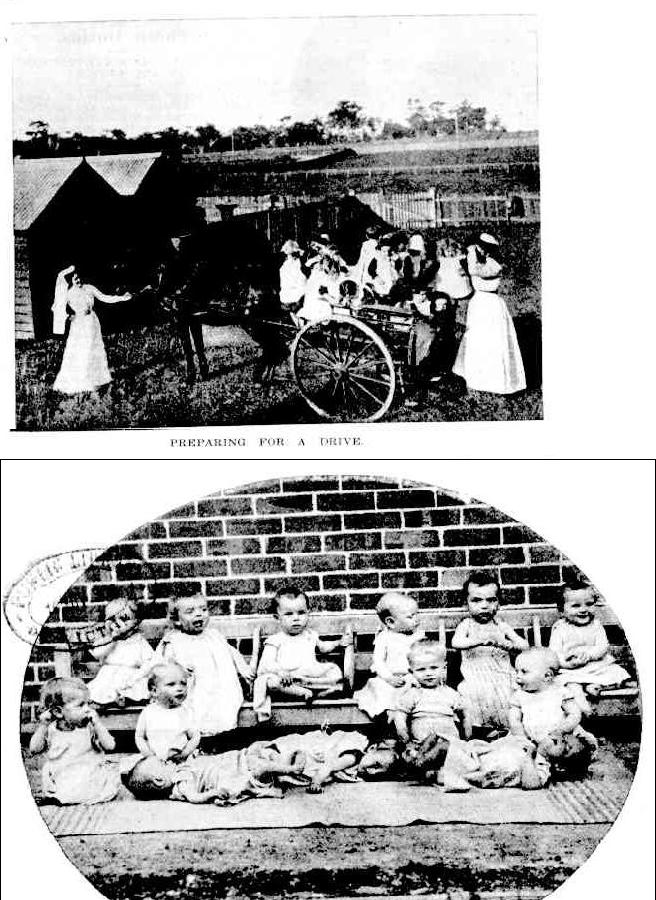
Scenes from the Ashfield Home
According to the Australian Women’s Register the Sydney’s Ashfield Infants Home, established as the Sydney Foundling Hospital in 1874 and became the Infants’ Home in 1877. It assumed responsibility for the care of infants of single mothers and destitute parents and provided a temporary home for the mothers. Rules for admission established in July 1874 ‘required firstly for each application to be dealt with on its merits; secondly, for the infant to be no older than three months; thirdly for the mother to produce satisfactory evidence of her previous respectability and fourthly there had to be proof that the father had deserted the baby and be beyond the reach of the law to enforce him to support it’.
The lower photograph shows thirteen of some forty children residing in the Home where , despite being ‘some of the happiest and best cared-for youngsters in Sydney’, they lacked parents, relatives and names – excepting that their guardians have bestowed upon them. These are the foundlings, stumbled upon by a policemen or left at someone’s doorstep. No one ever sees the person who left it there – a reporter wrote. There is never a clue to its identity. Mother and infant are lost to one another. But, the Town and Country these children had a great claim upon society ‘by reason of their absolute helplessness’. And so begins an account of the Home as a showpiece of all that is ‘best practice’ that was early twentieth century child rearing at a time when, according to well known Adelaide doctor Helen Mayo, infant mortality was high – particularly amongst the children of unmarried mothers.
Two or three years before reports from the Child Study Association, formed in Sydney in 1898 had begun to focus on infant behaviour, the sounds and gestures they made as communication. Following developments in the United States and United Kingdom well known anthropologist Professor Alan Carroll gathered a group of interested men and women to meet with the purpose of studying the child mind. During the next two decades the Association included leading educationists and welfare officials as well as drawing interest from feminists and women leaders such as Maybanke Anderson.
More recently historians have been exploring the intersection between psychology and emerging ideas about children in the nineteenth and twentieth centuries.The historian Sally Shuttleworth’s The Mind of a Child published in 2012 explores ideas about infancy and childhood during the nineteenth century Dickens’s Oliver Twist, Eliot’s Maggie Tulliver, Charlotte Bronte, Jane Eyre and Edmund Gosse’s autobiographical account of his childhood illustrate the growing apprehension of children as having different and separate lives to those of the adults around them. Missing from her account is Thomas Hughes’s 1857 classic: Tom Brown’s Schooldays, about the world of boys and school but this is a minor quibble against the richness and thoroughness of Shuttleworth’s research into the development of nineteenth century psychology. The ‘current cultural dominance of Freudian theory has tended to obscure the interesting pre-history of child psychiatry in the second half of the nineteenth century’, Shuttleworth writes. (p.18). She points to Charles Darwin’s observation of one of his children in 1840, published 37 years later in the journal, Mind, as a response to M Taine’s essay ‘The Acquisition of Language by Children’. M Taine established the practice similar to what has become known as Infant Observation. The observations, M Taine wrote, ‘were made from time to time and written down on the spot.In his study the subject of them was a little girl whose development was ordinary, neither precocious nor slow’. He detailed each movement, moment by moment.
From the first hour, probably by reflex action, she cried incessantly,
kicked about and moved all her limbs and perhaps all her muscles. In
the first week, no doubt also by reflex action, she moved her fingers and
even grasped for some time one’s fore-finger when given her. About the
third month she begins to feel with her hands and to stretch out her
arms, but she cannot yet direct her hand, she touches and moves at
wrandom; she tries the movements of her arms and the tactile an
muscular sensations which follow from them ; nothing more. In my
opinion it is out of this enormous number of movements, constantly
essayed, that there will be evolved by gradual selection the intentional
movements having an object and attaining it. In the last fortnight (at
two and a half mouths) I make sure of one that is evidently acquired;
hearing her grandmother’s voice she turns her head to the side from
which it comes.
M Taine’s account of a baby’s discovery of herself in the world prompted further investigations using child observation In 1898 An American woman, Millicent Shinn , building on the work of the psychologist G. Stanley Hall, published the observational study of her niece, ‘The Biography of a Baby’.Shinn’s methodology also drew on the work of Dr Joseph Le Conte on a daily basis from birth, drew was a response to the notion that through scientific observation one would that ‘children in developing passed through stages similar to those the race had passed through’. Even so, Social Darwinism which placed white society at the top of the tree relative to asian and aboriginal societies remained a strong underpinning in people’s’ thinking about children. During a visit to the Ashfield Babies Home in 1903, the writer “Barbara Baynton” wrote of her encounter with a small boy, ‘Australian born of Indian Parents’.
Quick and agile as his unknown forbears, he darts into the arena, and gripping one of the visitors around the knees [ensures] at least her attention. Releasing his hold, and flopping on the floor, he demonstrates conclusively that heredity is stronger than environment, doubling, twisting, contorting, somersaulting till his swarthy smooth skin flushes muddily. Standing erect he raises his hands above his head preliminary to a dry dive, and one is immediately transported to Columbo, with its shoals of child-beggars and their incessant cricket-like chirruping of “I’ll dive! I’ll dive! I’ll dive!”
We learn of Rangi’s parentage. He is about seven. His mother died at birth and he was placed in the Home shortly afterwards. His father visited for a short time… explanation enough to twentyfirst century readers about his neediness. Here though it is undestood in terms of heredity…His performances, the author writes ‘was not taught nor caught from association with his kin or race’. ( Sydney Morning Herald: 18 July 1903, p.5)
In his 1930s publication, The Civilising Process Norbert Elias also argued that in the latter half of the nineteenth century children were increasingly seen as less as little adults – as when the philosopher Erasmus was alive in the fifteenth and sixteenth centuries – but as children in their own right. Increasingly they were separated and segregated from adult concerns.
The development of orphanages segregating children from the adult world of the workhouse were one response. An Infants Home – a space where small children were raised until they were ready for adoption or fostering – with air and light, space to breathe and the provision of good food was considered essential. It was far away from the dingy crowded squalor of the workhouses and the orphanages were children were herded without maternal care. Such children ‘never grow properly if you have the lot of them together’, wrote English activist, Florence Davenport Hill in her 1867 book, Children of the State. ‘They only grow up into half-idiotic men and women’.In overcrowded conditions even a ‘good nurse was unable to relate to each child as an individual. Nor was there time to ‘draw out the intelligence of every child and nurse it as it would be nursed in a family home’ ( p.235).
So what do we see in the photograph of the thirteen babies at Ashfield? One of them is crying. Another looks solemnly into the camera. Are there others not ready to sit up? There are so many of them. We wonder who is caring for them and wonder about the impact of parental loss upon the children. For the reader in 1901 it is clear that the Home is a triumph, the photograph of healthy active babies a tribute to the modern techniques that are being followed in the care of the children, some of whom were very ill from neglect and starvation when they arrived.
The emphasis is upon luck. The idea is that environment rather than heredity will prevail and ultimately help the children to live better lives. We learn about the physical surroundings of the Ashfield Home, the flowers and trees evoking a sense of fecundity and care. But there is also the beginning idea that environmental provision also means psychological provision. There is the perception that loving care is best for children. We can be assured that all is well. The staff are trained: ‘duly qualified in the difficult art of nursing children’. Unmarried mothers also reside in the Home performing domestic duties – *the more reliable ones* assisting with the children. And at the Home they remain, these babies, until they are around three years old when they are taken over by the government and boarded out to foster parents.
Perhaps the best indicator of the Home’s success, the Town and County Editor writes, is the demonstrable affection between the children and their nurses… deemed better than most mothers. ‘Few mothers have the knowledge and tact which the staff nurses possess, and still fewer are able to spare the time which is devoted to the little ones here… A child does not pretend to be fond of its guardians just because visitors are present…’
For readers in 1901 these were lucky children.
References
Jed Sekoff, ‘The Undead: Necromancy and the Inner World’, in Gregorio Kohon, (ed), The Dead Mother: The Work of André Green, Routledge, London, 1999, pp. 109 – 127.
Florence Davenport Hill, Children of the State 1867.
Australian Town and Country Journal 16 November 1901, p,38. nla.gov.au/trove
.
.
.
06 Saturday Jul 2013
Posted in Australian History, Feminism, Government policy
I have been tracking newspaper items about foundlings – newborns abandoned by their mother – from the late nineteenth into the early twentieth century. The state: New South Wales although I am sure the other states had similar matters to consider. Foundlings were newsworthy. This entry is not atypical but it is rather more fully reported than many such items. It was published in 1879.
A FOUNDLING
A strange discovery was made on Saturday night at Ashfield, by a gentleman living near the Foundling Hospital, who found attached to the gate of his private residence a red carpet-bag containing a healthy-looking female child, apparently about 2 week old,wrapped in a piece of soft flannel. The other contents of the bag were a glass feeding-bottle and the following letter written in a neat female hand, and addressed to the matron of the Foundling Hospital:—
“Dear Madam,
—Please to be kind to this dear little girl, for it is hard, hard, for me to part with her; but I am a poor girl and have not the strength to work for its support; but if things turn out better than they are at present I will send money for its maintenance. Please call her Hilda McCarthur, and a fond mother’s blessing will be your reward. For the present, I do wish it was in my power to keep the dear little lamb, and the great God above, who is the only witness to my sorrow at this moment, will forgive me for this cruel act; but I hope I may yet, perhaps, in after years, show her a mother’s care, for a mother’s love she has already. And now I once more beseech you to call her the name mentioned above, and to be kind to her, for she is very good. And I remain, my dear Madam,
— A mother in sad, sad trouble.” (The Sydney Morning Herald (NSW : 1842 – 1954) Monday 7 July 1879 p 5).
One line of interpretation might be to consider the mother’s background – single, holding a secret, torn between her love for her baby and social expectations of her; hoping, vainly, most likely, that she might find a way to support her infant. Perhaps she was an educated lass, of the middle classes where education was more than basic reading and writing. She wanted a particular name for her child: what does that mean? In a society with so very few rights for single mothers, where illegitimacy was a mark of doom; a sign of inherited degeneracy, this mother was giving as much as she could to her child.
We can only imagine what might have happened next. Little Hilda would have been taken in and cared for, perhaps in a large nursery. Perhaps she was boarded out, Maybe her mother was able to find a position – as a servant or governess. It is clear though that she was one of many that the government of the day was turning its mind to – at the urging of a group of leading women and, indeed, if this report is indicative, sympathetic newspaper editors.
In 1881 New South Wales was one of the first of the Australian colonies to pass legislation making provision for state children to be boarded out – fostered – with families. The government, led by the venerable and colourful Henry Parkes, was influenced by a group of women – including Lady Mary Windeyer whose concern for the well being of orphans and foundlings was awakened by British reformer Florence Davenport Hill through her friendship with South Australian woman reformer, Caroline Clark. Hill had written of children living in workhouse and barrack style conditions, their uniformity, the subsequent loss of individuality and the ‘idiocy’ resulting from lack of parental care and bonding. Caroline Clark whose advocacy of boarding out also determined the direction of South Australian government policy. In her little book published in 1907: ‘State Children in Australia’ South Australian author, reformer and also a friend of Caroline Clarke, Catherine Helen Spence wrote of the value of boarding out for these abandoned children. Not only was their vitality apparent but the bonds formed with their foster families continued beyond these formal arrangements. Far better, she affirmed, for the stability of the state.
Hill, Clark and Spence all argued for the contribution of environmental factors as these interacted with inherited traits. They challenged popular notions of abandoned and illegitimate children being of inferior genetic stock – a position affirmed by American sociologist Richard Dugdale in his 1877 study of five generations of a New York family – which he called the Jukes family. Seeking to understand the origins and intergenerational transmission of ‘crime and dissipation’ Dugdale, I suggest, affirmed the importance of environmental factors in early infant development… traces of thought taken up by Freud and later theorists of the infant mind: D W Winnicott and John Bowlby.
17 Monday Jun 2013
Posted in Journals
The first volume of the Australian Journal of Psychotherapy was published in 1982. It also marked the formation and formalisation of Psychoanalytic Psychotherapy Association of Australia. It was, essentially, the first local ‘broad church’ – Australian- journal on psychoanalytic theory and practice in the country. The Lacanian based ‘Papers of the Freudian School of Melbourne’, was first published in 1979. Edited by a small group chaired by Melbourne Psychoanalyst Leonardo Rodriguez, the new Australian Journal of Psychotherapy contained seven papers and three book reviews, including member of the editorial committee Joan Christie’s piece on Janet Malcolm’s ‘Psychoanalysis: The Impossible Profession’. In time, the journal has accepted and published contribution from psychoanalysts, psychotherapists, couple therapists and social theorists from Australia and internationally. Since then a few other periodicals have emerged: the quarterly Psychotherapy in Australia which began in 1994, and the online journal of the Australian Psychoanalytical Society, Psychoanalysis Downunder which also began during the 1990s.
Developed by a team of passionately committed psychotherapists, most of whom were from Melbourne, it was hoped that the journal would become ‘a reading space for those interested in the developments of the talking cure and in reflections about the place of psychotherapy in the life of our culture. Founded on the same principles that made the therapeutic experience possible – to make the unconscious conscious… to be prepared to learn the truth… which nevertheless was not the private property of anyone, no matter how powerful’. Wise words. And so the journal was launched with a series of articles by several senior clinicians – on child and adolescent psychotherapy, on the technical issue of managing transference and countertransference in the consulting room and the formation of the human group. There was an article on linguistics and another on the ‘cultural vicissitudes of the human drives’.
In his preface to the journal Loren Borland, then President of the Psychotherapy Association of Australia, wrote briefly of the history of psychoanalytic thinking and practice in Australia and the formation. It brought together a number of like-minded people and groups across Australia, Borland noted.They may have operated independently of one another but followed the same trajectory as to purpose and future direction. Borland also wrote of the early phases – people needed time to trust one another, to feel free to discuss theory and practice openly and without fear of destructive criticism. Thus a Federal structure had been created; one enabling groups from each state to retreat and shore up their identity before venturing out again into the national sphere. Large groups can be very exposing.
Borland hoped that in time the safety of the federal model would eventually disappear. There were many ‘beginnings’, Borland continued: the first conference at Bowral in New South Wales in 1981 where people began to trust and talk theory and practice together was one of them. New work was beginning: to develop ethical guidelines particular to the practice of psychoanalytic psychotherapy – differentiated from the base professions: social work, psychology and psychiatry where psychotherapy was but a small part of their concerns. And of course, he added, work was beginning to relate psychoanalytic psychotherapy to the broader mental health system. And the journal? It was a place for discussion and reflection; where the status quo could be questioned, new concepts explored and ideas thrashed out in print. Moreover it was an Australian born psychoanalytic journal… with its own cultural base.
 Freud in Oceania