• About

Freud in Oceania

~ Histories of psychology and psychoanalysis in the Oceania region

Freud in Oceania

Author Archives: Christine

Australian showing of a German film about the psychoanalytic process: ‘Secrets of a soul’ – (1926- 1929)

09 Tuesday Feb 2021

Posted by Christine in 1920s, Film

≈ 2 Comments

Tags

Films on psychoanalysis; popular culture and psychoanalysis in Australia, killing the myth of the anti-intellectual Australian bushman, newspaper articles about psychoanalysis in Australia

This is a marvellous film. Made in Germany in 1926 it is about the psychoanalytic process, scripted by Hans Neumann and Colin Ross. The psychoanalysts Hans Sachs and Karl Abraham, both members of Freud’s inner circle, provided technical advice. Newspaper records digitized by the Australian National Library show it was played to some acclaim in 1928-29 – in Sydney and Melbourne, and in Launceston, Tasmania, In Queensland it visited Brisbane and the regional ‘planter’ sugarcane towns, Mackay and in Cairns and Townsville.

About a man, apparently happily married, who suddenly develops a phobia about knives, the film undertakes to explore the man’s unconscious, a result of his consultations with a psychoanalyst. Of course it is clear that this film was shown in many other countries, as well as in Australia. But this discovery of its showing, and possibly considerable local interest, amid reams of newspaper reports about the nature of Freud’s theory and its significance in 1920s Queensland, reveals a community of people interested in such complex ideas… distance may not have been such a tyrant after all.

There is much more to this film to explore… not least being the interpretations of psychoanalytic ideas brought by Sachs and Abraham.

The ‘dominant minority’: doctors, poets, and psychoanalysis: 1940s Australia

09 Saturday Jan 2021

Posted by Christine in 1940s, Australian History, Australian Women in Psychoanalysis

≈ 2 Comments

Tags

Arnold Toynbee cited by Bion, Dominant Minority, Psychoanalysis and history

A little note appears in the Australian Medical Journal – as part of the proceedings of the British Medical Association. The date is January 27 1945 and the page number is 93.. A correspondent want to know ‘what qualifications would be necessary before recognition would be granted to enable him to work in collaboration with a medical practitioner as a psychoanalyst’.

The reply was brief and to the point. ‘The Council stated that the holding of a medical degree would be essential’.

This little note marks medicine’s claim upon psychoanalysis in Australia in the mid twentieth century. It goes some way to answering the question about why its uptake was so slow. Of course, Freud wrote on the matter of the ’lay’ analyst. Ernest Jones, President of the British Psychoanalytical Society for many years preferred the medical influence even as the Society was constituted by a number of lay professionals – Anna Freud and Melanie Klein among them.

But I digress. The question for Australia is as much about the slow uptake of psychoanalysis as it is about who had the right to practice,

There is a view that the languid bushman, eschewing intellectualism, was hardly likely to consider psychoanalysis as something to pursue. And that in the quiet domesticity of urban Australia, so far from Europe, and real culture, psychoanalytic ideas were hardly likely to take hold.

Such a suggestion clearly affirms Russell Ward’s argument that the Bush Legend was just that.. a myth emerging from Settler Australia culture as it members grappled with a new and different environment so far from Home in Britain. Yearning and grief takes many forms, particularly if it is complicated by the ‘whispering’ thought that settlement had cost the original inhabitants their land.

This view of one’s fellow people- past ones -is rather thin, I think. That young white kids, living in the bush, and back blocks in the early to middle decades of the twentieth century, were making their way through schools and universities through scholarships certainly counters such ideas of anti – intellectualism. Their parents stepped aside for their kids education, shouldering the burden of the family farm while their kids studied or went off to boarding school. The Australasian Society for Philosophy and Psychology founded in 1923 held regular monthly meetings around Australia. It published a journal discussing philosophy, psychology and psychoanalysis for over two decades before the journal editors decided to focus on philosophy. By the end of the 1950s, psychoanalytic training was well enough established and taught in universities as well as the Australian Society of Psychoanalysts. The medical fraternity had relaxed enough to accept non medical professionals seeking professional training. Still, there was the sense psychoanalytic training was the province of an exclusive club – an uneasy inheritance, perhaps?

You don’t have to practice psychoanalysis to know about it, or be interested in its workings. . When the psychoanalyst and educationalist Susan Isaacs visited Australia in 1937, lecture halls across the country were filled to capacity when she spoke. She reached country women on the radio – possible a women broadcaster in Australia and not Britiin. Her ideas promulgated in the press, and taught at the University of Western Australia, prompted several young and talented women to seek opportunities for study in Britain and the United States. It was slow, as time is needed for youngsters to work their way through undergraduate years. But the British Council, a significant scholarship provider, enabled two young women to train as psychoanalysts in London. One of them, Ivy Bennett, returned in 1952 and establised the first lay psychoanalytic practice in Perth, Western Australia in 1953. She stayed for five years, returning to England, she said, for further qualification so as to stand up to medical professionals when she returned. Cecily de Monchaux, who left in 1947 decided to stay on, following her research interests and working to establish a psychoanalytic studies department at University College London. Ruth Thomas who left Australia in 1933 after eight years as a psychology lecturer at the University of Western Australia. This is the problem of the expatriate, the scholar, Ann Rees shows. There was not much for them to return to. Men, maybe, had a better time of it.

Psychoanalysis also had its place in literary circles even as it was explored, resisted, misunderstood, or not – and sometimes mocked!!! The Australian poet, Alec Hope’s 1942 poem, The Return from the Freudian Islands, ( Published in his ‘Selected Poems (1973), satirizes the ‘worship’that had come to surround Freudian ideas, likening these to imperial notions of civilizability. Hope clearly stands for poets and poetry if the venture of undestanding the human mind is to be accomplished. It’s biting satire, eventually imagining ‘ Saint Sigmund’ giving a lecture on his field. There is the discovery of Freud and the unconscious

For a time they thoroughly enjoyed/the brisk intolerance of the purified, In sects and schisms before The Holy Freud/Self-torn – while lesser saints were deified./

Till Faith, which never can let well alone, from heresy and counter heresy/Prompted the saint to bare beneath the bone/ The Ultimate Visceral Reality.

Long time he mused before the Sacred Id, Lomg prayed, before he finally began/ And, purged, impersonal, uninhibited, Produced at last The Basic Freudian Man.

And so Hope continues in this vein, in this poem of twenty, four-lined stanzas, reducing a body of ideas, arguing the case for poetry as the way to address emotional tensions in society and individual.

‘Sigmund, so that none of them should miss/ The beauty of the new world he had made,/ Explained the Triumph of Analysis:/Pimples and cramps now shed with pelt and thews,/ No dreams to fright, no visions to trouble them, For, where the death wish and self knowledge fuse, They had at last the human L.C.M…..

Here the saint paused, looking modestly at the ground/ And waited for their plaudits to begin./ And waited… There was nothing!. A faint dry sound/ As first a poet buttoned on his skin.

Clearly there is room for research about the way settler Australians construed themselves and about who talked with whom. Does Hope making a claim for his own discipline for understanding what makes us human, also point out how such matters can become siloed into groups, each defining their boundaries, and claim to knowledge?

As I write this I am reminded of Wilfrid Bion’s invocation of Toynbee’s concept of the ‘dominant minority’ in his 1948 paper, Psychiatry in a Time of Crisis. You will find it in the British Journal of Psychological Medicine. Bion describes Toynbee’s argument, that the ‘ailing civilization pays the penalty for its failing vitality by being disintegrated into a dominant minority, which rules with increasing oppressiveness but no longer leads, and a proletariat ( internal and external) which responds to this challenge by becoming conscious that it has a soul of its own and making up its mind to save its soul alive’.

More research is needed, particularly about the way ‘Medical men’, were positioned in mind twentieth century Settler Australian culture, thus able to assert their claim upon psychoanalytic knowledge. Perhaps it was about authority – and part of a broader debate about who, in fact, ruled in Australia. For alongside that little note in the Australian Medical Journal were other more immediate questions and discussions as the Australian Medical Profession was forced to share their space -with refugee doctors. There was also the curly question of socialized medicine which would, potentially, remove their right to practice as they wished.

Bion with his thoughts about the dominant minority, and Hope’s about the function of the poet in society, are addressing groups described by Bion as ‘psychiatrically disinherited’. It is possible for Society to be organised that way, Bion says. That people are prohibited access to their full emotional development, structured, socially, in such a way to prevent this. In what he called the Áge of Plastic, Hope critiqued the overvaluation of technological change splitting from emotion, as he reached to articulate the encessary taslk of restoring individuals or groups to a critical part of their inheritance. In 1966 Maurice Dunlevy, a critic for the Canberra Times described Hope’s mission:

‘From the beginning he has tried to reject its synthetic allurements; he has revealed the absurdity of its values and exoosed the quackery of its tribal psychologists, who have shown man’s soul as a bottled abortion.

He is ready to accept nothing at face value: My evening bus seeks out her north-west- passage/ And I my hero in the comic strip/. In every age the hero has taken ship/ Away from the Newer Deal, the Nobler message…

It’s seems Bion and Hope had a lot in common in their battle with the ‘establishment’.

REFERENCES

Iron poet of the plastic age (1966, March 19). The Canberra Times (ACT : 1926 – 1995), p. 11. Retrieved January 9, 2021, from http://nla.gov.au/nla.news-article105892384

W R Bion, Psychiatry in a time of crisis, British Journal of Medical Psychology, 21(2), 81-89.

AD Hope (1943), The return from the Freudian Islands, in AD Hope (ed,), (1973) Selected Poems, Sydney, Angus and Robertson: 11-13.
The knitting needle and a new life – Dr Suzanna Taryan, Melbourne, Australia

19 Wednesday Aug 2020

Posted by Christine in Book Reviews, Emigres, Hungarian influence in psychotherapy and child psychiatry in Australia, Infant psychiatry in Australia

≈ 1 Comment

Tags

Cranio facial births and mother infant bonding, escape from Hungarian uprising, infant mental health, infant observation as a research tool findings from observations of mothers with infants with servere cranio facial deformity, pioneering work in infant mental health Australia, refugee stories., Settler Australia and european political vuolence, Surviving political turmoil, surviving political violence, Women in psychiatry, Women in psychotherapy

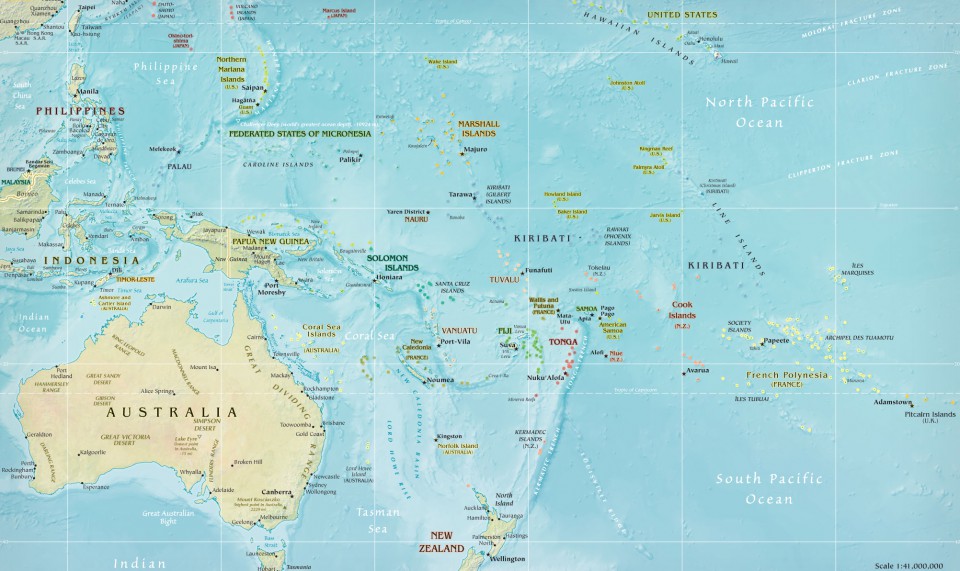
When I was a little girl in Budapest, one of my father’s prize possessions ( along with ‘Mari neni’, the skull sitting on our bookshelf) was a globe of the earth with a light in it. I loved that globe. ‘See just here, if you put a knitting needle in it from Hungary, it will come out in New Zealand,’said Dad. He claimed that New Zealand was a land of eternal spring, geysers and naked Maoris, and then he remarked, ‘That is where I would like to go‘ – as far away from the hated Communism of the 1950s, as possible. ( Suzanna Taryan, 2020, p. 11).

There are all sorts of ways to make history. This book by Suzanna Taryan is about the living and the writing of it – from her Hungarian childhood, her escape to New Zealand with her parents, and eventually her role in the early establishment of the professional branch in psychiatry, psychoanalytic psychotherapy, and Infant Mental Health at the Royal Children’s Hospital in Melbourne Australia. Her story is part of the larger refugee story – as Settler Australia and New Zealand evolved from Britishness to becoming culturally diverse nations – and all that this might mean.

I had interviewed Suzanna for my Clara Geroe project late in 2019, before the pandemic. Among other matters I am seeking to understand the Hungarian emigre experience – and its influence on the development of the psychoanalytic culture in Australia. Suzanna, just ten years old when the Hungarian Uprising occurred in October 1956, was happy to oblige. And in a sense this book, written for her family, signals the completion of her own personal project, a task triggered by my interest. She has a story to tell.

At the time of the Hungarian Uprising in 1956 Suzanna and her parents were living in an apartment next door to the AVO – the secret police building in Budapest. They did not want for an electricity supply… other Budapest households were apparently not so endowed. But when the people marched on the AVO building and dragged the police out onto the streets, and killed them, Suzanna and her family saw too much. Enough to decide to escape. Suzanna’s parents had experienced enough during the war. Her mother’s family perished in Budapest at the hands of the Hungarian fascists when the Russians swept in to liberate Budapest in 1944. Her father had spent time in a forced labour battalion. Of the Russians, Suzanna recounted her father’s words: “The Liberators forgot to leave after the war”. He opposed anything to do with Communism. Even though as he explained to his daughter, knowledge of that opposition had to remain within the walls of the family. Outwardly there would be conformity.

I have come to admire this man, Suzanna’s father. I like his wisdom and chutzpah! He was a survivor. He saved Suzanna’s mother’s life. I hope someone will make a movie about him.

And so the family escaped from Hungary, late in December 1956. They took buses and trains. They walked, with a few possessions and clothes stashed in backpacks, from Budapest all the way to the border between Hungary and Austria. Ten years old Suzanna carried the precious brew intended for bribes along the way. They tramped through deep snow, lost their money to unscrupulous guides, walked around in circles in darkness and eventually were found by Austrian people who provided shelter, food, and rest before the bus trip to Vienna.

Then there was the journey from Vienna to New Zealand where the family settled, and, eventually for Suzanna, Australia -all told through vignettes that mirror the people and culture of the time – their Britishness, smug superiority and their shock at Suzanna’s difference. There is Suzanna going to school without knowledge of English, being put into a class lower than her ability, shooting to the top and eventually making her way to medical school in New Zealand before undertaking psychiatry training in Melbourne. Suzanna tells her story through short descriptions of her encounters with senior professionals, the seminal moments in her life. Her battle to become a child psychiatry trainee – she had to qualify as a psychiatrist first – is told with wry humor as she overcomes one hurdle after another. Dr R, Director of Psychiatry at the Royal Children’s Hospital had put the ‘no vacancy‘ sign up when Suzanna applied for a registrarship there. She ended up at Prince Henry’s Hospital then in St Kilda Road, Melbourne. Her cultural difference was one matter to contend with. There was also the assumption of male superiority… has it gone away?

There are personal stories along the way, marriage, family, illness – all the things that constitute a life. Suzanna finally makes it to a consultant psychiatry job at the Royal Children’s Hospital in Melbourne. She is appointed to the Craniofacial unit alongside Dr L, the Chief Psychologist. Together they became pioneers. They built a body of experience and literature, about early parenthood of children born with facial deformities. It is creative, ground breaking work as the two devise research projects, observational studies of mother infant interactions, write it up and publish articles. Their collaboration is worthy of further study – it was part of the early development of the Infant Mental Health unit at the Children’s. Suzanna also lectured in this field at international conferences – part of the team brokering Australia’s reputation world wide.

I spent a brief period at the Children’s early in my professional career and was aware of this work, albeit from a distance. Dr L was also very influenced by the psychoanalyst Dr Clara Geroe during the 1950s.

This little book by Suzanna is a about courage, luck, and fighting to make opportunities happen despite the odds. It is an excellent contribution to the understanding of the Antipodean refugee story, and the Australian development of international mental health practice for infants. If you wish to obtain a copy of Suzanna’s book please send an email to freudinoceania@gmail.com

Imperial fossils, a piece of enlightenment, and a small triumph: a cathedral adventure – OR – Do statues float?

21 Sunday Jun 2020

Posted by Christine in British Imperial History, Colonialism and Imperial history, Imperial History Britain

≈ 2 Comments

Tags

Cathedrals, Imperialism, toppling old statues

During our British sojourn in September 2019 we trecked from Durham to Carlisle to visit the cathedral there. Carlisle Cathedral, is the seat of the Anglican Bishop of Cumbria. Wikipedia tells me it was founded as an Augustin priory and became a cathedral in 1133. It is also the second smallest cathedral in the British Isles and renowned for its ancient stone choir and for its vaulted blue ceiling.

BBC Choral Evensong: Carlisle Cathedral 1985 (Andrew Seivewright ...

Our guides there have told us two stories about this deep blue ceiling. The first is that it is a restoration of the Cathedral’s medieval ceiling. The second is that it is a Victorian decoration. We await the true story.

Cathedrals are important. A journey along their walls, floors and rooms tell us about the people who lived in the city in times past. It is about displays of family wealth and power, as well as grief, loss, and the community. Middle class Britain was built, for some, on eighteenth century slavery, or the monies realised with emancipation. The Church, particularly, the Anglican Church, was its expression. The Anglican Church was also a centre of Missionary activity at home and abroad.

It is probably not the done thing to climb up onto the lectern from where the minister preaches. But there was no apparent barrier. It seemed OK. The result was my letter to the Bishop and a reply from the Dean of the Cathedral.

My letter:

30 May 2020

Dear Lord Bishop

I visited Carlisle Cathedral during September 2019… my second visit from Australia, and a return visit  after discovering the Cathedral in 2018….I am interested in the way the Church represents itself to the people and is also an expression of contemporary culture.

During my visit to the cathedral last year I chanced to clamber up to the lectern from which the minister preaches. Upon this was a document, an account of the Britishers marvelous defeat of a rebellious African tribe during the nineteenth century. It was good British imperial stuff… extolling the virtues of the British Empire and all that.

Historiography has moved on. Historians today are immersed in the darker side of Empire. They are thinking about and exploring the appropriation of land and culture of indigenous people. They want to understand what the African, and indeed, indigenous people, were fighting for. And they are finding that the experience of invasion and objections to it to be valid concerns. 

The document on your lectern in 2019 is of historical value for its triumphalist story of empire. We need to know that this is what people of the Empire actually thought to be the truth. And we need to examine why this was so. Imperialism and colonialism are complex issues. Indeed for as many triumphalist stories of Britain’s place in the world as there are, including the one on your lectern, there are many documents querying these stories if not the the basis upon which Empire was built.

I suggest that the document on your lectern needs to remain but to be placed alongside a more  critical, if not revisionist, account of the very destructive activities of missionaries and others in places like Africa and India. My fear is that by not doing so the members of the Cathedral will show themselves to be locked in the past, and maintaining the nineteenth century/ early twentieth century phantasy that all is right with the world as long it is British – and white.

I leave this for your consideration and look forward to your reply”.

The Dean of Carlisle Cathedral replied on 18th June 2020.

Here is the text.

“Your email to the Bishop of Carlisle has been forwarded to me as the person responsible for Carlisle Cathedral. I am very grateful to you for writing as you have done. I am glad you climbed into the lectern and took time to read the notice that customarily rests there.

I have made enquiries. I understand that the text on display is the one received and put in place here when the lectern was lent to the Cathedral by Ivegill parish in 2003. It has not been reviewed since –not least, perhaps, because when the clergy mount the steps of the lectern to read a lesson at one of our services, a full size bible is in place that covers the paper with the notice on it.Your letter reaches me at a very timely moment. Across this nation, and much more widely, an important debate is running which shows us how important it is, as you suggest, to continue to interrogate the way the past is understood and interpreted.

Your helpful comments ensure that we will think again about this and any notice we have on display and how it might be interpreted. The Cathedral Chapter does not want to be thought to be locked in the past or to maintain a view of imperialism and colonialism which many used to hold as you set out in your email. I shall have time do this work before the Cathedral opens to the public again after the restrictions we have been observing during the Corona virus pandemic”.

Good for them!!

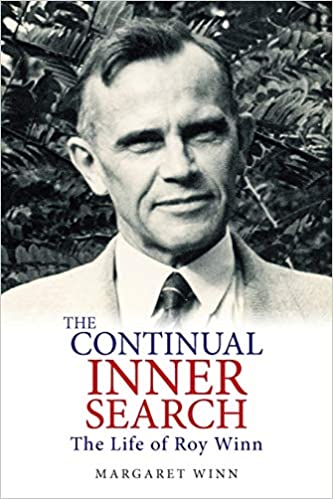
‘The continual inner search: the life of Roy Winn’ – Australia’s first practicing medical psychoanalyst (1890-1963)

10 Wednesday Jun 2020

Posted by Christine in psychoanalysis and biography

≈ Leave a comment

Tags

Biography Roy Winn, Roy Coupland Winn

Margaret Winn (2020) The continual inner search: the life of Roy Winn, Melbourne, Kerr Books.

********************************************

Margaret Winn, Roy’s grand daughter, has compiled this biography, published by Kerr Books in Melbourne in 2020. It is a labour of love, a task that has consumed a number of years, off and on. Margaret has sought to understand the rather remote figure of her grandfather who died in 1963, when she was 11 years old. He was not very interested in what she had to say, she recalls. But he was remembered by his psychoanalytic colleagues for his integrity and his contribution to the development of psychoanalysis in this country. This book, written for her family, is also Margaret Winn’s contribution to the history of psychoanalysis in this country.

Roy was born into a privileged family in Newcastle, New South Wales in 1890. He was the third of four sons of William and Janet Winn and a member of a leading, ‘God fearing’ family, members of the Primitive Methodist Church. His father and uncle Isaac Winn were active in church affairs but are also remembered for Winn’s Ptd Ltd, a super emporium store located in the middle of Newcastle. William Winn the deputy president of the Temperance Society – and young Roy took the pledge at the age of seven. Not unusual for young children in this age of evangelical Christianity. As a young man Roy wanted to be a medical missionary – the Australian Methodist Church had a mission in Fiji.

A significant section of the book is devoted to Winn’s war service… from his decision to sign up as a Medical Officer in 1915 until the war’s end. Winn lasted until the end of the war. After losing his foot towards the end of the war, he returned home and, eventually found his way to psychoanalysis. Reg Ellery, another psychiatrist interested in psychoanalysis, returned home at his own expense within a year of signing up. Winn’s Melbourne colleague, Paul Dane struggled with illness contracted in the field. And, like Winn, went on to use his war service in his later work with veterans.For her grandfather’s story Margaret Winn has consulted historians and libraries to trace her grandfather’s path through the war. Winn’s novelised version, ‘Men may rise’, is her guide. She thus contributes an account to the increasing pile of such family histories to the Australian historiography of war… and the foundation pile for historians of psychoanalysis in this country. For it is in Winn’s reflections, recorded in Men May Rise, that he comes to understand that he is both doctor and patient.

In 1920, newly married and with a child in tow, Winn and his wife travelled to England for Winn’s analysis with Robert Riggall, a member of the recently formed British Psychoanalytical Society. He returned to Australia in 1922 and tried to interest colleagues in the application of psychoanalysis to medical work. It did not work out and, in 1931, Winn left hospital practice altogether, and established his own practice in Macquarie Street Sydney. Margaret Winn also notes that her grandfather was not a trained psychoanalyst: he made use of what he had learned through his own analysis and reading, with patients. He was appointed as an Associate of the British Psychoanalytical Society in 1935.

Winn was actively involved in the effort to bring European Analysts to Australia during the 1930s. He was a liaison point for Ernest Jones in London, who, in one of the twentieth century’s great rescue efforts, found places in the United States, Britain and in some Dominion countries for a large number of psychoanalysts potentially trapped in Europe as the Nazis took control. Alone, and together with a number of leading figures in the Australian milieu of that time, lobbied the Australian government for their admission. Of the six who applied, only two succeeded: Andrew Peto and Elisabeth Kardos who were granted visas late in 1939. They decided not to emigrate. Clara Geroe, granted a visa with her husband, arrived in March 1940 and was subsequently appointed as Australia’s first training analyst through the British Psychoanalytical Society. Winn continued as an Associate until 1952. At this point he funded the establishment of the Sydney Institute of Psychoanalysis. By then Andrew Peto had arrived and, like Geroe, was working as a training analyst.

It was one of Winn’s colleagues, Janet Neild, who referred to the ”continual inner search’ that he carried through his life. This may have been his public face, or his working persona, or the place where he could carry out his own internal mission. Margaret Winn, a family member with a different experience of Roy, wants to understand her grandfather’s mind, as much as she can. She speculates about his ‘autistic’ side: wondering whether this contributes to him being something of an ‘outsider’ – and thus able to strike out on his own. ‘I am not sure he was autistic’, Margaret Winn wrote to me in an email. ‘ He might be the source of the genetic thread to later generations who do manifest high functioning autistic characteristics’. This is, after all, for the family’s understanding.

In another, professional, sphere, Roy Winn’s contribution is important for Australian psychoanalysis. He helped bring it into the medical fold and held its place within Sydney’s medical world. In a sense his work and dedication to seeing psychoanalysis established in this country was his quiet – and greatest- achievement.

When the building burned down… Drummond Street Relationship Centre, Melbourne, 2000-2001 OR… Some questions about managing the frame in the time of Covid.

25 Wednesday Mar 2020

Posted by Christine in Apocalypse, the psychoanalytic process

≈ 2 Comments

Tags

What happens when a fire destriys your workplace. Psychoaalytic response... throwing out the rule book... or revising it.. Thinking.maybe?

In these terrible days of Covid19,  when everything is under threat this little bit of history from my days at Drummond Street Relationship Centre in Carlton, Melbourne, Victoria comes to my mind.  “Drummond Street” formerly known as the Citizen’s Welfare Service of Victoria and, before that, as the Melbourne branch of the Charity Organisation Society of London,, has a long history of psychoanalytic work with couples and individuals. From the late 1970s Social  Workers were the main providers. Many of them were supported by Melbourne’s psychoanalytic community including members of the Melbourne Institute of Psychoanalysis.

One sunny day at the end of a long summer, just as the universities were about to open,  a terrible event occurred… and one that challenged what I had been taught about the management of the psychoanalytic frame… How does one think when the building in which one works is burned down. How do people cope when they have lost their space? I put this reflection forward for consideration… not because I know the answers. But this is what I remember of what was in my mind, then…

                                                     ***********************

In late February 2000, at 9.00 am one Tuesday morning, I arrived at my workplace, a government funded counselling and therapy organization, to find that a fire had destroyed its interior overnight. I can still recall the fire engines. The boss was looking rather stunned and people from everywhere had gathered around. My precious notes, preparation for a couple therapy training course I was presenting that afternoon were trapped in my office on the third floor…There was not a chance that I would be allowed in. The stairs were falling down.

The organization’s employees were clinicians practicing psychoanalytic couple and individual psychotherapy. The damage was extensive. The buildings were not usable for over a year while repair work was carried out. ‘Drummond Street’ was a large three storey mansion created from three conjoined  terrace houses  built during the 1890s Melbourne property boom. They were linked together by a corridor. The arsonists had planned their hit well. They had set the fire where it would do the most damage.  I do not know the motive. My colleagues and I fantasized about a neighborhood dispute over a car park at the back of the building. At the very least the Fire was a massive intrusion into the therapeutic space we had all developed with patients. It is not as if the reality of the event could not be spoken about. We also had to continue to work with our patients through this disaster.

Be that as it may. In the weeks before we were able to secure another building for our work the fire raised a question for all of us… What was the organization? What is the therapeutic space? Where is it located? What is the nature of the space between patient and therapist/ analyst? And what is the relation of the physical space of the consulting room to the interior world created by the patient and analyst together? For is it that relationship and the meaning of it for the patient, and the analyst,  the real phenomenon that can bring relief and change. My analyst at this time was very helpful as I delineated these issues for myself. Had the organization died in the fire? Or not? There were some in my collegial group who said it did. Was the organization the building? And what happens when there is no building, or physical space, a consulting room, to symbolize the analytic relationship?

What did analysts do in the London Blitz when their buildings were damaged if not obliterated? Today the virus confronts us with similar questions as we quarantine ourselves and our practices and go online.

The theories we use these days have emerged from experience… Some people are not gifted with the capacity for theory…others are… it is something that Melanie Klein pointed out.

In these troubled times when so much is at stake as the virus moves through our communities as much as we try to prevent it… it offers an opportunity to explore this question about where, and how, psychoanalysis is located and managed.

Foraging in the Geroe archive: Finding Aileen Palmer’s lost thesis

16 Sunday Feb 2020

Posted by Christine in Archive work, Historical research, Narrative and Memoir, Psychiatry, psychoanalysis and biography, western australia

≈ Leave a comment

Tags

Biography, Managing archives, Relicts, respecting scholarship, Sylvia Martin, The things one finds in unexpected places

Archives are relicts of a life. Bits of paper, shopping lists, advertising fliers for stoves, oil heaters and cars, personal messages and notes, are clues to the day in day out matters that people think about. Clara Geroe’s archive has many such things, all tossed into a suitcase and left for posterity. One smiles to discover a note in Geroe’s handwriting scrawled upon the back of some learned paper:  ‘Would you like to dine with us tonight?’ To whom was it addressed? Probably the person was sitting next to her, both of them lulled into boredom by some psychoanalytic conference speaker or other. Was it the end of the day? Or just after lunch with another three lectures to go? Did she disagree with the speaker? Or had it  occurred to her that she had forgotten to extend that particular invitation?

These are the little things found woven into correspondence from colleagues, poems, a paper for her interest, books, pamphlets and even a recipe collection. Archives are treasure troves of oddments. Some discoveries are totally astonishing and unexpected.  Archive work is a risky business.

In her early years in Australia Geroe’s English teacher, the author and literary critic Nettie Palmer, introduced Geroe to her family: Vance, her husband and a leading Australian author, and her daughters, Aileen and Helen. It is a side story in Sylvia Martin’s excellent biography of Aileen Palmer, Ink in her Veins. Geroe, a  cultured woman, and deeply interested and knowledgeable in literature and the arts, may have appreciated the Palmer’s friendship. Aileen Palmer’s work during the Spanish War, and her driving ambulances in England during the blitz, would have been known to Geroe. Aileen Palmer also studied French literature at the University of Melbourne and wrote a thesis on Proust. At the time of publishing her book, Martin said, no copy of the thesis was to be found. When Aileen broke down after her return to Australia from London, it is possible the Palmers sought advice from Geroe. Martin discusses Aileen’s hospitalization and psychiatric treatment at length. For a time she was a patient of Geroe’s – something Martin also discusses in her book. Perhaps Aileen liked Geroe enough to give her a copy of her thesis. Maybe it was a forgotten loan only to turn up almost thirty two years after Palmer’s death in Geroe’s archive…

Here is the link to Aileen’s story retold  in Martin’s piece, The Lost Thesis, ‘published last week in the online journal,  ‘Inside Story’.


Geroe family archive goes to the State Library of Victoria -its final destination

25 Saturday Jan 2020

Posted by Christine in Archive work

≈ 5 Comments

Tags

bushfires, keeping archives safe, The archives are finally gone from the shed. State library of Victoria, The risks of climate change.

Finally after almost eighteen months of waiting, the State Library of Victoria has completed its extensive renovations. It is ready to receive Clara Lazar Geroe’s archive together with those of her husband, Vilmos Geroe. I had custody of these boxes of material while waiting, and of course, researching. But it was also a worry, particularly as the bushfire season hit. The boxes were safely stored in fire resistant storage units but… what if….? One lot of 18 boxes, as much as could be carried in the vehicle, was taken away ten days ago. The remaining 12 boxes were collected yesterday. I slept well each night following. Looking after such an important collection is a responsibility.

We know that Clara Geroe, Australia’s first training analyst, qualified in Hungary in 1931. She kept her membership paper, a study of the analysis of a young girl with anxiety neurosis,  articles she wrote while studying neurology in Budapest, publications made later when she was working as a child psychoanalyst. She had to leave her library behind when she came to Australia but brought a few precious items including a copy of Alice Balint’s original ‘Psychoanalysis of the Nursery’. Copies of Imago, articles and papers written by Hungarian colleagues, were stored alongside her drafts of papers and drafts of drafts. And of course there were letters, fliers, circulars, and all the bits and bobs of her world. How interesting it was to find the original program for the 1936 Olympics, for example. Was it a quick dash over to Berlin for the event? Most probably. And a diary of a journey through Austria in 1929. There is, of course, material about psychoanalysis in Australia, the original reason for my interest. But the condiments to this,  that make up a life, are irrevocably threaded through the boxes.

Willi’s work as a travel agent complements his wife’s work. He acted for members of the Hungarian community from Melbourne, on their trips home after the war. He focussed on Africa as a destination, and kept ever so detailed notes of everything he did.

We must pay Homage to Willi Geroe and his and Clara’s son George for the preservation of this archive. Alongside Clara’s basic sorting, Willi gathered things together, sorted and bundled everything together. He was something of a hoarder it seems, or was he a meticulous if not obsessional collector of information. Tax returns from 1940 onwards were all bundled together,,, and conveyed to the library..

This is a gathering of interest to scholars of immigration, culture and psychoanalysis across the world.

‘They could not take my soul’…Lydia Tischler 2017 – and inpatient psychoanalytic treatment.

29 Sunday Dec 2019

Posted by Christine in Children in Hospital, Inpatient treatment, WW2

≈ Leave a comment

The British based child psychotherapist, Lydia Tischler, is an editor of the classic text: The Family as In-Patient: Working with Families and Adolescents at the Cassel Hospital. The Cassel Hospital in Kingston upon Thames, was originally established for the treatment of shell shock patients during the Great War. Under the directorship of psychiatrist Tom Main who developed the practice of psychosocial nursing, the work evolved into psychoanalytically orientated inpatient treatment of families. 

Tischler and her group also had an effect in Melbourne, Australia. During the late 1980s the Melbourne Clinic in Richmond in Melbourne under the directorship of Dr Brian Muir, a psychoanalyst, who came from Britain and the Cassel Hospital for the job. He was the head of the adolescent and family unit there during the 1970s.  Joan Christie then the Clinic’s Director of Nursing, and a psychoanalytic psychotherapist, was also involved. Patients with multiple and complex problems can need the supportive structure of the hospital in their psychotherapeutic journey. At least for a time. Some people with complex presentations cannot be worked with without such support. Their emotional world, so fractured by early, and accidental experiences, requires the consistency and availability of a safe secure environment.  As Marion Milner noted in her book, ‘The Hands of the Living God, an account of the analysis of a woman lasting more than twenty years, psychoanalytic treatment can enable the living of a productive life. Otherwise means a considerable demand on the public purse. It is one part of a complex policy debate over treatment efficacy, evidence and as others have pointed out, the reluctance of psychoanalysis to represent itself. 

The workings of the Melbourne Clinic project and the factors contributing to its ending are matters for historical research. I get the impression, at least as far as my memory goes, that this was an exciting and hopeful moment for psychoanalytic practice in this country. Why it ceased I do not know. 

These musings and  memories surfaced at the moment when I discovered Lydia Tischler’s interview online. Published in 2017 she speaks of her early life, the family’s arrest by the Nazis and the loss of her mother. Mengele’s nod to the right was enough to seal Lydia’s mother’s fate. Lydia Tischler was nodded to the right.

‘They could not take my soul’, she says.

Here is this most moving of interviews.   https://youtu.be/3lpTceEE3d8

Freud Conference, Melbourne, May 2020

22 Sunday Dec 2019

Posted by Christine in Announcements, Conferences, western australia

≈ Leave a comment

Tags

Freud in Australia, international guest speakers, Melbourne Psychosocial Group, The Australian bush legend is but a myth.., the legacy of Foo Davies, Things to do in Melbourne

Each year on the third Saturday of May, in that space between autumn and winter,  Melbourne hosts the Freud Conference at the Melbourne Brain Centre in Parkville.  It was begunin about 1982 by a group of academics from the University of Melbourne,students of the late Professor Alan Davies. and the founders of the Melbourne Psychosocial Group. Among them were the philosophers, Douglas Kirsner and Ron Gilbert. Together with the political scientist and historian, Judith Brett, the group invited all who were interested to schlepp down to Lorne, a coastal resort a couple of hours  south of Melbourne, for a weekend of wining, dining, and talking about Freud.It featured long beach walks, lectures and time for contemplation, and reading in the final days of the indian summer.

When the conference moved to Melbourne in the early 2000s it became a day event but retained its status as an annual ‘must’ on the calendar, for all who wish to explore psychoanalytic thought and its application to society. Its attraction also lies in the fact that anyone with an interest in the subject can attend. It is not open to ‘members only’ to this or that psychoanalytic organisation, It is a space within which to give and receive knowledge, drawing on local and international developments.

Australia is a long way from Europe and the United States. It is not an easy trip but it is one that has been made often. A peek into Australia’s online newspaper archive will show how often a reporter would troop down to the docks to welcome people from their overseas study trips. Or someone would arrive for a lecture tour. The Freud Conference continues that tradition inviting internationally renowned  guest speakers to stand alongside local ones.  a long Australian tradition of looking outward, and inward, for knowledge development and exchange.

A scroll through the  Freud Conference blog hosted by Chris Hill, from the Psychoanalytic Psychotherapy Association of Australia, gives a taste of the event, and access to the papers that have been presented. Maryanne Prodreka representing the Australian Association of Group Psychotherapists, Ros Glickfeld from the Australian Psychoanalytical Society and Chris Hill constitute the organising committee.

Next year the the conference theme will be ‘Love in a Hostile Environment: Thoughts on the young adult, the couple and the society we live in’.

It is a reason to visit Melbourne too. The conference flier with details about registration etc is here. 

← Older posts
Newer posts →
December 2025
M T W T F S S
1234567
891011121314
15161718192021
22232425262728
293031  
« May    

Archives

  • May 2024
  • May 2023
  • April 2023
  • November 2022
  • February 2022
  • June 2021
  • February 2021
  • January 2021
  • August 2020
  • June 2020
  • March 2020
  • February 2020
  • January 2020
  • December 2019
  • October 2019
  • April 2019
  • March 2019
  • January 2019
  • January 2018
  • September 2017
  • December 2016
  • August 2016
  • May 2016
  • April 2016
  • February 2016
  • November 2015
  • September 2015
  • August 2015
  • July 2015
  • June 2015
  • May 2015
  • April 2015
  • March 2015
  • February 2015
  • December 2014
  • November 2014
  • September 2014
  • August 2014
  • June 2014
  • April 2014
  • March 2014
  • January 2014
  • November 2013
  • September 2013
  • August 2013
  • July 2013
  • June 2013
  • March 2013
  • January 2013
  • December 2012
  • November 2012
  • October 2012
  • September 2012
  • August 2012
  • June 2012
  • May 2012
  • April 2012
  • March 2012
  • February 2012
  • January 2012
  • December 2011
  • November 2011
  • October 2011
  • September 2011
  • August 2011

1910s 1920s 1930s 1940s 1950s Archive work Australian History Australian Women in Psychoanalysis Australian Women Writers Book Reviews Book Reviews Clara Geroe Conferences and Lectures Emigres Feminism Historical research historical source material John Springthorpe Lay analysis lectures Narrative and Memoir Newspaper reportage Press Psychiatry Reviews seminars Susan Isaacs the psychoanalytic process War Neurosis western australia WW2

Recent Posts

  • A philantropic project. The contribution of Anne Kantor, Psychoanalytic Psychotherapist, to the Melbourne psychoanalytic project.
  • Freud Conference 2023: Indigenous voices- Psychoanalytic listening 17 June 2023 ( in person and online)
  • “TROVE” the National Library of Australia’s jewel, has been saved!!!

The Australian Women Writer’s Challenge 2017

Blogroll

  • WordPress.com News
  • Psychotherapy Matters

Online Journals

  • Psychoanalysis Downunder

Organisations

  • New South Wales Institute of Psychoanalytic Psychotherapy
  • Australian Psychoanalytic Society
  • Victorian Association of Psychoanalytic Psychotherapists
  • http://www.psychoanalysis.asn.au/
  • Australian Centre for Psychoanalysis
  • Australian Association of Group Psychotherapists

Resources

  • Stanford Encycopaedia of Philosophy
  • Charles Darwin – Complete Works
  • National Library of Australia
  • Sigmund Freud Archives

The Australian Scene - History

  • Australian Dictionary of Biography
  • International Dictionary of Psychoanalysis

Enter your email address to follow this blog and receive notifications of new posts by email.

Join 104 other subscribers

Copyright

Creative Commons Licence
This work is licensed under a Creative Commons Attribution 3.0 Australia License.

Comments, Suggestions, Ideas and Other Matters

I am very interested in your comments, suggestions and responses to this blog and its content - good, bad, indifferent. It is all part of a broader conversation - about history, about psychoanalysis and the way people think about things. So if you'd like to make a comment on this blog, please feel free to do so. And, if you are interested in conversing further or, indeed, want to 'speak' to me offline my email address is freudinoceania@gmail.com I look forward to hearing from you.

Blog at WordPress.com.

  • Subscribe Subscribed
    • Freud in Oceania
    • Join 83 other subscribers
    • Already have a WordPress.com account? Log in now.
    • Freud in Oceania
    • Subscribe Subscribed
    • Sign up
    • Log in
    • Report this content
    • View site in Reader
    • Manage subscriptions
    • Collapse this bar
 

Loading Comments...